| Highlights from yesterday |
|
Comments |
- Iran’s Revolutionary Guard Corps (IRGC) says its navy has struck a “Saildrone-type” US unmanned vessel in the Strait of Hormuz.
- UK Maritime Trade Operations says it has received a report that two vessels were hit by projectiles off the coast of Oman.
|
|
|
| |
|
|
| |
|
|
Oil hits highest price since May amid supply disruption concerns
Brent crude closed at $107.63 per barrel on Thursday, up 6.3 percent amid concerns over global energy supply disruptions after the Houthis captured the strategic port city of Mocha in Yemen, and over reports of more vessels being targeted in the Strait of Hormuz.
US West Texas Intermediate (WTI) crude also reached its highest price point since mid-May, closing at $103.82 per barrel, up 6.7 percent.
|
|
|
US senator slams Trump over Iran war timeline and lack of strategy
Democratic Senator Ed Markey has criticised Trump in a post on X.
“Trump claims that his illegal and unwinnable Iran war will end right after the midterm elections,” he said. “He’s lying.”
“His own advisors know better. This war of choice will drag on until Trump leaves office unless Congress cuts off funding,” he added.
“We cannot wait two more years to end this disaster.”
|
|
|
Brent crude hits $108 a barrel amid escalating shipping disruptions
Oil prices are continuing their upward trajectory, with Brent crude futures gaining $1.05 as of 00:45 GMT, or 1 percent, to reach $108.68 a barrel.
US West Texas Intermediate (WTI) crude went up 95 cents, also 1 percent, to $103.45.
The gains came as both major benchmarks are on track to end the week at more than $100 a barrel for the first time since mid-May, according to Reuters, in the wake of increasing attacks along key shipping routes in the Middle East and fears of a prolonged disruption to supplies.
Both benchmarks rose more than 6 percent on Thursday.
|
|
|
Satellite images reveal oil slicks near Strait of Hormuz
An image from the European Copernicus program taken on Wednesday shows brownish streaks on the water some 20km (12.4 miles) off the Iranian coast, east of the Strait of Hormuz.
Another Copernicus image of the same location taken on Thursday shows winding streaks of a similar length.
AFP, which analyzed the satellite images with the help of experts, said these streaks are oil slicks near the Strait of Hormuz following US strikes on oil tankers suspected of links to Iran’s Revolutionary Guard Corps (IRGC).
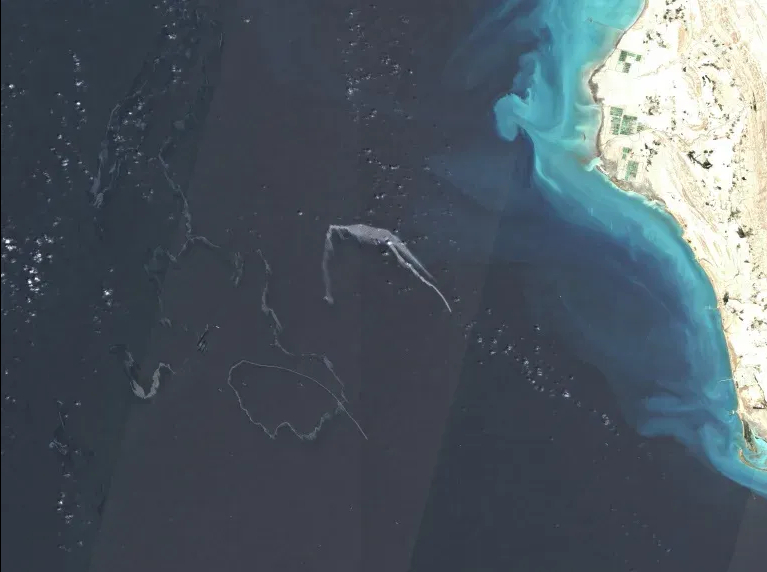
Copernicus images indicated possible oil slicks after US strikes on tankers in the Strait of Hormuz [AFP]
|
|
|
Strait of Hormuz vessel transits drop to 7 amid regional tensions
Preliminary ship-tracking data shows vessel transits through the Strait of Hormuz falling to seven on Thursday, compared with 11 the previous day, remaining well below the 10-day average of 15, Reuters reports.
Citing preliminary figures, Reuters said two vessels exited the waterway, while five entered.
The data remains subject to updates as certain vessels navigated the passage with their transponders switched off, meaning they were excluded from official counts.
|
|
|
IAEA accuses Iran of ‘noncompliance’
The board of governors of the United Nations nuclear watchdog has passed a resolution accusing Iran of failing to comply with its nuclear nonproliferation commitments and referring the matter to the UN Security Council (UNSC).
The diplomatic move, backed by the United States and its key European allies, comes more than six months into the US-Israeli war against Iran, and as tensions flare in the Strait of Hormuz, where the US and Iran have traded attacks on vessels in recent days.
|
|
|
Iran refutes nuclear watchdog’s noncompliance claims
Iran’s UN envoy has dismissed a resolution passed by the International Atomic Energy Agency (IAEA) board of governors that accuses Iran of failing to comply with its nuclear nonproliferation commitments and refers the matter to the UN Security Council.
“Renewed accusations against Iran’s peaceful nuclear program are political and not technical in nature,” Ambassador Gholamhossein Darzi said in a letter addressed to the Security Council president, the IRNA news agency reports.
The IAEA resolution, which is backed by the US and its key European allies, expressed “grave concern” over Iran’s “continued noncompliance” with its obligations under the Nuclear Non-Proliferation Treaty (NPT), to which it is a signatory.
Under the NPT, Iran is forbidden from producing nuclear weapons and is required to meet IAEA safeguards to verify that any nuclear material it has is for peaceful purposes.
It is the first time in 20 years that the IAEA board has passed such a resolution.
“The Islamic Republic of Iran categorically rejects the baseless accusations and distortions raised by some members in this meeting regarding Iran’s peaceful nuclear program,” Darzi said.
|
|
|
Iran claims to have captured a US ‘sail drone’ near Hormuz Strait
Iran’s Revolutionary Guard says its navy struck a US-operated surface drone at the entrance of the Strait of Hormuz.
The Iranians claim to have ‘thwarted an aggressive mission’ using the drone, which is shaped like a sail boat. Washington has yet to comment on the claim.
|
|
{youtube}https://www.youtube.com/shorts/pokV5iIYz-8|250|370|1{/youtube}
|
US national average diesel price tops $6 a gallon for first time ever
Average US diesel prices have surpassed $6 a gallon (3.8 litres) for the first time on record, according to data released on Thursday by price tracker GasBuddy, cited by Reuters.
The milestone follows oil supply disruptions driven by the war on Iran and Ukrainian attacks on Russian refineries, topping the previous record of $5.85 a gallon set the previous week.
|
|
|
South Korean, Iranian foreign ministers speak about Hormuz
South Korea’s Foreign Minister Cho Hyun has spoken by phone with his Iranian counterpart Abbas Araghchi about the latest developments in the Middle East, including the Strait of Hormuz, according to South Korea’s Foreign Ministry.
During the call, Cho expressed deep concern over the regional situation and stressed the need to guarantee the safe passage of all vessels, including South Korean vessels, in Hormuz, the ministry said.
The call comes as Seoul reportedly considers deploying military forces to Hormuz. According to sources cited by South Korea’s Yonhap news agency, a South Korean government team assessing security in the area returned from the United Arab Emirates on Thursday.
|
|
|
Israeli pressure caused collapse of US-Iran MoU
Washington’s warnings about an Iranian nuclear weapon are a longstanding pretext, and Tehran never pursued one, according to Hossein Royvaran, a political science professor at Tehran University.
“There is a religious edict prohibiting the acquisition of nuclear weapons. If Iran had wanted to acquire such a weapon, it could have done so quickly, but there is no political decision to that effect,” he said.
He said Washington has invoked the nuclear issue for two decades to justify sanctions, war, and attacks on schools, sport centres, and, most recently, weddings.
“Therefore, I believe this is nothing new; it is the same rhetoric behind which America tries to hide and use to justify all its crimes.”
Regarding the collapsed nuclear negotiations, Royvaran said Iran had reached a preliminary understanding in Geneva, with a draft agreement expected to be signed within days under Omani mediation, committing Tehran not to militarize its nuclear program.
“Who went to war and derailed the agreement? Trump. If Trump becomes more dangerous in the coming days after the elections, Iran also has all the tools at its disposal. Iran can now sink all American naval vessels. It does not do so because there would be consequences.”
Royvaran said the memorandum’s collapse followed pressure from Israel, adding that “AIPAC controls the White House and controls many decisions.”
|
|
"AIPAC controls the White House and controls many decisions"
|
Oil prices dip, but still above $100 a barrel
Oil prices have fallen slightly, but are still expected to remain above $100 a barrel heading into the weekend.
After earlier gains, Brent crude futures fell $2.01 to $105.62 a barrel as of 05:55 GMT, while US West Texas Intermediate crude dropped $1.38 to $101.10 a barrel.
On Thursday, both benchmarks increased more than 6 percent.
The fluctuation comes as traffic remains low in the Strait of Hormuz, where the US and Iran have traded attacks on vessels in recent days.
|
|
|
Iran’s president ‘not in favor of continuing the war’
Speaking at a meeting with the heads of the country’s top universities, Iran’s President Masoud Pezeshkian said he does not favor continuing the war, but that the country must build resilience against future challenges “so that we are not forced to negotiate with the enemy from a different position”, ISNA (Iranian Students News Agency) has reported, with the president adding that universities should help the government “in economy, management, culture, literature, and all fields”.
Pezeshkian also said the government should draw on the help of Gen Z students, saying: “We must make sure that instead of engaging in protest, they engage in solving problems.” He added that, as president, he holds “no political angle with anyone”, saying: “Whoever helps us solve the country’s problems, with whatever political viewpoint, I accept.”
He said he had no conflict with anyone, “not left or right, not religious or non-religious”, adding that solving problems “has nothing to do with people’s beliefs or convictions”.
“Economic measures must take into account the country’s conditions, otherwise they will lead to negative results and losses instead of addressing the issues,” he said.
|
|
|
| |
|
|
| |
|
|
US-Israel war on Iran exposes divisions in BRICS
India hosts the BRICS Leaders’ Summit from Saturday, seeking to raise the bloc’s profile, even as the United States-led war on Iran exposes divisions among its members, with Tehran and Abu Dhabi on opposing sides.
The September 12-13 summit in New Delhi comes more than six months after the US and Israel launched attacks on Iran, which has been a BRICS member since 2024. The United Arab Emirates also joined that year.
At a meeting of the grouping’s foreign ministers in May – also in India – the BRICS failed to form a consensus on the conflict.
“May’s foreign ministers’ meeting ended without a statement because Iran wanted American and Israeli actions named and the UAE would not agree to it,” said Imran Khalid, a geostrategic analyst and senior fellow at Foreign Policy in Focus.
|
|
|
Negotiating with Iran, regional neighbors and keeping US happy will test India’s ‘diplomatic mettle’
Being able to balance the expectations of Iran, as well as those of its regional neighbors, including the United Arab Emirates, all while not alienating its ally, the US, will be a test for India’s “diplomatic mettle,” says Harsh Pant, director of the Observer Research Foundation.
“We have seen how the foreign ministers’ meeting earlier this year of BRICS could not come to a consensus document because of divisions between the UAE and Iran in particular. So this fault line, Iran and the UAE and Saudi Arabia fault line, runs through BRICS this year,” Pant said.
“This year looks like a challenge and I think India will be trying its best to convince [both Iran and the UAE] around certain issues on which a consensus can be produced.”
Both Iran and the UAE have “very strict requirements as to what they would want to see in the document, so it will be a tough call,” said Pant, speaking from New Delhi.
“But I am assuming that it would be not only India, but Russia and China and others also trying to convince the two sides to come up with a consensus document, because ultimately it is also a question of BRICS credibility.”
If BRICS fails to reach a consensus document, it could look to a large part of the world that it’s an ineffective organization, which would hurt its credibility, added Pant.
|
|
|
India faces tough ‘balancing act’ as divided BRICS members begin summit
Security is really high as dignitaries arrive, a lot of traffic is halted and streets cordoned off. There are posters of a smiling Prime Minister Narendra Modi welcoming summit guests. The summit’s theme is building for resilience, innovation, cooperation and sustainability.
As leaders come in, they are not wasting time. They are trying to make the most of the summit and their personal relationships with Modi. But in the backdrop are escalating external wars and divisions within the bloc, which has expanded to 11 members.
The members coming in, like Iran, come with expectations. Iran has already urged the bloc to condemn the US-Israeli aggression on it. On the other hand, the UAE, which is also a new member, has blocked trade with Iran in response to retaliatory strikes on US bases in the UAE.
One of the bloc’s goals is to forge consensus on issues. India has worked hard to put this summit together and to make it a success. Now it has a balancing act to perform.
|
|
|
| |
|
|
| |
|
|
Smoke seen rising near Saudi Arabia’s critical East-West pipeline, says UK media outlet
Satellite imagery cited by the UK’s Reuters news agency showed smoke near Saudi Arabia’s East-West oil pipeline, one of the country’s key energy assets.
Saudi Arabia’s government did not immediately report any incident in the area.
The East-West Pipeline has become vital to Saudi Arabia since the outbreak of the war as state oil giant Aramco used it to ramp up crude flows from its eastern coast to the Red Sea to its west, diverting crude away from the Strait of Hormuz.
|
|
|
IEA not expecting oil supplies from Gulf producers to fully recover until next year
The International Energy Agency (IEA) says the global oil supply deficit is expected to worsen this year.
Global oil inventories fell an additional 95 million barrels last month and the oil market needs to work harder to resolve the US-Israel war on Iran, said an agency statement.
The IEA does not expect oil supplies from Gulf producers to fully recover until next year.
|
|
|
Oil prices in US set to end week above $100 per barrel
John Driscoll, director of JTD Energy Services, said that rising diesel and Brent crude prices reflect growing disruption in global energy markets, warning that oil supplies remain at risk due to tensions and threats to key shipping routes.
|
|
|
Iran says regional meeting on safe shipping routes in Hormuz being held in Oman on Monday
Iran’s foreign ministry says a meeting will be held in Oman on Monday to discuss safe shipping routes in the Strait of Hormuz with Iraq and Gulf states.
Delegates will discuss the outcomes of negotiations between Iran and Oman, said a statement from ministry spokesman, Esmaeil Baghaei.
He added that an understanding was reached between Iran and Oman on temporary shipping lanes: “Iran remains committed to ensuring the security of navigation in the strait”.
|
|
|
Trump reiterates Iran will ‘never, ever have a nuclear weapon’ in 9/11 speech
US President Donald Trump has reiterated that Iran will never have a nuclear weapon during a speech at the Pentagon marking the 25th anniversary of the 9/11 attacks.
“We salute the service members working right now to ensure the world’s number one sponsor of terror, the Islamist Republic of Iran, will never, ever have a nuclear weapon,” Trump said.
|
|
|
US Defense Secretary Hegseth promises to ‘finish this fight’ with Iran in 9/11 remarks
Defense Secretary Pete Hegseth has said US forces control the Strait of Hormuz and will defeat Iran as the conflict between the two countries stretches into its seventh month.
In a speech commemorating the 25th anniversary of the September 11th attacks, Hegseth said, “We control the strait. We will finish this fight.”
“We are ensuring that Iran will never have a nuclear weapon,” he added.
|
|
|
India’s Modi urges freedom of navigation in meeting with Iran’s Pezeshkian
In a meeting with Iran’s president, India’s prime minister emphasised the need to safeguard freedom of navigation and commerce, as well as the safety of seafarers, according to an Indian foreign ministry statement.
Narendra Modi and Masoud Pezeshkian met on the eve of the BRICS summit in New Delhi today.
Modi reiterated India’s position that “all issues must be resolved through dialogue and diplomacy” and “underscored the need for continued efforts to ensure lasting peace and stability in the region.”
The ongoing conflict between Iran and the United States has choked off Gulf oil exports to many countries, including India and several Indian sailors have been killed in attacks on tankers.
|
|
|
UAE releases 10 Iranian fishermen detained for months
Ten Iranian fishermen detained in the United Arab Emirates for several months have been released and allowed to return home, Iran’s consulate in Dubai has confirmed.
Iranian state-run Press TV reports the fishermen were detained by the UAE coast guard in March and April after GPS and vessel-tracking disruptions caused their boats to stray into Emirati waters.
The UAE last freed 55 detained Iranian fishermen in mid-July.
GPS jamming caused by the US-Israeli war on Iran has led to many Iranian fishermen accidentally straying into Emirati waters, Press TV added.
|
|
|
US ‘warmongering’ has empowered Tehran: Iranian cleric
A senior Iranian cleric says US “warmongering” has backfired, shifting the regional balance of power in Tehran’s favor.
“Had it not been for US warmongering, we certainly would not stand at this level of power today,” said Mohammad-Hassan Aboutorabi Fard, one of Tehran’s interim Friday prayer leaders.
“Had it not been for US warmongering, the Strait of Hormuz would not be in the powerful grip of the Armed Forces and IRGC forces.”
|
|
|
GCC and Iran to discuss temporary shipping lane to boost trade through war-impacted Strait of Hormuz
Earlier this week, Iranian officials were saying that they had agreed on a temporary shipping lane, and this would be announced within a couple of days. Before announcing this, regional players are going to come together, and they will try to find a way for a common problem, which is that commercial trade passing through the Strait is way down below the usual figures before the war.
This will not be the first time the countries are coming together since the war began in terms of officials. But this is the first time that GCC countries, six of them, Iraq and Iran, are coming together on a foreign ministry level in Oman.
Iran has been using the Strait of Hormuz as military leverage against the United States. Now, it is trying to turn this into a diplomatic card. So what is going to expect on Monday, is not a return to the negotiation table or peace talks. It is a way to find a regional solution to a regional problem.
But with the assistance and support of the GCC countries, this may trigger another launch of talks with the United States.
|
|
|
Iran’s president says ‘bullying’ country won’t work
Iranian President Masoud Pezeshkian says “bullying” will not force the country to surrender and accuses the US of lacking humanity by targeting Iran’s civilian infrastructure.
“Since the US cannot force the Iranian people to surrender through bullying, it seeks to drive them to capitulate by depriving them of their livelihoods and essential resources; yet, the Iranian people will not yield,” Pezeshkian said in comments reported by the semi-official Fars news agency.
“If they are men of war, let them fight the military; what business do they have with the people’s bread, livelihoods, and infrastructure? If they possess any humanity, why do they cut off the people’s access to food and water?”
There is credible evidence suggesting that the US military has targeted Iranian civilian infrastructure on several occasions during the war. Iranian officials accuse Trump of ordering such attacks in an effort to pressure Tehran into accepting his demands.
|
|
|
Saudi Arabia suspends crucial East-West pipeline bypassing Hormuz following attacks
The Saudi Arabian Ministry of Energy says it is suspending its only route to export oil that bypasses the Strait of Hormuz after “multiple targeting incidents”.
In a post on X, the ministry said it was enforcing a “precautionary suspension” of the East-West pipeline.
Satellite imagery suggests that the pipeline was targeted by the Houthis during their lightning offensive to seize complete control of Yemen’s entire Red Sea coastline.
|
|
|
Saudi Arabia says East-West pipeline was attacked by drones launched from Iraq
Saudi Foreign Ministry says that the East-West oil pipeline was attacked by drones launched from Iraq.
Saudi Arabia has chosen not to retaliate at this stage, the ministry’s statement said, “to allow the Iraqi authorities the opportunity to take measures to prevent attacks launched from its territory against the Kingdom and neighboring countries.”
|
|
|
Saudi pipeline disruption puts further pressure on oil markets
Ben Cahill, a non-resident senior fellow at the Atlantic Council Global Energy Center, says any prolonged shutdown of Saudi Arabia’s East-West pipeline would be a major blow to oil exports and add further pressure to already tight global energy markets.
“This is a real blow,” Cahill said, saying the pipeline is “the principal bypass option to avoid the Strait of Hormuz”.
He said some oil is still moving through Hormuz, although the waterway is “not operating at anywhere near capacity”, while Saudi Arabia is also using oil held in storage in the region and elsewhere to continue supplying customers.
But Cahill said access to the Red Sea has been “absolutely critical”, with the East-West pipeline providing Saudi Arabia with its most important alternative export route.
He said the latest disruption comes as many of the safeguards that helped stabilise oil markets in recent months have weakened.
“The key buffers that got us through the last six months have basically been worn away,” Cahill said.
He added that “there’s less slack in the system, everything is running hot”, with refined product markets, particularly diesel, even tighter than headline crude prices suggest.
If attacks continue and there is “any real threat that the Red Sea is going to be cut off for some time”, Cahill said it would mean further upward pressure on prices.
|
|
|
Head of Iran’s Basij accuses US of trying to ‘sow discord’ in country
The head of Iran’s voluntary paramilitary force says the US is trying to “sow discord in the country” to weaken it, according to the semi-official Fars news agency.
“The US aims to create division among domestic factions; by maintaining cohesion, we must not allow them to succeed in this endeavor,” said Hossein Taeb, the Basij’s top commander.
“We must address issues such as the hijab and other cultural matters while upholding internal cohesion and unity, ensuring that these issues do not disrupt our domestic solidarity.”
The Basij falls under Iran’s IRGC and serves as an internal security force, tasked with maintaining law and order, as well as repressing dissent.
|
|
|
Iran will meet with GCC countries on Monday to advocate for the ‘evacuation and expulsion’ of US forces from the region
Iran’s government has said it is meeting with regional representatives in Oman on Monday to focus on security and safe shipping routes through the Strait of Hormuz.
“This is going to be a briefing session about the latest developments in the Persian Gulf. Iran will brief on the Strait of Hormuz after the war ends, and Iran and Oman are probably on the same page, but the United States has been rocking the boat,” said Professor Mostafa Khoshcheshm from the University of Applied Sciences in Tehran. He described the meeting as an effort to encourage Gulf Cooperation Council states to push Washington to step back.
Tehran is expected to warn that if the US continues attacking Iranian ships and harbors, similar escalation could occur elsewhere. Professor Khoshcheshm also said Iran will tell Arab states that “if it cannot export its crude oil, then nobody else can,” and that Gulf states hosting US bases and warships used to attack Iran could themselves face consequences, though “Tehran is not going to attack them, but attack US interests in their states.”
Iran is also expected to announce a new sanctions zone in the Persian Gulf, prohibiting use of a “southern corridor” it describes as hazardous. Several tankers attempting that route were reportedly contacted by Iranian naval forces and redirected, a day after other vessels passed safely through an Iranian-designated corridor.
Professor Khoshcheshm argued that diplomacy should begin with the “evacuation and expulsion” of US forces from the region, framing the moment as part of a broader global power shift toward Russia, China, Iran and India.
|
|
|
Iran says meeting with GCC states, Iraq aims at reaching shared regional security
Iranian Foreign Ministry spokesperson Esmaeil Baghaei says that the goal of the regional meeting in Oman on Monday is to reach shared regional security.
Iran and Oman will discuss navigation in the Strait of Hormuz with the other Gulf countries and Iraq, Baghaei told the Iranian state broadcaster (IRIB).
Baghaei blamed the United States for instability in the key waterway and rising fuel prices.
“Iran found itself in a situation where it had to take action to safeguard its national security,” he said.
Baghaei added that Iran recognizes the importance of reaching a diplomatic solution but added that “negotiation is impossible if the other party is not ready.”
|
|
|
US military says it has redirected nearly 100 vessels to date as part of Iran blockade
US Central Command says it has redirected 99 commercial vessels in its blockade of Iran to date.
In a post on X, CENTCOM said it is ensuring “total compliance” of the blockade in the Strait of Hormuz, the strategic waterway Iran has kept largely closed for the last six months of conflict.
Iranian diplomats are due to meet with Iraqi and GCC delegations in Oman on Monday to negotiate the security of the key maritime chokepoint.
|
|
CENTCOM still continues to provide no evidence, such as name of the vessel, IMO registration of the vessel. location/position where the vessels have been redirected, date and time.
We have not seen maritime traffic watchdogs keeping data of vessels being redirected since the first blockade last April.
Then, it is unlikely that there are (still) shipping lines who do not know that there is a blockade for three months now.
|
Iran slams Hegseth’s 9/11 anniversary comments targeting Tehran
Iran’s foreign ministry spokesman Esmail Baqaei has slammed US Defense Secretary Pete Hegseth’s 9/11 anniversary remarks to defend the war on Iran.
Hegseth used the occasion to say the US was “still sending terrorists where they belong – to hell,” targeting Iran, he added “and tankers to the bottom of the ocean where they belong, and we are ensuring that Iran will never have a nuclear weapon. The economic pressure tightens every day.”
Iran’s foreign ministry spokesman responded on X, “The narrative advanced by the U.S. Secretary of War on the anniversary of 9/11 is riddled with fundamental contradictions: you cannot wage aggression, carry out cowardly assassinations, and inflict civilian casualties while simultaneously claiming exclusive authority to define terrorism and determine whose violence is legitimate”.
Baqaei added, “The perpetrators of 9/11 were not Iranians; they were the very same people whom the U.S. itself had armed, organized, or otherwise cultivated in the preceding decades”.
“Yet the so-called “war on terror” that followed brought Afghanistan and Iraq years of war, occupation, civilian deaths, and devastation on a massive scale. Against this backdrop, invoking the anniversary of 9/11 to justify a reckless and unlawful war against Iran is utterly absurd. A criminal war that has involved the assassination of officials of a sovereign state and the targeting of civilians, including women and children, cannot be made morally coherent simply by wrapping it in the language of counterterrorism”.
|
|
|
