| Highlights from yesterday |
|
Comments |
- Several areas in Iran’s Sirik have been hit by projectiles, with multiple explosions heard across the coastal region, including Minab County and Qeshm Island, state media report.
- US President Donald Trump claims the war will end “immediately” after midterm elections in the US and predicts falling oil prices, adding that negotiations with Iran “could happen”.
- The Iranian Foreign Ministry says Tehran is ready for regional dialogue to “foster mutual trust, achieve sustainable security, and promote economic progress”, adding that Gulf and Sea of Oman security must be ensured through littoral cooperation and “without the interference of foreign powers”.
- UK Maritime Trade Operations says attacks on shipping continue in key transit routes in the Gulf, with “several merchant vessels” disabled.
- The International Atomic Energy Agency (IAEA) has passed a resolution to report Iran to the UN Security Council over Tehran’s refusal to allow inspections of its nuclear facilities. China and Russia opposed the move.
- Iranian First Vice President Mohammad Reza Aref denounced the IAEA resolution as a double standard and said that Tehran will continue using nuclear energy for peaceful purposes.
|
|
|
| |
|
|
| |
|
|
US naval blockade hits livelihoods in Iran’s Bandar Abbas
The lack of safety in the Strait of Hormuz is significantly affecting coastal Iranian cities.
The port city of Bandar Abbas is one area where business has slowed dramatically due to the war.
|
|
|
Iran war looms over Trump at Republican midterm convention in Dallas
The Republican midterm convention has represented a gambit for the party: centering US President Donald Trump in the final stretch of the midterm elections, even as the first two years of his second term have cast a polarising political shadow.
That has been particularly true when it comes to the war on Iran, which Trump launched alongside Israel on February 28, and the knock-on effects on affordability in the United States, a key issue for many voters.
As Trump prepared to deliver a keynote address on Wednesday in Dallas, prices for Brent Crude, the global benchmark, rose above $100 a barrel for the first time since July, a reminder of the conflict’s continued fallout for global markets.
|
|
|
Trump’s Iran war deadline is a midterm political message
Trump says he believes the war on Iran will end after the US midterm elections in November. He also says he expects oil prices to come down straight away. Currently, the price of Brent Crude is back at $100 per barrel.
Alex Vatanka is a senior fellow at the Middle East Institute.
He says Trump is using the midterm elections to his advantage.
|
|
|
Iran’s UN envoy calls sanctions on 27 Iranian airlines ‘economic terrorism’
Iran’s UN envoy has condemned the new package of US sanctions on the Iranian aviation sector as an example of “economic terrorism” in a letter to the Security Council, the IRNA news agency reports.
Ambassador Gholamhossein Darzi accused Washington of imposing collective punishment and committing a crime against humanity.
He argued the sanctions constitute a clear violation of the UN Charter and fundamental rules of international law, including human rights law and the obligations to protect civilians.
In August, Iranian Foreign Minister Abbas Araghchi dismissed Trump’s threat of the “most crushing economic operation ever” against Iran.
“Doubling down on failed policies will only bring further defeat and enmity of Iranians. US economic terrorism threatens global economy and sovereignty worldwide,” he wrote on X.
|
|
|
Oil holds firm above $100 as Middle East supply fears grow
Oil prices are holding firm after Brent crude breached $100 a barrel, with traders expecting deeper supply disruptions as Iran and the United States launch their largest attacks on shipping since their six-month-old conflict began.
Brent crude futures rose 0.1 percent to $101.34 a barrel as of 01:07 GMT, while US West Texas Intermediate (WTI) crude was up 0.5 percent at $96.55 a barrel.
The US Energy Information Administration (EIA) raised its oil price forecasts for this year and next on Wednesday, as global stockpiles drop due to the loss of Middle Eastern supply.
The EIA said it now expects Brent to average about $91 a barrel in the spot market this year, a nearly 5 percent increase from its prior forecast. US WTI crude prices are expected to average $84.65 a barrel this year, also a nearly 5 percent hike from the previous projection.
The report was finalized on September 3, before the latest escalation.
|
|
|
| |
|
|
Several US aircraft damaged in Iranian strikes on Jordan base: US media
CBS News, citing sources with direct knowledge of the matter, reports that multiple US military aircraft were damaged in Iranian strikes on the Muwaffaq Salti airbase in Al Azraq, Jordan, early on Wednesday.
CBS reported that roughly eight F-15s sustained light damage and were returned to service, though one A-10 Thunderbolt, commonly known as the Warthog, was struck and lost a wing.
The attack formed part of a wave of Iranian retaliatory strikes after the US said on Tuesday that it had hit five Iranian oil tankers in response to Tehran’s attempts to target a US Navy warship.
Iran’s Islamic Revolutionary Guard Corps said it struck eight tankers in retaliation, as well as two warships and the airbase in Jordan. According to the report, US forces in Jordan launched more than 30 Patriot missiles to intercept the incoming Iranian projectiles.
|
|
|
| |
|
|
‘We’re winning’ the war on Iran; ‘We control the Hormuz Strait’: Trump
Trump took the stage for the opening of the Republican Party midterm convention in Dallas, Texas.
In his keynote address, the US president blamed previous administrations’ green policies for the rising cost of living and said his administration had “rapidly” brought down “food prices and almost every other item”, adding that “oil prices will be going down as soon as we win the war with Iran”.
“We’ll win it. We’re winning it. We control the Hormuz Strait,” he said.
Trump went on to say that the waterway between the Gulf and the Gulf of Oman should be renamed the “Trump Strait”.
“I’m sure the Iranian leadership will be thrilled with that,” he said.
Trump said Iran has been “the bully of the Middle East for 51 years”, but “they’re not the bully any more”.
|
|
|
Strait of Hormuz vessel transits drop to 7 amid tensions
Preliminary ship-tracking data shows vessel transits through the Strait of Hormuz falling to seven on Wednesday, compared with 12 the previous day, remaining below the 10-day average of 14, Reuters reports.
Reuters said that four vessels exited the waterway while three entered. The data remained initial and subject to updates, as certain vessels navigated the passage with their transponders switched off, meaning they were excluded from the official counts.
|
|
|
US-Iran war over Hormuz is threatening the Gulf’s waters
The US-Israel war on Iran is increasingly being fought at sea, with both sides targeting oil tankers and other vessels in and around the Strait of Hormuz.
On September 8, the United States struck five Iranian oil tankers, provoking a counterattack on Jordan’s Al Azraq airbase.
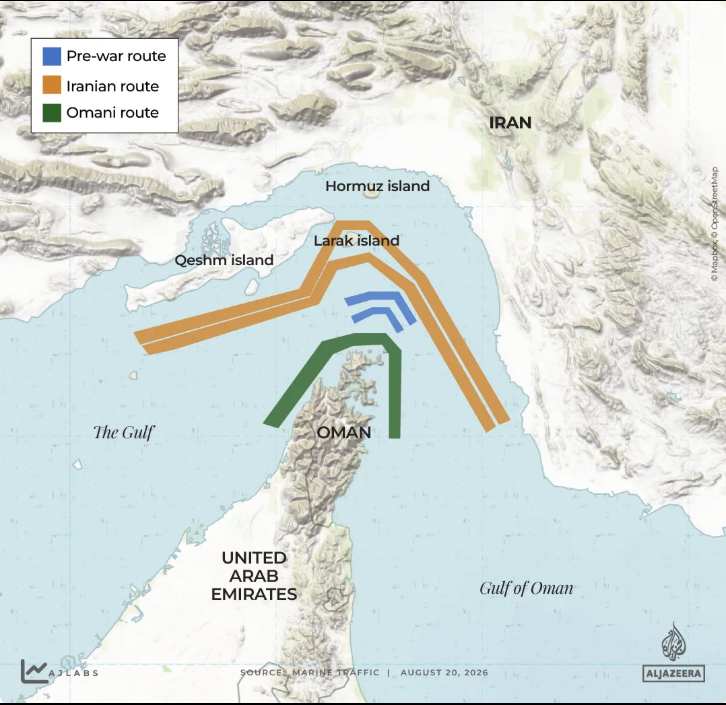
Just three days earlier, the US had hit three Iranian tankers. Those strikes came after Iran launched ballistic missiles towards a US aircraft carrier and a Navy destroyer near the strait, according to US Central Command (CENTCOM). Iran also subsequently said it had targeted three oil tankers travelling through an “unauthorised route” in the strait, as well as three US-linked vessels elsewhere.
|
|
|
Iran’s higher-level education facing toughest sanctions yet
The president of the University of Tehran says sanctions have led to unprecedented isolation for Iranian academia.
Mohammad Hossein Omid told the Mehr news agency that Iran had lived under sanctions since the revolution but was now “in the most severe situation we are in”.
“Even our friends are not publishing their articles in many journals, and we have also encountered problems in many international contracts,” he said.
He added that Iranians would seek partners in countries where cooperation remained possible.
Mehr reported last week that ETS, which administers the TOEFL and GRE standardized exams, suspended both tests in Iran in compliance with US education sanctions, creating an obstacle for Iranian students hoping to study abroad.
Seyyed Mehdi Abtahi, Iranian deputy science minister for research, called the measure “a sanction against science, not a country”, and said a package of policies in response would be announced soon.
|
|
|
Asian stocks tumble as oil hovers above $100 for second day
Asian stocks dipped as oil stayed above $100 a barrel for a second day.
Stock indices in Japan, South Korea, Australia, Taiwan and Hong Kong saw small losses as the US-Iran war left investors concerned about energy-driven inflation.
On Wednesday, oil breached $100 for the first time since June after the US attacked five Iranian crude oil carriers, and Iran retaliated with missile attacks on US forces in Jordan and strikes on shipping.
It eased slightly on Thursday but has remained above the $100 mark.
Nick Twidale, a chief market strategist at ATFX Global, said traders who held off selling shares in hopes of a Middle East peace deal may now “hit the trigger as the realities of a longer conflict kick in”.
With the US and Iran exchanging strikes around the crucial Strait of Hormuz – and Saudi Arabia entangled in a conflict with Yemeni rebels – there appears little prospect of an end to the crisis.
|
|
|
South Korea team returns from Hormuz deployment mission
A South Korea fact-finding team sent to the Middle East to assess the situation in the Strait of Hormuz has returned to Seoul.
The assessment followed repeated calls from US President Donald Trump for Seoul to help with efforts to secure the strategic waterway.
No decision has been made yet but opposition is growing at home, where a majority of South Koreans are against providing military assistance. Polls show 55 percent oppose sending military assistance, versus 30 percent in favour.
Before the war South Korea depended on the strait for up to 70 percent of its crude oil.
“I think we should send troops. The reason is that the Strait of Hormuz is directly tied to the global economy because of oil, and the global economy directly affects the lives of people around the world,” said resident Hong Nam Pyo.
|
|
|
Iran’s leadership opposes parliamentary effort to crack down on foreign influence
Iran’s government is publicly opposing a parliamentary bill that would impose criminal penalties for a broad range of activities deemed to amount to foreign influence or infiltration.
The bill, backed by parliament’s National Security and Foreign Policy Commission, would restrict contact with foreign media and institutions as well as the sharing of information and scientific cooperation, state broadcaster IRNA reported.
Opponents argue that the bill is draconian and targets arts and culture.
Vahid Agah, law professor at Allameh Tabataba’i University in Tehran, told IRNA he opposed the bill for a number of reasons, including practicality.
“If this law is passed, we will have to hire about three to four million people in the Ministry of Foreign Affairs and security agencies to monitor 70 million,” he said. “We cannot stop the development of culture and art, media and, in fact, its export abroad.”
|
|
|
UN nuclear watchdog reports activity at Iran’s Pickaxe Mountain
The International Atomic Energy Agency (IAEA) has confirmed activity at Iran’s Pickaxe Mountain, according to reporting by Bloomberg News.
The IAEA has not made an official statement on the reported discovery.
The US and Israel have long suspected Iran is hiding uranium centrifuges and centrifuge parts at a site under the mountain.
US President Trump has repeatedly threatened to bomb Pickaxe. On Wednesday, he said Washington had noticed some activity at the site and warned Iran not to “get cute because we will have to hit them very hard.”
US-based think tank Center for Strategic and International Studies revealed this week that new satellite imagery showed a significant uptick in construction activity at the site.
|
|
|
Protesters urge South Korea gov’t to avoid Hormuz naval mission
In Seoul, demonstrators pressed the government to reject US calls for a South Korean military deployment to the Strait of Hormuz, warning against joining a “war of aggression”.
Polls show 55 percent oppose sending troops and 30 percent are in favour, even as the strait remains vital for South Korea’s oil and petrochemical imports.
Iran has warned any Korean military role would have “serious consequences”.
|
|
|
Iranian judiciary chief meets with pro-government activists
Iran’s chief justice has held a meeting with speakers, activists and others who have participated in pro-government rallies since the US-Israeli war on Iran began more than six months ago.
Gholam-Hossein Mohseni-Ejei praised the crowds that had gathered in support of the government in the capital, Tehran, calling them “a source of despair for the enemy”.
“With the amazing presence of millions of people in the streets, the hard and soft plots of the aggressor enemies were neutralised, and the best and most excellent encouragement and hope was created for the warriors and the armed forces,” Mohseni-Ejei said.
Mohseni-Ejei warned that the “enemy” was trying to “exploit” divisions among Iranians. To prevent this, he said Iranians should distinguish between those who make mistakes and others with malicious goals. Mohseni-Ejei maintained that everyone should follow the law, including laws they disagree with.
|
|
|
IRGC’s Tehran commander says Iran is ‘on threshold of offensive operations’
The top IRGC commander in Tehran says Iran has moved beyond defensive operations and is now “on the threshold of offensive operations”, state-run Press TV reports.
“This is a turning point whose effects the enemies will soon understand,” Hassan Hassanzadeh said.
“We are prepared to be present at any point in the country at high speed and destroy the enemy under any circumstances. Our capacity for rapid transportation and specialized and special operations has been developed through repeated exercises in recent years”, Hassanzadeh said.
He denied Trump’s claims that the US has destroyed Iran’s military capabilities.
|
|
|
US military claims nearly 100 commercial ships redirected in Iran blockade
US Central Command (CENTCOM) has claimed it redirected 96 commercial ships and allowed more than 50 other vessels supporting humanitarian aid to pass to date as part of its campaign to blockade Iran.
Tehran has kept the vital Strait of Hormuz shipping lane largely closed and has vowed to weather the US bid to choke off maritime trade to Iran.
|
|
|
US unmanned vessel struck in the Strait of Hormuz: Iran’s IRGC
Iran’s Revolutionary Guards say they have attacked a US unmanned vessel in the Strait of Hormuz.
In a statement broadcast by Iran’s state-run IRIB, the IRGC said its navy struck a “Saildrone type” unmanned vessel, “thwarting its aggressive mission”.
The IRGC also said the US has deployed unmanned vessels to the Strait of Hormuz in recent days.
On Tuesday, the IRGC claimed they captured an unmanned US naval drone it identified as a Dive-LD vessel.
US Central Command (CENTCOM) said on Tuesday that “an underwater drone operated by U.S. forces malfunctioned,” adding that it was surveying regional waters in support of ongoing operations.
|
|
|
Iranian embassy reiterates commitment to peaceful nuclear program
The Iranian embassy in Austria says Tehran “will not relinquish its legitimate right to a peaceful nuclear program”.
In a statement on X, the embassy accused the US and Israel of disrupting “verification arrangements” by launching attacks on the country’s nuclear sites.
The statement comes after the International Atomic Energy Agency’s Board of Governors passed a resolution yesterday to refer Iran to the UN Security Council for refusing access to inspectors from the UN nuclear watchdog.
The embassy says the US and Israel used the “disruption as the pretext for an IAEA Board of Governors’ resolution against Iran”.
Tehran says it has stopped UN inspections at some of its nuclear sites in response to US-Israeli strikes on the country’s programme in June last year.
|
|
|
Iran’s parliament speaker sarcastically predicts Trump administration’s plan to contain oil prices
Iranian Parliament Speaker and chief negotiator Mohammad Bagher Ghalibaf has posted a chart on X outlining what he sarcastically describes as Washington’s plan to contain oil prices.
The chart highlights a series of steps that Ghalibaf predicts the Trump administration will take to lower the price of oil.
One of the steps involves Trump administration officials betting that oil prices will decline before the government releases supplies from its strategic reserves. The prediction appears to insinuate that members of the Trump administration are engaging in so-called “insider trading”, which is illegal in the US in specific circumstances.
The chart also predicts that Trump will falsely claim that peace talks are under way in a bid to lower oil prices before dispatching envoys to engage in non-existent negotiations.
|
|
|
Iran security chief says UN nuclear watchdog has undermined global non-proliferation
The head of Iran’s Supreme National Security Council Mohsen Rezaei bashed as “illegal” a move by the UN nuclear watchdog (IAEA) this week to refer Iran to the UN Security Council for alleged non-compliance with the Non-Proliferation Treaty (NPT).
“The anti-Iran resolution adopted by the Board of Governors is illegal, technically unfounded, entirely political and unacceptable, bearing the clear imprint of US and Zionist pressure,” Rezaei wrote on X.
“The IAEA’s politicized & disruptive actions will push countries toward withdrawing from the NPT,” he added.
|
|
August 21, 2026 - Iranian lawmaker Qasem Ravanbakhsh said a proposal for Iran to withdraw from the Nuclear Non-Proliferation Treaty has been submitted to parliament and is being pursued.
“The issue of withdrawing from the NPT has been raised, and the secretary of the Supreme National Security Council has also taken a position on it,” the hardline lawmaker from Qom said. “A proposal on this issue has also been submitted in parliament and is being pursued.”
|
Russia and China oppose UN snapback sanctions on Iran
Russia and China have both expressed their opposition to the reimposition of United Nations sanctions on Iran under the snapback mechanism during a UN Security Council meeting.
The opposition comes after the International Atomic Energy Agency’s Board of Governors passed a resolution yesterday to report Tehran to the council.
Russia’s ambassador to the UN, Vasily Nebenzya, said Moscow would not “allow sanctions on Tehran to be reimposed under any circumstances”.
China’s deputy permanent representative to the UN, Sun Lei, described the US’s actions as the “primary causes of the complex and intractable situation” in the Middle East. Lei cited US President Donald Trump’s unilateral withdrawal from the previous nuclear deal with Iran in 2018, Washington’s policy of maximum pressure, and Trump’s decision to attack the country twice during negotiations.
Iran has denied the UN nuclear watchdog access to some of its facilities following US-Israeli strikes on its nuclear program in June last year.
|
|
|
Canadian PM says he spoke to Trump about Iran
Canadian Prime Minister Mark Carney says he spoke to US President Donald Trump “a couple of times” recently about the ongoing wars in Iran and Ukraine, without elaborating.
Carney told reporters in Calgary that he had spoken with Trump “because part of our responsibility is to work together”, even as the two neighbors and longtime allies entered a bruising trade war this month.
|
|
|
Two vessels hit by projectiles off Oman coast: UKMTO
The UK Maritime Trade Operations (UKMTO) Centre says it has received a report of two vessels involved in an incident 4 nautical miles (7.4km) west of the port of Khasab in Oman.
An alert issued by UKMTO says the master of a vessel reported seeing four unknown projectiles hit two unknown vessels, causing a fire on one vessel. The master said he was unsure of the status of the second vessel, 6 nautical miles (11km) north of his position.
|
|
|
Iranian FM discusses regional escalation, tensions with Pakistan army chief
Iranian Foreign Minister Abbas Araghchi has discussed escalating tensions and regional insecurity with Pakistan’s army chief Asim Munir, according to the Iranian diplomat’s Telegram channel.
During a phone call, the two “emphasised the need for vigilance and coordination among regional countries in response to current developments, and stressed the importance of utilizing shared capacities to help establish lasting peace and security in the region”.
Pakistan’s military leader played a crucial role in mediating between the US and Iran in securing the now-defunct June memorandum of understanding that aimed to end the war.
|
|
|
