| Highlights from yesterday |
|
Comments |
- US Central Command says it destroyed five Iranian crude oil carriers after the Islamic Revolutionary Guard Corps (IRGC) targeted a US Navy warship with ballistic missiles.
- The IRGC then announced that it launched missile strikes on US forces stationed at the Al Azraq base in Jordan.
- The IRGC also said it urged crews to leave oil tankers in Kuwait and Bahrain, warning that it would target ships in the area.
- US Secretary of State Marco Rubio warned Iran that Washington will continue to strike Iranian oil tankers in retaliation for attempted attacks on US warships.
- The IRGC claimed that its navy captured a US submersible, and that its air defences intercepted an MQ-1 drone over the Strait of Hormuz.
- The Pentagon casualty database reported that an additional 30 US troops were wounded in the war on Iran, bringing the total to 820 wounded and 18 killed since the conflict began.
- The US has announced sanctions on 27 Iranian airlines and warned companies against doing business with them.
- The US State Department said Washington would not relent in its economic campaign against Iran after also sanctioning 36 entities connected to the Iranian government’s aviation sector.
- Iranian Foreign Minister Abbas Araghchi dismissed the latest US sanctions, stating Washington is resorting to more penalties after failing to achieve its war goals.
|
|
|
| |
|
|
| |
|
|
Iran condemns US attacks on Iranian commercial vessels as ‘war crime’
Iran’s Foreign Ministry has condemned the “aggressive” US attack on Iranian commercial vessels in the Gulf of Oman and the Gulf on Saturday, September 5.
In a statement, the ministry said the strikes were “a continuation of the US military aggression against Iran” and part of Washington’s “maritime blockade and economic war” against the country.
It called the attacks a violation of the UN Charter and “a war crime” that threatens international peace, security and commercial shipping.
The ministry said Iran remains “determined to firmly defend its sovereignty and national interests”, warning that responsibility for the consequences of continued US “aggressive and interventionist actions in the region lies with the US regime and its allies and partners”.
|
|
|
Jordan says it intercepted 18 of 20 ballistic missiles fired from Iran
Jordan’s Armed Forces spokesperson says the kingdom came under a missile attack originating from Iranian territory over the past hours.
Jordanian air defence systems engaged 20 ballistic missiles launched towards Jordanian territory, successfully intercepting and destroying 18 of them, while two fell in open areas, the spokesperson said.
Jordan’s military activated its defences “in accordance with approved operational procedures” to protect the kingdom’s airspace and the safety of its citizens, the spokesperson added, and tracking and assessment operations remain ongoing.
He also said that nobody was killed.
|
|
|
Iran’s IRGC claims missile strikes on US combat destroyers
Iran’s Revolutionary Guard Corps (IRGC) has announced that its operational units struck US combat destroyers DDG-119 and DDG-53, which carry cruise missiles and Aegis systems, in response to “aggressive actions and malicious harassment against Iranian oil tankers and vessels”.
In a statement carried by Iran’s semi-official Tasnim news agency, the IRGC claimed the operation inflicted “significant damage” on the naval vessels.
|
|
|
IRGC claims retaliatory strikes on US base in Jordan, destroyers
The IRGC said in a statement that it responded to the recent US strikes and caused damage to the US base in Jordan. It said it targeted US destroyers that were carrying ballistic missiles.
What Iran says is that it retaliated in a “much stronger way, and we inflicted damage”.
We have no verification of the level of damage that Iran claims to have caused to the US base in Jordan. These remain Iranian claims.
The US hasn’t commented on the claimed damage to its assets.
|
|
|
US tanker strikes are becoming a ‘pattern’ in the Gulf
These cycles of escalation are becoming a pattern, as confirmed by the US secretary of state, who stated clearly that every time Iran attempts an attack on a US naval vessel, there will be a response directed at Iranian tankers.
This first occurred a few days ago in the same circumstances: US warships came under missile attack, and the US responded by striking Iranian tankers.
CENTCOM said there were no injuries in the latest round of attacks, and the ships resumed normal patrol routines afterwards. CENTCOM confirmed that four Iranian tankers were struck in the Gulf of Oman, while another was struck near Kharg Island.
The US is now finding new and different targets in response to Iranian attacks – or what the US says are Iranian attacks.
|
|
|
Oil prices climb towards $100 a barrel
Oil prices have continued their upward trajectory for the fourth straight session, with Brent crude futures rising $1.57, or 1.6 percent, to $99.49 a barrel as of 00:01 GMT.
US West Texas Intermediate (WTI) crude went up $1.60, or 1.72 percent, to $94.63 a barrel.
The gains came after Iran launched new attacks on US military assets in the Gulf.
Brent crude prices have jumped by a quarter since early August as hopes for a permanent resolution to the six-month-old war faded and as fighting flared again.
|
|
|
Missiles interceptions heard over Jordan
Missile interceptions have been heard in eastern Jordan, according to our correspondents on the ground.
|
|
|
Decades of planning behind Strait of Hormuz defence, says former IRGC commander
Iran’s military readiness to defend the Strait of Hormuz has been “the result of years of strategic planning designed to counter regional threats,” according to Esmaeil Kousari a member of the Iranian parliament’s National Security and Foreign Policy Committee and a former IRGC brigadier general.
Kousari told the ISNA news agency that the army and the IRGC prepared defensive postures and operational responses dating back to the final years of the Iran-Iraq war to ensure swift reactions to foreign military presence in the area.
|
|
|
Tanker strikes fit into US strategy of ‘economic strangulation’ of Iran
Whether these tanker attacks are part of a formulated strategy or a question of circumstance isn’t entirely clear at this point. However, there’s no doubt these attacks on Iranian tankers will have an economic impact on Iran, and that fits into what the US administration has declared as its current strategy: economic strangulation.
President Trump and his advisers are insisting that the way forward is to concentrate on “economic strangulation”, as they’ve put it, and Trump appears reluctant to use military means, preferring economic measures at this stage.
But Trump has made clear that when US and allied resources come under attack, there will be a military response. That’s exactly what we’ve seen in recent days, and it presents a possible escalation of the ongoing conflict – one that still fits into the broader economic strategy of pushing Iran back to the negotiating table.
|
|
|
Jordan intercepts 18 missiles in latest Iranian retaliation, avoids civilian harm
The Jordanian military spokesperson confirmed the interception of 18 of the 20 Iranian missiles launched at Jordan.
The other two fell on open ground without any damage to civilians.
The spokesperson said they followed the necessary procedures to defend their country and that harm to civilians has been avoided.
The Jordanian military said they will continue to defend the kingdom from those attacks.
In the meantime, Iran has been threatening to retaliate against American assets in the region, including in Jordan, Bahrain and Kuwait.
There’s a genuine concern that a new escalation might be even worse than what has happened during the past six months and that it’s about to take place, and countries are bracing for that both here in Qatar and the rest of the Gulf Cooperation Council countries.
But at the same time, there are efforts to mitigate the situation. Just hours ago, the Qataris have been talking about new efforts, a fresh attempt to bring the parties of this conflict to the negotiating table through seeking the help of other countries, including China, to try to bring about that result.
|
|
|
IRGC claims targeted 2 US vessels, 8 oil tankers in Strait of Hormuz
Iran’s Islamic Revolutionary Guard Corps has said its forces have targeted two US vessels and eight oil tankers in the Strait of Hormuz.
In a statement carried by Iran’s semi-official Tasnim news agency, the IRGC said that its navy struck the vessels “in response to the aggression and malice of the American terrorist army” after the US struck five Iranian tankers.
The IRGC also reported that its forces targeted 10 additional “violating ships” that it accused of attempting to pass through a “prohibited and unsafe zone” of the strait, “incited and supported” by the US.
The IRGC said the strait remains under its “strong and authoritative surveillance and management”.
|
|
|
Six commodity vessels transit Strait of Hormuz amid low traffic
Strait of Hormuz shipping traffic has remained low, holding below normal levels, according to preliminary tracking data.
Six commodity vessels transited the waterway on Tuesday, down from nine the day earlier and below the 10-day average of about 12, Reuters reports, citing Kpler data.
The figures could change as some ships typically switch off their transponders during the voyage.
Of the six vessels, five were entering, and one was exiting, initial data from Kpler showed at 02:00 GMT. They included one Panamax and one intermediate tanker.
Meanwhile, 25 commodity vessels transited the Bab al-Mandeb strait on Tuesday, another major maritime chokepoint in the Middle East, with 11 vessels entering and 14 exiting.
This compares with an average of 27 ships going through Bab al-Mandeb over the past 10 days.
Among the vessels travelling through the strait were two Suezmax tankers, eight Aframax tankers and one Very Large Crude Carrier.
|
|
|
US sinks tanker in Gulf of Oman after Iran targets Navy warship: CENTCOM
US Central Command has released footage of an Iranian ship “sinking in the Gulf of Oman,” saying it was destroyed by American forces on Tuesday.
The post added that the attack on the tanker came “in response to attempted attacks” by Iran’s Islamic Revolutionary Guard Corps on a US Navy warship.
|
|
|
Iran, US trade strikes over Hormuz as diplomacy hangs on shipping corridor plan
Iran considers the US attacks targeting oil tankers and commercial vessels in the Strait of Hormuz a direct escalation. That’s why the IRGC says it targeted the US base in Jordan, along with US destroyers carrying cruise missiles and ballistic missiles.
Iran is making a show of the missiles it fired from across the country towards Jordan. It claims to have struck the US base there, but the Jordanian side says the missiles were intercepted.
The calculations and tensions in the Strait of Hormuz appear to have shifted, as both the US and Iran continue tit-for-tat operations, each day targeting additional vessels and oil tankers, carrying the conflict into another dimension.
However, Iranian officials have also underlined that there’s a door open for diplomacy.
Within the next couple of days, Oman and Iran are expected to introduce a temporary shipping corridor they have agreed to install in the Strait of Hormuz.
Despite all the tension, that means there’s still a chance for diplomacy.
|
|
|
Iran’s UK embassy condemns sanctions, affirms commitment to international law
Iran’s embassy in the UK has condemned London’s decision to impose sanctions on Tehran, calling the move “illegal” and warning it will deepen mistrust between the two countries.
In a statement shared by Iran’s semi-official Mehr news agency, the embassy said it expressed “deep regret” over the sanctions. It emphasized that such measures would only “deepen the wall of mistrust” and weaken the basis for bilateral cooperation.
Iran “has always been committed to international law”, the embassy said, adding that its nuclear programme remains under the full supervision of the International Atomic Energy Agency.
It called on the UK to instead condemn the “aggressive action” of the US and Israel against Iran, which it said constitutes “a clear violation of international law and Iran’s sovereignty”.
|
|
|
Qatar civil defence brings naval vessel fire under control with no injuries
Qatar’s interior ministry says that civil defence crews have controlled a fire on a naval vessel at Al Wakrah port, with no injuries reported.
|
|
|
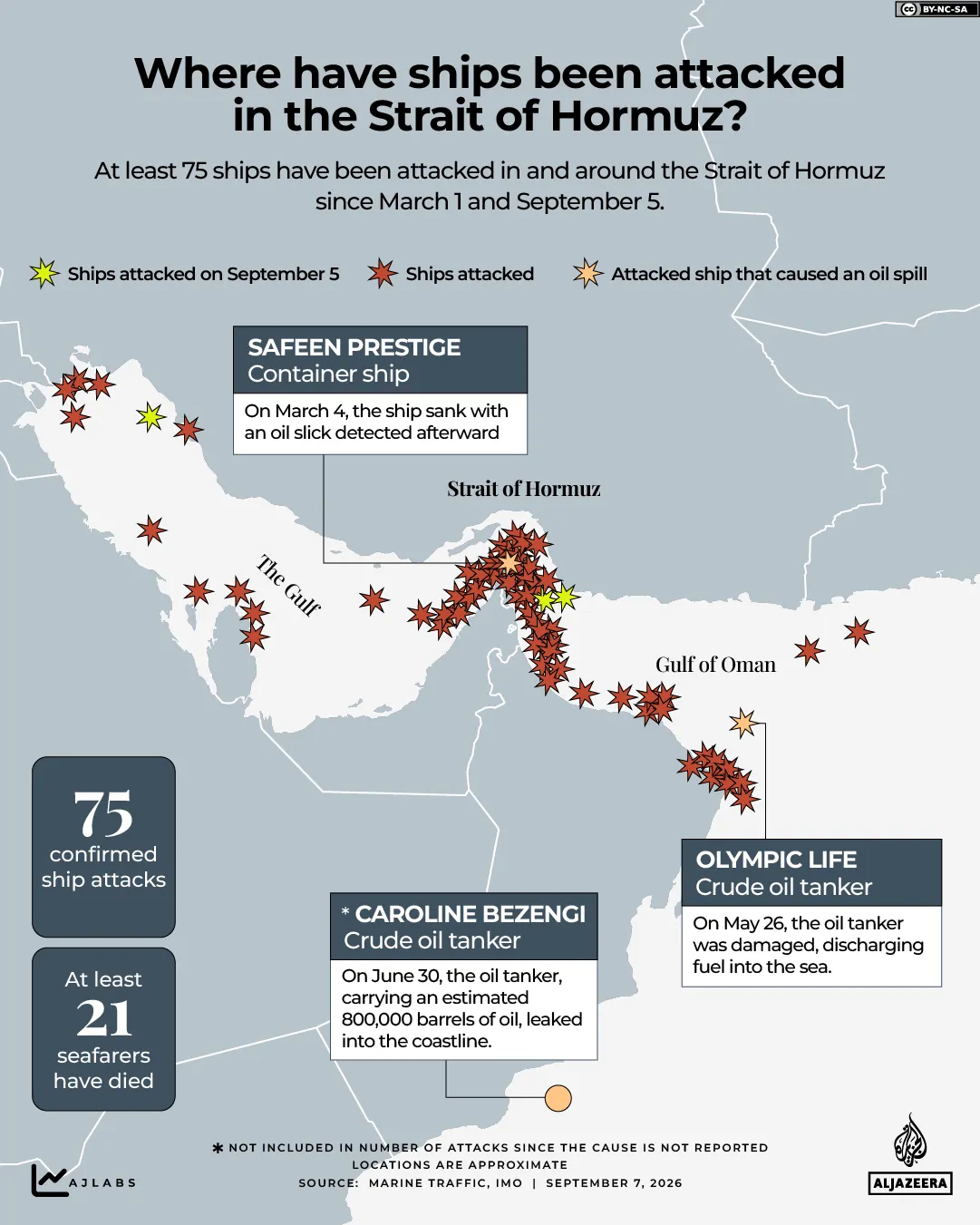
US-Iran war over Hormuz is threatening the Gulf’s waters
The war on Iran is increasingly being fought at sea, with both sides targeting oil tankers and other vessels in and around the Strait of Hormuz.
The tit-for-tat attacks have turned Hormuz into a potential environmental tinderbox. With tankers carrying millions of barrels of crude and petroleum products passing through or waiting around the waterway, a successful strike could trigger a fire, a sinking – or a major oil spill.
“Sensitive habitats such as coral reefs, mangroves, seagrass beds and coastal sediments may retain pollutants for much longer,” Hussein Samh Al Masroori, associate professor at Sultan Qaboos University, said.
He says that oil and petroleum hydrocarbons can directly affect fish, corals, plankton and other marine organisms. Fish eggs and larvae can be particularly vulnerable.
|
|
|
Brent crude futures hit $100 a barrel as Middle East war escalates
Oil futures rose past $100 a barrel, breaching the symbolic barrier for the first time since July 24 as intensifying conflict in the Middle East prompted growing concern about oil flows.
Brent crude futures rose $2.15, or 2.2 percent, to $100.07 a barrel by 07:21 GMT, while US West Texas Intermediate crude was up $1.70, or 1.83 percent, at $94.73 a barrel.
This week, attacks by Iran-backed Houthis on Saudi energy facilities set oil installations ablaze, threatening a significant expansion of the conflict.
A growing number of banks, including Goldman Sachs, Bank of America and HSBC, have raised their crude price forecasts in recent days.
|
|
|
Egypt and Pakistan discuss Middle East turmoil in phone call
Pakistan says Foreign Minister Mohammad Ishaq Dar had a telephone call with his Egyptian counterpart Badr Abdelatty to discuss regional developments as attacks ramp up in the Middle East.
The Foreign Ministry affirmed the need for “close consultations”, which include Saudi Arabia and Turkey, and agreed to hold a meeting on the sidelines of the upcoming UN General Assembly in New York City.
Pakistan has been a key mediator in the US-Iran conflict, and in April Islamabad hosted talks between the two sides, marking the highest-level direct engagement since 1979. Pakistan also brokered a ceasefire that began on April 8, temporarily halting hostilities.
|
|
|
Trump’s sanctions and blockade not enough to ‘strangle Iran’
Luciano Zaccara, a Middle East analyst, says Iran and the US do not seem to be interested in returning to the negotiating table despite ongoing attempts by mediators.
“Both sides are saying that they will not stop retaliating if they are attacked,” he said. “So we are in this tit-for-tat mechanism that sees no end.”
Both sides are unwilling to “sit down and think again” about measures that could de-escalate the situation, said Zaccara.
Increased sanctions and the naval blockade on Iran do not seem to be enough to achieve what Trump aims to accomplish, he added.
Zaccara said the US expects the economic punishment to “strangle the Iranian economy”, adding attacking ships and oil facilities directly appears to be another element of pressure.
|
|
|
US calls Iran attack on Jordan base ‘ineffective’; no casualties reported
A US official in Washington, DC, says a ballistic missile barrage fired at American forces in Jordan did not inflict any casualties.
“The Iranian response was ineffective against integrated air-and-missile defences. Missiles launched by Iran toward Jordan resulted in no casualties among US forces,” the official said on condition of anonymity.
Overnight, Iran’s Islamic Revolutionary Guard Corps said it attacked the US military at Jordan’s Al Azraq base. Amman said 18 missiles were intercepted while two hit uninhabited areas.
|
|
There are no satellite images found, which shows the situation at the bases in Jordan on the day of the attack to support the American claim.
|
Protesters urge South Korea to stay out of the US war on Iran
Dozens of South Koreans have urged their government not to deploy naval forces to the strategic Strait of Hormuz, denouncing what they called Washington’s “illegal war” on Iran.
Protesters outside the US embassy in Seoul waved signs saying, “Do not join a war of aggression” as their leaders weigh a “contribution” to the waterway’s “security”.
President Trump has pressured key ally South Korea to help in the conflict, which has seen Iran take a stranglehold on the strait – a key route for about 20 percent of global energy supplies.
“We cannot send our young people into a sea of death,” chanted demonstrators.
The protest came a day after South Korea authorities said they sent a fact-finding mission to assess the situation in Hormuz, while stressing no decision had been made on any deployment.
|
|
|
UKMTO reports ‘several’ cargo ships disabled in ongoing Gulf attacks
A British maritime monitor says attacks continue on shipping in key transit routes in the Gulf with “several merchant vessels” attacked and disabled.
“Reports indicate the vessels were subject to disabling fire as part of ongoing military activity” in the northern Arabian Gulf and the Gulf of Oman, a UKMTO advisory said.
UKMTO said it’s unable to confirm any casualties.
|
|
|
All indications pointing towards more escalation in US-Iran war
Leaders in the Gulf and across the region who have been trying to mitigate dialogue between Iran and the US are waking up yet again to escalation and strikes and tit-for-tat attacks.
The last 24 hours certainly represents a major violent escalation.
The IRGC says it launched a “devastating missile attack” on US forces at the al-Azraq base in Jordan in retaliation for the attacks by the US.
It claims that the operation it carried out struck maintenance and deployment sites for F-35, F-16 and F-15 fighter jets.
This is very different from what Jordan’s military has said, that it intercepted 20 ballistic missiles with 18 of them taken down and two falling in open areas, causing no damage and no casualties.
Separately, the IRGC also said it struck two US Navy destroyers along with two additional US vessels and eight oil tankers in the Strait of Hormuz.
All indications are – no matter what side of the story you believe, no matter what version of events each side is reporting – pointing towards more escalation in the coming days and weeks.
|
|
|
Vessel seen listing off UAE after projectile attack
A cargo ship is listing at anchor off the United Arab Emirates indicating water intake after being hit by a projectile, the United Kingdom Maritime Trade Operations says.
The stricken vessel is located 45km (24 nautical miles) northwest of Port Rashid, it said.
UKMTO said the incident was reported by a third party. The UK maritime monitor earlier said “several merchant vessels” had been attacked by “disabling fire” overnight in Gulf sea routes.
|
|
|
Qatar condemns latest Iran strikes on Jordan
Qatar has denounced Iran’s ballistic missile barrage launched at Jordan.
“We condemn the renewal of Iran’s attacks on Jordan and consider them a violation of its sovereignty and a breach of international law,” the Foreign Ministry said in a post on X.
“Continuation of Iranian aggression is an escalation that will complicate efforts to contain tensions and undermine diplomatic endeavors.”
The statement added: “We hold Iran fully legally responsible for this aggression and all the resulting repercussions and consequences. We emphasize the necessity of halting all military operations and aggression that threatens the region’s security and stability.”
|
|
|
CENTCOM rejects IRGC claim that it struck navy destroyers
The US military has rejected claims by Iran’s Revolutionary Guard that two US Navy destroyers operating in the Middle East came under attack.
“No US Navy warship has been struck. All IRGC attempted attacks failed,” US Central Command said in a post.
“Meanwhile, US forces have successfully destroyed 10 Iranian tankers in just the last week,” it added. “These vessels were part of a multibillion-dollar shadow network that funds the IRGC, and Iran cannot defend them.”
|
|
On September 6, 2026, Iran confirmed it propelled missiles at a US aircraft carrier and a US Navy destroyer that were “harassing” Iranian ships.
Tehran hasn't claimed that it "struck" as "propelled" is a term similar to "launched" or "fired" both "into the direction of"
Then, why needed CENTCOM three days to come with its denial?
|
Iran says its latest attacks were retaliation in self-defense
Iran’s foreign ministry says the armed forces will not hesitate to exercise their inherent right to self-defense and will respond to any aggression.
In a statement, the ministry condemned US attacks on Iranian tankers, warning of the escalatory consequences of such attacks.
“In response to the US’s aggressive actions against Iranian oil tankers, armed forces, in accordance with their inherent right of legitimate defense, attacked US military bases and facilities located in Jordan, which continues to support US military attacks against Iran, as well as several US vessels,” it said.
More lines from the statement:
- The US military attack on commercial vessels in the Gulf and the Sea of Oman – as a continuation of the US military aggression, naval blockade, and the economic war of the US regime against Iran – is a clear violation of the United Nations Charter and international law.
- The US’s aggressive actions against Iranian commercial vessels are not only a dangerous escalation of tensions in the region, but also a clear threat to regional and international peace and security.
- The ministry reiterates the responsibility of the UN Security Council and the UN secretary-general to take immediate action against the US violations of international peace and security.
|
|
|
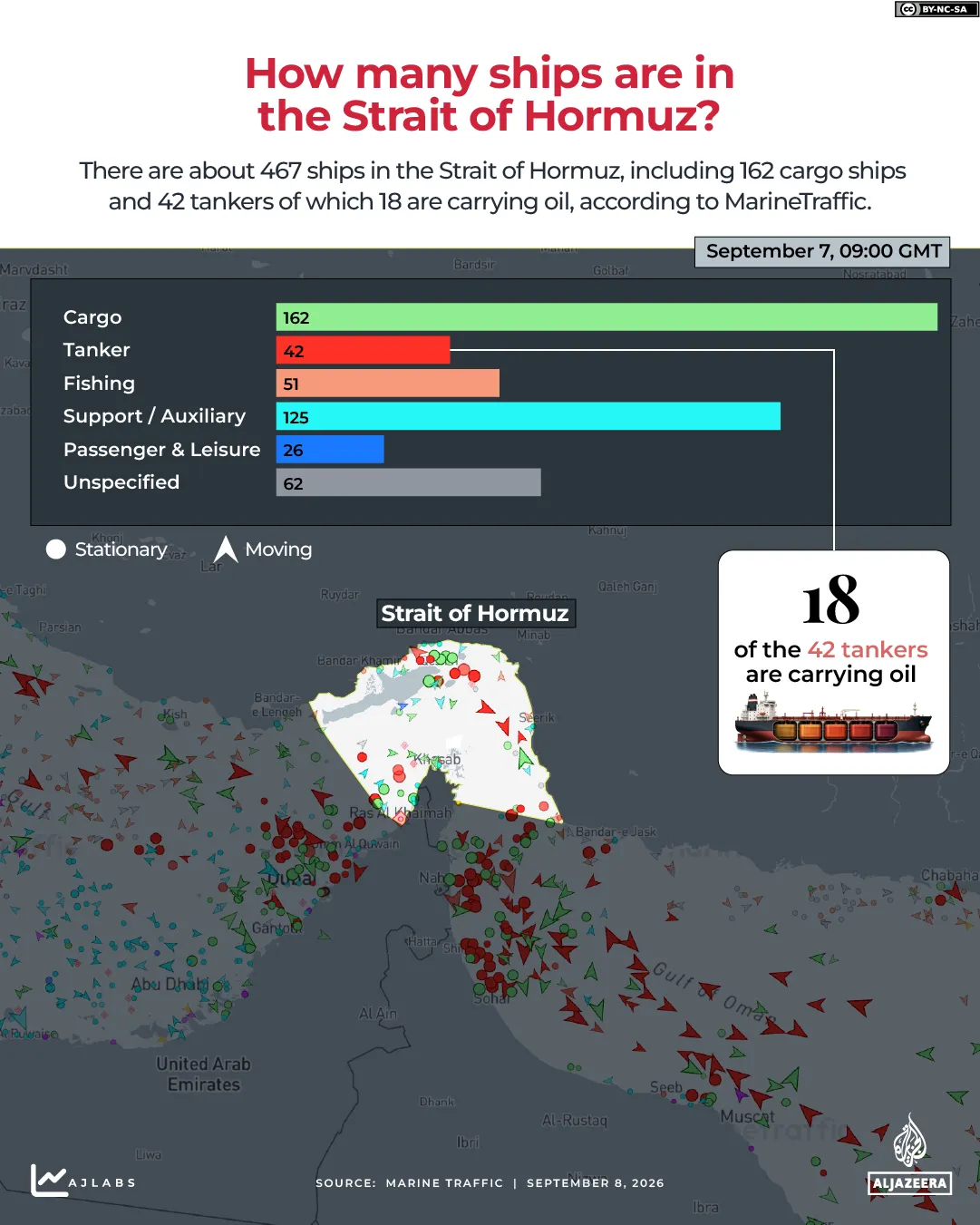
Gulf waters under threat amid strikes on oil vessels
The US-Iran war is increasingly being fought at sea, with both sides targeting oil tankers and other vessels in and around the Strait of Hormuz.
On September 8, the US struck five Iranian oil tankers, provoking an Iranian attack on Jordan’s Al-Azraq airbase.
Just three days earlier, the US also hit three other Iranian tankers.
Those strikes came after Iran launched ballistic missiles towards a US aircraft carrier and a navy destroyer near the Strait, according to US Central Command. Iran too subsequently said it had targeted three oil tankers travelling through what it called an “unauthorised route” in the Strait, as well as three US-linked vessels elsewhere.
|
|
|
IRGC says maritime restricted zone to extend into Gulf of Oman, Arabian Sea
An IRGC spokesperson says a restricted area extending from Chabahar in Iran into parts of the Gulf of Oman and the Arabian Sea will be announced.
Any ship that passes through the area will be sanctioned, he said, adding that its exact coordinates will be announced.
His comments come after Mohsen Rezaei, secretary of Iran’s Supreme National Security Council, was quoted by state media on Sunday as saying Iran would establish a restricted zone outside the Strait of Hormuz in the coming days.
|
|
|
‘Blatant violation’: Saudi Arabia denounces Iran attacks on Jordan
Saudi Arabia expressed its “strongest condemnation” over Iran’s “continued unjustified and brutal” strikes on Jordan.
The foreign ministry said Iranian bombardment constitutes a “blatant violation” of international law and the “principles of good neighborliness”.
It stressed the importance of an immediate halt to strikes on Jordan and other countries in the region, and called for “serious steps towards achieving security and stability” for the Middle East.
Earlier, Iran’s Islamic Revolutionary Guard Corps said it targeted a military base in Jordan housing US forces with a barrage of ballistic missiles. The US said no casualties were reported. The IRGC said retaliatory attacks will continue until “US aggression” ends.
|
|
|
Seafarer killed on board tanker near Dubai
A seafarer has been killed in an incident involving the oil products tanker Hercules Star while anchored off Dubai, the vessel’s charterer Peninsula said.
The cause of death has not yet been revealed.
“In addition, one member of the crew is missing and a specialist team is working to locate them. All other crew members are accounted for.”
|
|
|
Tanker attacked at Iraq’s Khor al-Amaya port: Source
Earlier, British maritime monitor UKMTO said it had received a report of another attack on a tanker off Iraq.
An Iraqi source said that the oil tanker had been targeted at the port of Khor al-Amaya in territorial waters near Basra.
The targeted tanker was carrying two million barrels of Iraqi oil and was stationed around the loading area, the source added.
|
|
|
Iran reaffirms right to self-defence, but says open to diplomacy
Iran’s Foreign Ministry says it is preserving its right to self-defence but would like to invite international institutions, including the UN Security Council, to the table for mediation.
Its statement also keeps the door open for mediation under international institutions, but it says that as long as the US continues to attack Iranian vessels and oil tankers, it will continue to target US assets.
Shortly after the Foreign Ministry statement, Iran’s IRGC said the maritime restricted area would extend from Chabahar in Iran into parts of the Gulf of Oman and the Arabian Sea, with its precise coordinates to be announced.
This is a game-changer because now the Iranians are extending this conflict from the Strait of Hormuz to the Arabian Sea.
So, within a couple of days, we could be discussing different naval projects between the US and Iran.
|
|
|
Iran captures unmanned US submarine
The IRGC says its naval forces “trapped one of the most modern, intelligent, unmanned submarines of the terrorist US army at the entrance to the Strait of Hormuz”.
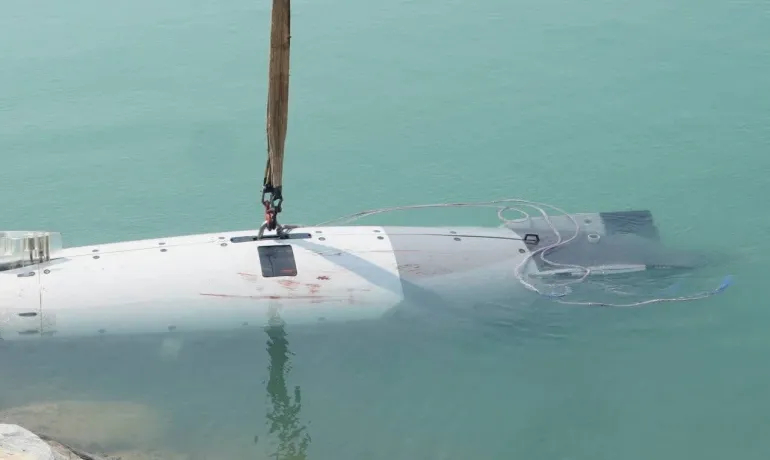
Iranian state media identified the vessel as a Dive-LD – an autonomous underwater vehicle built by California-based defence firm Anduril Industries.
The submersible, about six metres (20 feet) long, is designed for long-duration missions such as surveillance, seabed mapping, and mine detection. The US said the vessel “malfunctioned a day ago”.
|
|
|
US intends to prosecute war with both military and economic actions
There is certainly an example of how the United States intends to continue to prosecute this war with more military actions and economic action.
Under Operation Economic Outcast, there were sanctions imposed on at least 27 entities involved in the aviation business and those outside the country that support them.
This is because the US see them as providing cover to move troops and weapons around Iran.
The military action just re-emphasized the fact that although this is a low-key conflict, with a lot of tit-for-tat, the reality is the US military hasn’t left the area; they are still there in great numbers and should Trump wish to escalate military action that still remain be an option for him.
|
|
|
Beijing, Tehran, Moscow denounce US-E3 push to refer Iran to the UN Security Council over nuclear program
China, Iran and Russia have issued a joint statement opposing efforts by the US and three European countries to have the IAEA refer Tehran to the Security Council over Iran’s denial of access to its nuclear facilities.
“The alleged ‘referral’ to the UN Security Council lacks a legal basis, intends to aggravate the situation, and is inconsistent with the co-authors’ stated commitment to diplomacy,” the joint statement said.
The US, UK, France and Germany are calling on the IAEA’s Board of Governors to refer the matter to the Security Council.
Beijing, Tehran and Moscow described the finding of Iran’s alleged non-compliance with IAEA inspections in 2025 as “politically motivated and far-fetched”. All three countries said that attacks on Iran’s nuclear facilities by the US and Israel are the primary reason why Iran has refrained from granting the IAEA access to its nuclear facilities.
They called on “all responsible Member States to carefully consider its implications and refrain from supporting the draft resolution”.
|
|
|
Iran’s civil aviation chief says US sanctions won’t halt flights
The head of Iran’s Civil Aviation Organization says US sanctions on the country’s airlines may increase costs but will not ground flights.
“[This is] a repetition of a failed policy against the Iranian nation, a policy that the country’s aviation industry has faced for decades and one that has been met time and again with the capabilities and resilience of Iranian specialists,” Abuzar Shiroudi said.
“Sanctions may increase the cost of operations and the procurement of some needs, but they have so far failed to halt the country’s flight operations, and they will not be able to do so today either,” he added, referring to new sanctions announced by the US Treasury yesterday.
|
|
|
Sound of explosion heard in Iranian city of Jask
The sound of an explosion coming from the sea has been heard in the Iranian city of Jask, the Fars news agency reports.
It is not immediately clear what caused the explosion or its exact location.
|
|
|
Europe’s gas prices surge to highest levels since 2023, sparking winter energy concerns
Gas prices in Europe exceeded 80 euros (about $93) per megawatt-hour (MWh) today, the highest price since 2023, according to the Dutch TTF, a wholesale market that’s considered the price benchmark for European gas.
The new price spike is concerning as gas reserves in Europe are low as the continent heads into winter, when energy demands surge.
EU member states were warned in March to start storing gas due to the supply crunch and rising prices caused by the US and Israel’s joint war on Iran.
|
|
|
Iran widening military response to US naval blockade
Ali Akbar Dareini, a researcher at the Centre for Strategic Studies in Tehran, says Iran is widening its military response to the US naval blockade in the Strait of Hormuz by targeting US warships.
“So far, Iran had confined its attacks to US military bases, but it has decided to break the siege,” Dareini told Al Jazeera.
By targeting US warships, Tehran is telling Washington that it can strike moving targets and that “we see you, we know where you are and we are able to successfully hit you,” the analyst added.
The IRGC claimed its forces targeted two US vessels and eight oil tankers, along with 10 additional ships transiting the Strait of Hormuz. The US military’s Central Command claimed that no US warships were hit and that all attempts by Iran have failed.
|
|
|
IAEA board approves resolution to report Iran to Security Council over nuclear program
The International Atomic Energy Agency (IAEA) board has passed a resolution to report Iran to the United Nations Security Council over its refusal to allow inspections of its nuclear facilities.
Twenty-three of the board’s 35 members voted in favour of the resolution, while three voted against and eight abstained. Russia, China and Niger opposed the measure.
The Permanent Mission of Iran to the UN condemned the board, which oversees the UN’s nuclear watchdog, for passing what it described as a “biased, political resolution”.
Earlier in the day, China, Russia and Iran issued a joint statement opposing the resolution, which was drafted by the United States, the United Kingdom, France and Germany.
All three countries described allegations that Iran denied IAEA inspectors access to its nuclear facilities as “politically motivated and far-fetched”.
It is not clear what, if any, actions the Security Council could take against Iran. China and Russia are permanent, veto-wielding members of the council and could block any resolution against Tehran.
|
|
|
Iran’s deputy foreign minister says IAEA resolution ‘cannot achieve anything in Security Council’
Kazem Gharibabadi says that disruptions from attacks on Iran’s nuclear facilities were used by the United Nations nuclear watchdog as a pretext to refer Iran to the UN Security Council over “non-compliance”.
In a social media post, Gharibabadi said that the resolution by the board of the International Atomic Energy Agency (IAEA) “will not compensate for the failure of your policies and actions nor can achieve anything in the Security Council”.
The IAEA board of governors passed a resolution reporting Iran to the Security Council for the first time in 20 years for breaching its non-proliferation obligations.
Iran’s representative to the International Atomic Energy Agency Reza Najafi told Press TV that the resolution “was passed under political pressure from the US and its allies”.
|
|
|
Trump claims war to end, oil prices to come down after midterm elections
The US president has spoken briefly to reporters, claiming that the war would end “immediately” after the elections, slated for early November.
Donald Trump also said that while the US is not looking for a deal with Iran, negotiations “could happen”.
On Israel, he said that he would be speaking to officials about the recent sanctions on illegal settlements in the occupied West Bank.
“All they want is a nuclear weapon, and if they have a nuclear weapon, the whole world is in trouble,” Trump said. “We’re going to have nuclear … there’s going to be a lot of other things on the table that wouldn’t have been on the table three months ago”, he said, without clarifying whether he was referring to negotiations with Iran or options for US military action.
Asked about the possibility of resumed talks with Tehran, Trump said, “We’re not looking for it, to be honest.
“We’re so far down the line, they have very little country left right now. Yes, a negotiation could possibly happen. This war will end immediately after our election.”
|
|
"All they want is a nuclear weapon"
The United States was the first in the world that wanted a nuclear weapon by rushing in 1942 its secret Manhattan nuclear project after Albert Einstein warned Washington that scientists in Nazi Germany managed to create a fission.
The US became the introducer of nuclear militarization
In 1956, David Ben-Gurion wanted his secret Manhattan project by saying "What Einstein, Oppenheimer, and Teller -the three of them are Jews- made for the United States could also be done by scientist in Israel, for their own people."
Be-Gurion made this statement after the Israelis signed Eisenhower's Atom For Peace Agreement.
|
Iranian diplomat denounces IAEA-backed resolution as ‘political tool’
Iran’s ambassador to the UN in Vienna says a resolution passed by the UN nuclear watchdog is a “political tool”.
Earlier today, the International Atomic Energy Agency’s (IAEA) board passed a resolution drafted by the US, UK, Germany and France to report Iran to the Security Council for denying UN inspectors access to its nuclear facilities.
Commenting on future requests to inspect the country’s nuclear sites, ambassador Reza Najafi said that Tehran “will cooperate only to the extent that circumstances and safety permit”.
Iran has denied the IAEA access to some of its nuclear facilities since Israel launched attacks on the country’s nuclear program in June 2025.
|
|
During the mediation in Geneva days before the war, Oman told the media that Iran was willing to do concessions on its nuclear program. But Jared Kushner told his father-in-law, the US president, that Iran was going to attack, which the Pentagon rejected by saying that Tehran was not preparing an attack before Netanyahu reignited his war from June 2025.
|
Iranian lawmaker urges US military to leave Gulf
Ebrahim Azizi, chair of the Iranian Parliament’s national security committee, has mocked US military personnel in a post on X, urging them to leave the Gulf.
“Iran’s navy just sent a clear message: the security and stability of the Persian Gulf are managed by Iran. To the remaining forces: Save what’s left of your gear and head home while you still can, and focus on defending your own borders!” said Azizi.
|
|
|
Rubio vows to ‘strangle’ Iran economically
US Secretary of State Marco Rubio has said US forces will continue to target Iranian oil tankers in retaliation for attacks on their warships, adding that Washington aims to “strangle” Tehran economically.
“At the end of the day, they continue to fire at our naval ships, and when they fire at our naval ships, they pay a price in tankers,” Rubio told reporters. “They lose a lot of tankers, they don’t hit our ships, but they lose five tankers.”
“They’ll continue to pay a price for that; in the meantime, we’ll continue to strangle them economically,” he added.
|
|
|
Iranian MP suggests IAEA resolution on Tehran’s nuclear program is merely symbolic
Iranian lawmaker Hassan Ghashghavi says a resolution passed by the IAEA to report Tehran to the Security Council over its refusal to allow nuclear inspections by the UN watchdog will “lead nowhere”.
“Last year, there was much ado about the reimposition of the UN nuclear sanctions,” Ghashghavi said in a post on X.
“Now, once again, to cap off America’s military attacks, they have issued a new resolution in the IAEA Board of Governors, even though they know it will lead nowhere, just as in the past. Europe and America will pay the price for their division of labor.”
Earlier today, the International Atomic Energy Agency’s (IAEA) board passed the resolution drafted by the US, UK, France and Germany. Tehran, along with Beijing and Moscow, opposes the resolution.
It’s not clear what, if any, actions the UN Security Council can take against Iran, with permanent, veto-wielding members China and Russia able to use their status to oppose any measures.
|
|
|
Iranian First VP says US has no right to moralise over Iran’s nuclear program
Iran’s First Vice President says the resolution passed by the International Atomic Energy Agency’s (IAEA) board is a double standard and that Tehran will continue to use nuclear energy for peaceful purposes.
“The approval of the Board of Governors’ resolution against Iran’s peaceful nuclear program, proposed by the atomic bomb possessors, the perpetrators of Hiroshima, and the violators of the JCPOA, is a symbol of today’s world’s double standards,” Mohammad Reza Aref said.
“Those who threaten our infrastructure and civilization have no qualification to judge. The Iranian nation stands firm on its legal rights and the strategic path of peaceful nuclear energy.”
The resolution was drafted by the US, UK, Germany and France and calls for Iran to be reported to the UN Security Council for refusing access to inspectors from the UN nuclear watchdog.
|
|
|
Iran ready for dialogue and cooperation with region: Foreign ministry
The Iranian Foreign Ministry has said Tehran is ready for dialogue and cooperation with nations in the region to “foster mutual trust, achieve sustainable security, and promote economic progress”.
Iran believes “security in the Gulf and the Sea of Oman must be ensured through cooperation among littoral states and without the interference of foreign powers”, the ministry said in a statement.
The ministry also said that Iran “categorically rejects” claims that it interferes in Yemeni affairs. The Iranian statement pointed to “the insistence of certain Arab League member states on making baseless accusations against Iran rather than focusing on supporting the Palestinian people and confronting the Zionist regime”.
The hostilities in Yemen resurfaced earlier in September when the Houthi rebels, backed by Iran, launched a large-scale offensive against government forces.
|
|
|
Explosion heard near Iran’s Qeshm Island: State media
A reporter for the state media outlet IRNA says that a loud explosion was heard a few moments ago on Qeshm Island in the Strait of Hormuz.
“It is not yet clear whether the sound originated from the sea or if the explosion occurred within Qeshm,” IRNA says.
|
|
|
Explosions heard in Minab County, Sirik; officials say sounds originated from sea
Multiple explosions have been heard in the city of Sirik and Minab County, according to the Fars news agency.
Fars also confirmed the explosions heard on Qeshm Island, which we reported a short while ago.
The news outlet quoted the Hormozgan governorate as saying that the sounds originated from the sea.
|
|
|
‘Several areas’ in Sirik hit by projectiles, IRNA says
Iran’s state news agency IRNA said the projectiles were fired by the “enemy”.
|
|
|
Pakistani diplomat hopeful of better US-Iran deal soon
Pakistan’s ambassador to Russia says he believes the US and Iran could soon agree on a better framework to end the war than the previous memorandum of understanding, according to Iranian news outlet ISNA.
“Despite the recent escalation of tensions in the region, we believe that a better understanding will soon be achieved between the United States and the Islamic Republic,” Faisal Niaz Tirmizi said, ISNA reported, citing Russia’s RIA Novosti news agency.
Pakistan emerged as a key mediator during the previous round of talks between Washington and Tehran to end the conflict. Islamabad has continued its efforts behind the scenes to get both countries to return to negotiations. Qatar has also been trying to mediate an end to the war.
|
|
|
Trump’s timeline of ending war by November cause for ‘head scratching’
US President Donald Trump’s claim today that the war on Iran will end “immediately” after the US November midterm elections appears more of a hope than a realistic deadline, says Alex Vatanka, senior fellow at The Middle East Institute.
“My own reaction – and having looked at other reactions available to us – is one of essentially scratching our heads. What is the American president talking about?” Vatanka said.
He added that it was difficult to rationalize the idea that Iran is just waiting on the November 3 congressional elections.
“In fact, what I think Iranians are waiting for is something that they can look at and say, diplomatically, ‘This was worthwhile’, which takes us to the substance of the disagreement – whether it is reopening the Strait of Hormuz, or the future of Iran’s nuclear program,” he said.
“That will only change if negotiations are resumed. And the two sides can, perhaps, be willing to be able to find common ground. That’s how you get this war ended for good. Otherwise, I just can’t see how this conflict’s going to end.”
Vatanka said Trump’s latest assertion also suggests that he is hoping that renewed US sanctions and economic pressure will compel Iranians to give up.
“But again, that is just a hope, because nobody knows”, he said.
|
|
|
