| Highlights from yesterday |
|
Comments |
- US President Donald Trump said he is “not in a hurry” to resume talks with Iran, saying that economic and military action are both effective.
Iran’s Foreign Minister Abbas Araghchi wrote to the UN, calling the new US sanctions an “act of state and economic terrorism” and urging member states not to implement them.
- Qatari Prime Minister and Foreign Minister Affairs Sheikh Mohammed bin Abdulrahman bin Jassim Al Thani will visit Tehran on Thursday, where he will meet Iranian officials to discuss ways to de-escalate tensions.
- The US designated the UK-based Palestine Action group a “global terrorist” organization, a move cofounder Huda Ammori called a threat to free speech.
|
|
|
| |
|
|
| |
|
|
Tehran diplomacy gathers pace as Qatari PM visits to de-escalate tensions
There’s a growing sense in Tehran tonight that diplomacy is gathering pace despite a broader agreement remaining some way off.
Today, Qatar’s foreign minister and prime minister, Sheikh Mohammed bin Abdulrahman bin Jassim Al Thani, is going to pay a visit to Tehran to meet with high-level Iranian officials.
The aim of the visit, as per the Qataris, is to de-escalate tensions and create a platform for dialogue.
This visit comes after a very busy week featuring visits from Pakistan’s army chief, followed by Oman’s foreign minister. Qatar hopes that all these discussions may create a platform for dialogue between Iran and the United States.
We heard Omani and Iranian officials saying that they agreed on a framework for a temporary shipping route in the Strait of Hormuz, which is the most urgent problem in the region for now, alongside efforts to clear mines from the waterway.
Qatar expects these negotiations may open the way to resume talks between Tehran and Washington. However, these expectations should be measured as both sides have different points of view when it comes to communication.
Even so, this is an important development. After months of military confrontation, a diplomatic channel exists between these countries, though Iran points out that these talks shouldn’t be taken as a direct resumption of bilateral negotiations, as they are just talks with mediators.
These are the main differences between the US and Iran. There isn’t a big expectation for an imminent breakthrough in this conflict right now, but all parties hope that diplomacy builds a new platform for dialogue and, hopefully, for the resumption of formal negotiations.
|
|
|
Pakistan rejects claims army chief visited Tehran as Trump’s envoy
Pakistan has pushed back against reports that its army chief, Field Marshal Asim Munir, traveled to Iran as Trump’s envoy, calling the claims “misleading and factually incorrect”.
Foreign Office spokesperson Tahir Andrabi, speaking at his weekly media briefing on Thursday, said Munir’s visit to Tehran on August 24 was undertaken “purely in the context and backdrop of Pakistan’s ongoing role as mediator”.
“The visit underscored Islamabad’s sincere and constructive role in bridging differences between Washington and Tehran,” Andrabi said, adding that the Iranian leadership had appreciated Pakistan’s efforts.
During the visit, Munir met Iran’s president, Supreme National Security Council representative, parliament speaker, foreign minister and interior minister.
The Pakistani military’s media wing said Iranian officials “appreciated Pakistan’s constructive role and sincere efforts”. An Iranian presidential office official also said the visit’s results “would become visible soon”, describing it as “highly fruitful” with “highly valuable diplomatic” outcomes.
|
|
|
‘Americans signaling they are ready for more diplomacy’
You need to look at the last 72 hours, the Pakistani army chief, then the Omani foreign minister and now the Qatari prime minister and foreign minister all [visiting Iran] within three days.
It appears that a there is new mechanism, at least for the Strait of Hormuz, which was the biggest sticking point between Tehran and Washington, negotiated between Iran and Oman.
It appears that the Americans are also signaling behind closed doors that they are ready to come back to the table if the Iranians give some concessions.
The presence of the Qatari prime minister indicates that there is US backing for taking some messages to Iran and taking some messages from them.
However, there is so much breakdown in the decision-making in Iran, which is why mediators need to make them come together. There is the Basij, the IRGC, the foreign ministry and the presidency; if they don’t come to the table, it is very unlikely that they are going to get anywhere.
|
|
|
Qatar’s FM meets Iranian officials in Tehran
Qatar’s Foreign Minister has met his Iranian counterpart and other officials in Tehran, Iran’s Foreign Ministry has confirmed.
|
|
|
Iran, Qatar discuss agreement to implement ‘joint project’ to clear mines in Hormuz
Qatar’s Foreign Ministry says Iran and Qatar discussed agreement to implement “joint project” to clear mines from the Strait of Hormuz.
The statement follows a meeting between the foreign ministers of both countries in Tehran today.
|
|
|
Qatar, Iran discuss creation of temporary shipping corridor through Strait of Hormuz
The foreign ministers of Qatar and Iran, during a meeting in Tehran today, also discussed proposed framework that includes creation of a temporary shipping corridor through the Strait of Hormuz, Qatar’s Foreign Ministry says.
|
|
|
Qatar, Iran discuss ways to ‘reduce escalation, create appropriate conditions for dialogue’
During the meeting of foreign ministers from Iran and Qatar in Tehran today, “the latest developments in the regional situation were reviewed, along with the efforts being made to reduce escalation and create appropriate conditions for dialogue, contributing to the enhancement of regional security and stability,” Qatar’s Foreign Ministry said in a statement.
|
|
|
There is realization that there is room to come back to the table
There is hope for a deal as Qatar’s PM met Iranian officials in Tehran.
It appears that there is now a realization that there is room for negotiation, mediation, and to come back to the table.
Traffic in the Strait of Hormuz is not zero but there is also not complete freedom of movement.
Details of the deal between Oman and Iran have not been disclosed or made public, but apparently there is a deal that ships will be able to navigate. They are going to be coming in with Iranian permission, going out with coordination, and no naval ships are going to enter.
|
|
|
Ghalibaf stresses need to de-escalate tensions in meeting with Qatar’s PM
Iran’s Parliamentary Speaker and top negotiator Muhammad Bagher Ghalibaf has emphasized the need to de-escalate regional tensions during a meeting with Qatar’s prime minister in Tehran, according to Iran’s Tasnim news agency.
The two exchanged views on the current developments in the region and efforts to reduce tensions and create suitable conditions for resuming dialogue, the report added.
|
|
|
Qatar’s PM looking to assess on Tehran trip if ‘Iranian front is united’
The Qatari prime minister’s visit to Tehran is a chance for him to re-evaluate “if the Iranians actually are serious about taking this deal with Oman to be very practical and to allow freedom of navigation”, Abdulla Banndar Al-Etaibi, an assistant professor of international affairs at Qatar University, said.
The meeting will also help Sheikh Mohammed assess if “the Iranian front is actually united and they can really apply what’s being agreed on”.
“This is important because after Wednesday’s Omani-Iranian announcement that they had agreed on a new temporary shipping route in the strait, the IRGC made a separate statement saying it had full control of the waterway, including the regional water system in Oman.”
|
|
|
Mediation gaining momentum as Qatari PM holds Tehran talks on Hormuz and de-escalation
Qatar’s prime minister was holding talks with Iranian officials today, discussing de-escalation and the potential reopening of the Strait of Hormuz, as part of a wider push by regional mediators to bring Washington and Tehran back to the negotiating table.
Hossein Ebrahimi, a political analyst in Tehran, said that mediators “are trying their best again to put [the US and Iran] back on the negotiating table and open the doors to diplomacy”. He said Qatar’s visit follows earlier delegations from Pakistan and Oman, adding that this week’s joint statement between Oman and Iran “can be considered an opening door to further negotiations and the management of the strait”.
Ebrahimi said new US sanctions “will add more challenges on the ground” and “push more pressure on the Iranian public”. He added that even if talks produce a new agreement, “Iran has said clearly that this doesn’t mean the strait will be fully open.” Ebrahimi noted that Tehran holds significant leverage over the waterway that it is likely to invoke in future negotiations, while working to “control the situation in order to bring the United States back to the MoU”.
|
|
|
Qatari PM meets Iranian officials in Tehran to discuss de-escalation efforts
Qatar’s Prime Minister and Foreign Minister Sheikh Mohammed bin Abdulrahman bin Jassim Al Thani has met in Tehran with Mohsen Rezaei, secretary of Iran’s Supreme National Security Council, the Qatari Ministry of Foreign Affairs announced.
The meeting discussed the situation in the region and the repercussions of escalation, along with regional and international efforts to reduce tensions and enhance regional security and stability.
The Qatari prime minister stressed the importance of prioritizing wisdom and responsibility in dealing with the current crisis to preserve regional security and stability, the ministry said.
Sheikh Mohammed also met separately in Tehran with Iranian President Masoud Pezeshkian, discussing the regional situation and its repercussions on security and stability, as well as efforts to reduce escalation and create conditions conducive to dialogue, according to the ministry.
|
|
|
Iran’s Ghalibaf tells Qatar PM: US must honour MoU commitments, blockade will fail
Iran’s chief negotiator and Parliament Speaker Mohammad Bagher Ghalibaf told Qatar’s prime minister that the Trump administration “makes wrong decisions based on misinformation, squandering US resources and destabilising the region”.
Ghalibaf said the US “economic blockade will fail,” adding that “Washington must implement its commitments under the MoU.”
|
|
|
Iran’s Rezaei: Tehran preparing list of conditions to reopen Strait of Hormuz
Mediators have asked Iran for its conditions to open the Strait of Hormuz, and Tehran is preparing a list, Mohsen Rezaei, secretary of Iran’s Supreme National Security Council, said in a televised interview on Al Manar TV, affiliated with Lebanon’s Hezbollah, according to Reuters news agency.
Rezaei said the conditions include ending the war in the region. He added that Iran has agreed to a transit corridor with Oman, with part of it lying in Omani waters and some in Iranian waters, saying that ships would transit through a designated central channel in the strait if the US meets Tehran’s conditions.
Rezaei’s statements come as Qatar’s prime minister holds talks in Tehran, part of intensified efforts by regional mediators to pave the way for a US-Iran agreement to de-escalate the conflict and reopen the Strait of Hormuz.
|
|
|
| |
|
|
| |
|
|
Iranians ‘feeling the pressure’ as new US sanctions bite
Iran’s economy has been battered by decades of international sanctions and domestic mismanagement.
The recent war inflicted further damage, and now comes another blow: the new US sanctions target sectors including technology, gold, aviation, and shipping, as well as digital assets.
They are also weighing heavily on the already weak local currency, as the rial has hit new lows against the US dollar.
For many businesses, these sanctions mean yet another setback.
But despite the mounting strain, there’s also defiance. The government says it’s working on measures to counter what it describes as US economic warfare, but the consequences of the sanctions are already evident.
For months, Iran has been caught between the threat of further confrontation and the prospect of a diplomatic solution. As the uncertainty persists, one thing remains certain: everyday Iranians are feeling the pressure.
|
|
|
Head of Iran-China Chamber of Commerce says resistance ‘inevitably entails costs’
The president of the Iran-China Chamber of Commerce and Industry says people must remain “resilient” as Trump seeks to force Tehran into making concessions by increasing economic pressure.
Majidreza Hariri said that the latest raft of sanctions imposed by the US would not cause “misery and famine”.
“I have explicitly stated in the conversation that the people’s livelihood has certainly been placed in dire straits, not only because of the sanctions, but the siege also exacerbates the situation,” Hariri posted on X.
“However, the siege will not drag us into the peril of misery and famine and it should not cause panic. Resistance against aggression inevitably entails costs, just as we witnessed losses in the military war, but we must remain resilient,” he added.
|
|
|
Iran unable to import enough petrol amid US blockade: Official
Iran has been unable to import enough petrol to make up for insufficient domestic production because of a US naval blockade, according to a senior Iranian official.
“Petrol production is insufficient, and because of the US naval blockade, we cannot import it,” the official IRNA news agency quoted Vice President Mohammad Jafar Ghaempanah as saying.
The remarks came as Iranians have in recent days queued outside petrol stations, with the war with the United States increasingly shifting towards economic pressure on Tehran.
On Monday, the Iranian president’s chief of staff Mohsen Haji-Mirzaei said petrol quotas would be reviewed, without elaborating.
|
|
|
Pakistan says it’s not bound by US sanctions on Tehran
Pakistan says it does not consider itself bound by US sanctions on Iran.
Addressing reporters in Islamabad on Thursday, Foreign Ministry spokesperson Taher Andarab said Pakistan does not believe Washington’s unilateral sanctions on Tehran adhere to international law and that issues should be resolved through dialogue.
On Monday, the US Treasury Secretary, Scott Bessent, announced a series of new sanctions on Iran, as the Trump administration seeks to increase economic pressure to force concessions.
|
|
|
Iran’s Ghalibaf says country in ‘full-scale economic war’
Iran’s Parliament Speaker Mohammad Bagher Ghalibaf says the country is in “a full-scale economic war”, adding that Iran “will defeat the enemy in this field as well”, according to the official IRNA news agency.
|
|
|
Iranian official says ‘no shortage of goods but issue of high prices’
The head of the Iranian Chamber of Guilds says there is no shortage of goods inside the country despite the US naval blockade.
“We have no shortage of goods, but there is an issue of high prices. Part of the price increase is due to logistical issues and changes in transportation routes because moving goods by rail and road is more time-consuming and costly than previous routes,” Qasem Noudeh Farahani said in comments reported by the IRNA news agency.
The war has placed immense pressure on Iran’s economy, which was already in dire straits after decades of crippling sanctions.
New sanctions announced by Washington on Monday caused Iran’s currency, the rial, to plunge to a new all-time low against the US dollar.
|
|
|
Ghalibaf slams ‘failing’ US ‘funneling billions’ to ‘terrorist proxy, Israel’
Iran’s Parliamentary Speaker Muhammad Bagher Ghalibaf has slammed Treasury Secretary Scott Bessent’s comments on Iran’s economy in a new post on X.
Ghalibaf says, “Instead of funneling billions to its terrorist proxy, Israel, and 750 bases, this failing empire could spend that cash on its own people”
“But nah, that’d make too much sense for this regime. Scotty, man [?], your credibility is on the line. Do something”, he continued.
|
|
|
| |
|
|
| |
|
|
Tanker hit by ‘unknown projectile’ catches fire in Strait of Hormuz
A tanker has been struck by an unknown projectile in the Strait of Hormuz, setting the vessel on fire, according to the UK Maritime Trade Operations (UKMTO) agency.
Citing local authorities, UKMTO said the fire has since been put out and that all crew are “safe and accounted for”, with no reported environmental impact.
|
|
|
Oil prices slide to extend multi-day losses
Oil prices are continuing their downward trend, with Brent crude futures dropping 60 cents, or 0.7 percent, as of 00:04 GMT, to $87.24 a barrel.
US West Texas Intermediate (WTI) crude was down 56 cents, or 0.7 percent, at $81.67.
The declines came as expectations grew that upcoming talks between Iran and Qatar could reopen the vital Strait of Hormuz and ease supply disruptions stemming from the US war on Iran, according to Reuters.
|
|
|
Strait of Hormuz ship traffic remains low amid US-Iran standoff
Ship movement through vital Gulf waterways stayed suppressed amid the ongoing diplomatic and political friction between Washington and Tehran, according to shipping figures cited by Reuters.
Data from Kpler indicated that cargo ship sailings through the Strait of Hormuz increased slightly on Wednesday compared with Tuesday, but remained consistently lower than the 10-day average, the report added.
|
|
|
Oil prices fall over hopes for Hormuz deal
Oil prices have kept falling on expectations that talks between Iran and Qatar might lead to the opening of the Strait of Hormuz and reduce supply disruptions from the war in the Middle East.
Brent crude futures LCOc1 were down $1.07, or 1.2 percent, to $86.77 a barrel at 06:45 GMT, in line for a fourth day of declines.
West Texas Intermediate crude futures CLc1 fell $1.13, or 1.4 percent, to $81.10, in line for a fifth day of losses.
|
|
|
Egyptian and Russian FMs discuss situation in Strait of Hormuz
Egypt’s Foreign Minister Badr Abdelatty and his Russian counterpart Sergey Lavrov have discussed recent developments in the Middle East, including the joint Iran-Oman proposal to establish a temporary maritime corridor in the Strait of Hormuz, according to a statement from Egypt’s Foreign Ministry.
Their call also covered Egyptian-Russian relations, the ministry added.
|
|
|
Iranian crude exports continue despite US blockade: Oil minister
Iran’s Minister of Petroleum Mohsen Paknejad says global sales of Iranian crude oil have not stopped despite the US blockade on Iranian ports and vessels, according to state-run IRIB.
Paknejad says deliveries have reduced. He refused to go into details as these could be “exploited by the enemy”.
|
|
|
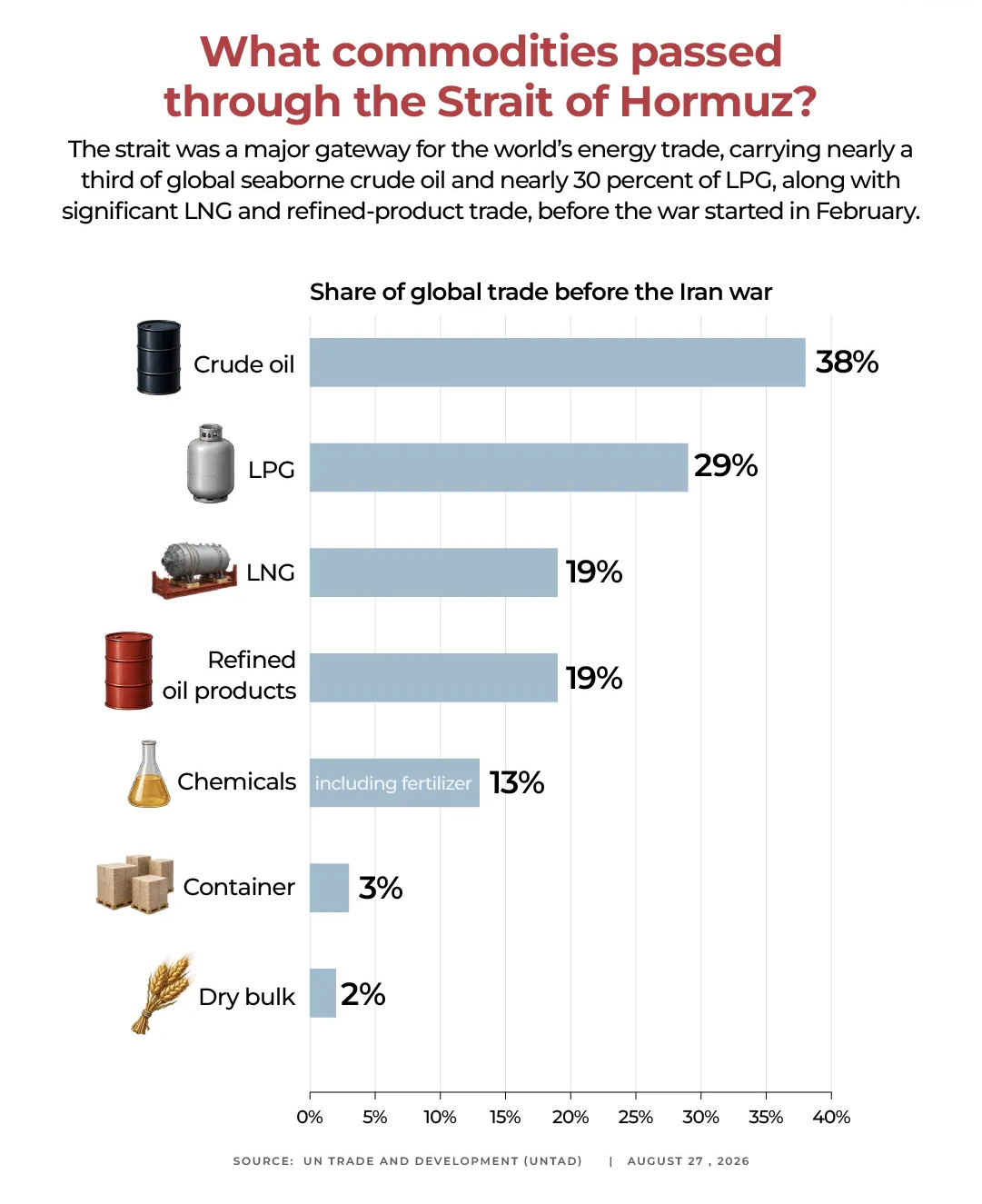
How a 95 percent drop in Hormuz traffic changed global shipping
Six months into the war on Iran, the closure of the Strait of Hormuz continues to drive one of the worst maritime shipping disruptions in decades.
Traffic through the 33km (21-mile) chokepoint has fallen from more than 100 vessels a day to just five, disrupting the flow of oil, gas and goods worldwide.
Al Jazeera visualises how a crisis in one narrow passage has disrupted an industry that carries about 80 percent of the world’s trade.
|
|
|
US CENTCOM says blockade continues, 75 commercial vessels redirected
US Central Command (CENTCOM) said that US forces have “redirected 75 commercial vessels, disabled 3 and boarded 2 to ensure compliance” in the Strait of Hormuz.
|
|
None of the reports that we have added to the summaries, details the location where CENTCOM claims to have "redirected" vessels.
|
Tanker hit by unknown projectile, UK maritime mission says
A tanker was hit by an unknown projectile in the Strait of Hormuz, causing a fire that was later extinguished, according to the United Kingdom Maritime Trade Operations (UKMTO).
The incident was reported by local authorities on August 25, with UKMTO issuing a warning on Thursday. All crew members were reported safe and accounted for.
Authorities are investigating the incident. UKMTO advised vessels transiting the Strait of Hormuz to exercise caution and report any suspicious activity, marking the regional threat level as severe.
The incident comes as tensions remain high around the strategic waterway. Washington maintains that the US blockade against Iran continues, contributing to an almost 95 percent decrease in daily vessel passages from pre-war traffic levels.
|
|
|
Source in US government: Agreements between Iran and Oman are ‘of no interest’ to US
A source in the Trump administration is saying that any agreements between Iran and Oman do not concern the US.
The source also repeated a frequent US government claim that the Strait of Hormuz is open and all mines have been removed. They also said that there are no ongoing or scheduled negotiations with Iran, and that the naval blockade on Iran remains in place.
|
|
|
Trump says Russia ‘behaved quite well’ with Strait of Hormuz
US President Donald Trump said that Russia has behaved quite well with the Strait of Hormuz.
Speaking in the Oval Office, Trump said that Iran is “not paying their troops” and is “in deep trouble”, adding that Washington is “in control” and continues its blockade against Iran.
“Millions and millions of barrels of oil are coming out of the Strait every day,” Trump claimed, saying that Washington has “totally cleared” the critical waterway of mines.
|
|
|
Iranian security chief says US must ‘fulfil Iran’s conditions’ to open Strait of Hormuz
Iran’s security chief, Mohsen Rezaei, says the “US must first take practical steps to fulfill Iran’s conditions and then Iran will proceed to open the Strait of Hormuz”, the Islamic Republic News Agency (IRNA) reports.
The former Islamic Revolutionary Guard Corps commander reiterated previous pledges by Tehran that if Washington “starts any evil”, Iran would “bring disaster to its military and economic interests”.
|
|
|
Iran threatens US economic interests if maritime blockade continues
Iran will target US economic interests if the maritime blockade against the country continues, a senior Iranian official warned Thursday.
“If the blockade continues, we will target US economic interests fully and with intensity and force,” Iran’s Supreme National Security Council Secretary Mohsen Rezaei said, according to state broadcaster IRIB.
Rezaei said Iran had “broken the maritime blockade” during the ceasefire and exported between 70 million and 80 million barrels of oil.
He added that Iranian oil sales had returned to their pre-sanctions level.
|
|
|
What would it take to make a US-Iran corridor agreement work?
Jason Campbell, senior fellow at the Middle East Institute, about Trump’s statement on not planning to speak with Gulf countries signals about US strategy towards Iran in the near term:
“Right now, the White House is trying to get a victory out of all of this, and that’s why they’re continuing to pursue naval blockades and additional sanctions. I think they understand that if they were to reach out to the Gulf states, it might look like Washington is trying to get others to do something it hasn’t been able to do diplomatically.”
“For that reason, it might look like a concession for the White House to admit that it’s engaging with the Gulf – and of course, there are conversations, I’m sure, happening more behind closed doors that might suggest some engagement. But right now, the White House certainly doesn’t want to make it look like it’s having to rely on others to reach some resolution with Iran.”
On what guarantees the US would need to offer Tehran to make a temporary corridor arrangement a reality, Campbell pointed to the fallout from an earlier draft agreement:
“Article 5 of the Memorandum of Understanding (MoU) was interpreted as having the United States grant them sovereignty over the Strait of Hormuz, which is something the Trump administration was very quick to walk back. It’s going to be very difficult now to come up with some new agreement where Washington either provides financial assistance through the unfreezing of resources, or offers any sort of wording that does not grant Tehran at least joint sovereignty over the Strait of Hormuz.”
|
|
|
| |
|
|
| |
|
|
Sailor who jumped from USS Lincoln faces disciplinary action
A sailor who jumped from the aircraft carrier USS Lincoln this month in what his wife described as a suicide attempt is facing disciplinary action from the US Navy.
According to documents reviewed by MS NOW (formerly MSNBC), the sailor stands accused of malingering and absence without leave, and could lose half his pay.
“I think they’re insane for doing this to people who need mental help,” his wife told the US media outlet.
Asked why it was pursuing punishment for suicide attempts, a US Navy official told MS NOW it was committed to the wellbeing of every sailor and that asking for help was a sign of strength.
The Lincoln’s deployment had been extended repeatedly during the war on Iran, leading to an outcry over the strain on crew members due to the length of time at sea and deteriorating conditions on the carrier, including a demand for hearings by a group of Democratic senators.
The USS George Washington aircraft carrier arrived in the Middle East earlier this month to relieve the Lincoln.
|
|
This looks clearly revenge.
|
USS Theodore Roosevelt to deploy to Middle East for at least 7 months
The US Naval Institute says that the aircraft carrier USS Theodore Roosevelt is preparing for a deployment operation in the Middle East that will last more than seven months, as the US war on Iran continues.
Chief of Naval Operations Admiral Daryl Caudle and Master Chief Petty Officer of the Navy John Perryman told reporters on Wednesday that the Theodore Roosevelt, its escort ships, and embarked Carrier Air Wing 11 are due to relieve the Japan-based USS George Washington, which entered the Navy’s 5th Fleet area in the Middle East last week.
|
|
|
| |
|
|
| |
|
|
Iran’s Pezeshkian calls for Muslim nations’ unity despite differences
The president of Iran is delivering a speech at the 40th International Islamic Unity Conference in the capital Tehran.
In his televised speech, Masoud Pezeshkian called for unity among Muslim nations despite their differences.
The president also condemned US-Israeli aggression against his country.
“Iran stood strong against US-Israeli aggression,” he said, in remarks quoted by state media.
“Iran is not in a weak position and it knows how to defend itself,” Pezeshkian added.
|
|
|
‘No Muslim country’s territory should be used against another’: Pezeshkian
The Iranian president says his country did not start the war in the region but “stood firmly against the aggressors”.
“The US and the Zionist entity launched a war on Iran,” he said.
The president was speaking at the 40th International Islamic Unity Conference in the capital, Tehran.
He also reiterated Iran’s position that the country’s neighbors should not be used to launch attacks against it.
“No Muslim country should pursue its security in the insecurity of its neighbors,” the president said in remarks quoted by state media.
“No Muslim country’s territory should be used against another Muslim nation,” he added.
|
|
|
Pezeshkian calls for Muslim nations to boost economic cooperation
The Iranian president says the economic size of Muslim countries is small in comparison with their population and geostrategic location in the world, calling for more cooperation in the area.
Pezeshkian was speaking at the 40th International Islamic Unity Conference in the capital, Tehran.
He said that 57 member countries of the Organization of Islamic Cooperation (OIC), from Southeast Asia to Africa, were “at the heart of vital sea and land routes with energy resources, young populations and a large market”.
Pezeshkian stressed that the economy of these countries in 2024 would be about 9.2 trillion dollars, which would account for only 8.3 percent of the world economy.
The president also said that only 19 percent of the member countries’ exports stayed within the group, while the rest went to countries outside the OIC, calling for more trade within the Muslim nations.
|
|
|
| |
|
|
| |
|
|
Iran’s nuclear industry is world-class, says Iranian chief
Iran’s nuclear chief says the country’s nuclear industry matches some of the world’s best, despite US sanctions and military strikes.
“Today, Iran’s nuclear industry is moving alongside and on a par with the leading countries in this field,” Mohammad Eslami, head of the Atomic Energy Organization of Iran, said on Wednesday.
Tehran’s enemies allege its nuclear program is for non-peaceful purposes as they seek to weaken the country, he added.
“They themselves know in substance and their actions have also demonstrated, that their main objective is to prevent the progress of the Islamic Republic of Iran.”
Iran maintains that its nuclear program is solely for civilian purposes, including nuclear energy.
Trump says he launched the war on Iran, alongside Israel, to prevent Tehran from weaponizing its nuclear program. However, US intelligence concluded that Iran was not planning to build nuclear bombs, while media reports now suggest that Iran may be more inclined to try to acquire them because of the war.
|
|
|
IAEA’s chief says no ‘solid evidence’ that Iran is rebuilding nuclear facilities
UN nuclear watchdog chief Rafael Grossi says there is no “solid evidence” to suggest that Iran is rebuilding its nuclear facilities following US and Israeli attacks.
In an interview published by Argentinean newspaper Clarin, Grossi said talks on Tehran’s nuclear program remain stalled because of the war. He added that Iran’s roughly 440kg (972 pounds) of highly enriched uranium is still located where it was at the time of the Twelve-Day War last year.
“The facilities have suffered significant damage. Perhaps they are beginning to rebuild some of their infrastructure, that can’t be denied, but there’s no solid evidence to suggest that’s the case. So, the issue remains a major unresolved matter,” Grossi said.
“We are ready, and I hope we can resume work there as soon as possible.”
|
|
|
Kuwait, Pakistan sign joint defence cooperation agreement
Kuwait and Pakistan have formalized a joint defence and military cooperation agreement during the visit of the Kuwaiti defence minister to Pakistan.
Officials said the aim of the agreement is to “strengthen operational coordination, exchange military experiences, and enhance the level of readiness and integration” among the armed forces of both countries.
Both sides reaffirmed their commitment to “enhancing institutional ties and expanding mutually beneficial defense cooperation”.
Earlier this month, Pakistan signed a joint defence agreement with Saudi Arabia and Turkey.
|
|
|
Pakistan to train Kuwaiti forces under new defence deal
Pakistan’s armed forces will assist Kuwait in training and capacity building of its military and defence forces, according to state-run Pakistan TV.
Kuwait and Pakistan formalized the defence and military cooperation agreement during the visit of the Kuwaiti defence minister to Pakistan.
Pakistan TV says Pakistan will also help Kuwait with “border management and other mutually agreed areas of defence cooperation”, under the agreement.
Iran has repeatedly targeted US military facilities at Kuwait’s Ahmad Al-Jaber during the war, describing the operation as retaliation for US strikes.
|
|
|
‘Kuwait had asked for Pakistani troops to be stationed in the country, but Islamabad was non-committal’
Ayesha Siddiqa, author of, Military Inc., and a professor at King’s College London, says Kuwait was looking to formalize an agreement whereby Pakistan would deploy troops to the country along the same lines as Saudi Arabia, but Islamabad did not agree.
“Kuwait had asked for Pakistani troops to be stationed in the country – such as the Saudi – Pakistan arrangement, where Pakistani troops have been deployed for decades to ensure security, but Pakistan was non-committal,” Siddiqa says on the Kuwait-Pakistan Joint Defence Agreement signed today.
“The question for Pakistan is, can it really afford to get involved in other war theatres – and risk its troops – when it’s less justifiable than its involvement in Saudi Arabia – where there is an ideological angle – that is securing the holy land and Mecca – so the symbolism is there, which there isn’t in the case of Kuwait,” she said.
“This defence deal with Kuwait is effectively the result of the space Pakistan has acquired as a result of US positioning in the Middle East following its war with Iran, or even a Trump plan which predates the Iran war to reduce America’s physical footprint in conflict zones and sustain its influence through local agents, such as Pakistan”.
|
|
|
Pakistan treading fine line between ambitions and Gulf Arab security needs
Ayesha Siddiqa says Pakistan is treading a fine line between its own ambitions to geopolitically emerge as a “middle power” with increasing security needs of Gulf Arab states at a precarious time.
Speaking on the Kuwait-Pakistan Joint Defence Agreement, Siddiqa said the US-Israel war on Iran has opened space for the realization of certain realities.
“The Middle East as a region is very nervous despite all these Arab countries having US bases – it doesn’t mean anything after what happened during the US-Iran war,” Siddiqa tells Al Jazeera, referring to the bombardment of US bases across the Gulf Cooperation Council (GCC), including Kuwait, which was pummeled by Iran and its regional proxies.
“It goes without saying that Pakistan’s military leadership is being ambitious – that it is geopolitically positioning itself to be a ‘middle power’ when its domestic conditions, economic, social and political, do not give it comfort in that space.
“With Pakistan struggling to survive economically, on top of the political instability, the country can’t even claim to be a middle power by offering security guarantees elsewhere in the region.
“From Pakistan’s perspective, the focus is on selling technology, providing training and, of course, to give Kuwait the confidence of Pakistan extending its nuclear umbrella – or status as a nuclear-armed state.”
Pakistan in turn, says Siddiqa, expects financial support to the defence sector, which could include “financing defence industrial projects and purchasing of defence products jointly manufactured by Pakistan and other states such as China and Turkiye”.
|
|
|
Iranian officials inspect Kharg Island oil infrastructure
Ali Nikzad, the deputy speaker of Iran’s parliament, has surveyed the state of Kharg Island’s oil infrastructure following months of US attacks, according to state-run Tasnim news agency.
At its peak, Kharg Island, off the coast of southern Iran, processed 90 percent of the country’s total oil exports, processing approximately 1.5 million barrels per day or about 950 million barrels every year.
|
|
|
Head of Iran’s top security body fires warning at Netanyahu
Moshen Rezaei, Iran’s security chief, has said that Iran will send Netanyahu “to hell,” according to the semi-official Mehr news agency.
Rezaei said that Iran is “closely monitoring the developments related to Beirut and its southern suburbs”, adding that those areas are Iran’s “red lines”.
If the conflict resumes, “we will prepare ourselves for a new phase; any future war will be different from previous ones”, he said.
|
|
|
‘Credibility is at a premium with the White House’
Jason Campbell, senior fellow at the Middle East Institute, about the mounting pressure on regional powers to find a resolution to the conflict – and whether Washington still has the credibility to broker one.
Asked how much pressure nations feel to find a solution, given that US President Donald Trump has said he will not be speaking with Gulf countries on the matter, Campbell said:
“There’s a tremendous amount of pressure for parties to find a solution. For several months now, since the onset of the war, many of the Gulf states have borne the brunt of the attacks carried out by Iran. Their economies are being hurt more and more by the closing of the Strait of Hormuz, and by geography, they’re going to have to find a way to coexist with Iran going forward.”
“So there’s a lot of pressure there – they didn’t sign up for this war, and I don’t think they’ve been sufficiently kept apprised of developments, or been influential in shaping Washington’s pursuit of the war,” Campbell continued.
On whether the White House still holds credibility with Gulf states, he said:
“The credibility of the White House has been diminished over these past few months. We’ve seen time and again the president make a statement – either a threatening statement, or one that suggests an end to the war is right around the corner – only to find out days or hours later that the statement was either an exaggeration or, in some cases, a fabrication. We’ve seen deals eventually fall apart on both sides. Right now, credibility is at a premium with the White House.”
|
|
|
