| Highlights from yesterday |
|
Comments |
- US President Donald Trump has submitted a civil nuclear agreement with Saudi Arabia to Congress, maintaining that the pact will only advance if the kingdom joins the Abraham Accords, a US administration official told Reuters.
- Iranian Deputy Foreign Minister Kazem Gharibabadi said that the Strait of Hormuz is shut despite an interim transit accord with Oman, maintaining that Washington must honor its obligations under the memorandum of understanding for the waterway to open.
- Trump said that all mines were cleared in the strait’s international waters and that Tehran has been warned that any ships dropping new mines would be “immediately and systematically destroyed”.
- Turkish President Recep Tayyip Erdogan said that Ankara will keep pushing for regional peace, promising that Turkiye will block any attempt to execute what “bloody scenarios” for the Middle East.
- UK Finance Minister John Healey said that London backs Washington in seeking a diplomatic path on Iran and welcomed the increased pressure on Tehran through the expanded US sanctions revealed on Monday.
|
|
|
| |
|
|
| |
|
|
The 5 economic sectors at the heart of new US sanctions on Iran
The US has declared “maximum pressure” on Iran, aiming to cut off channels used to bypass existing sanctions by targeting five sectors it says sustain the Iranian economy.
- Shipping: The most significant target, carrying most of Iran’s oil and trade – roughly 170 million tonnes annually, per Iran’s Chamber of Commerce – with imports worth $50bn to 70bn. Restrictions would compound the existing disruption caused by the blockade of southern ports.
- Gold: The second targeted sector, which Iran has used as an alternative method of settling payments and revenue through barter arrangements to bypass the international financial system. Restrictions would affect entities, particularly in China and Russia, engaging in gold-based barter. Tehran has also used gold to help stabilise its currency as foreign-reserve levels declined, while many citizens turn to it as a store of value. Official Iranian data puts gold trade over the past five months alone at $98m, excluding informal or unofficial imports.
- Digital assets: Used by Iran as a means of receiving payments, including for oil sales. This remains a smaller channel, but Iran’s digital economy currently accounts for an estimated 2.5 percent of gross domestic product (GDP).
- Aviation: Already limited by sanctions on parts and aircraft, this sector faces further strain on fleet operations.
- Technology: Restrictions here target long-term industrial and military capacity rather than immediate economic impact.
|
|
|
Bessent, Bahrain’s finance minister discuss Iran sanctions in call
US Treasury Secretary Scott Bessent has spoken with Bahrain’s finance minister, Sheikh Salman bin Khalifa Al Khalifa, on “Operation Economic Outcast” against Iran, the US Treasury Department says.
In a post on X, the department said Bessent stressed that “Iran must not be permitted to threaten international commerce or use the Strait of Hormuz as leverage against the global economy”. He also emphasised “the importance of sustained financial pressure on Iran’s remaining economic lifelines” and said that “the US will hold the regime’s financial enablers accountable”.
Bessent welcomed “Bahrain’s longstanding partnership and its continued commitment to safeguarding the integrity of the international financial system”, the department said. Both officials agreed on “the importance of continued coordination between the US, Bahrain” and Gulf Cooperation Council partners, as well as “the broader international community to combat illicit finance and strengthen economic security”.
|
|
|
New US sanctions deepen economic fears in Iran as diplomacy hangs in balance
Washington is threatening countries, companies and banks doing business with Iran in a new sanctions campaign aimed at cutting off Tehran’s revenue.
The measures come as Iranians face high inflation, rising prices and a sharp devaluation of the local currency.
The economic pressure adds to the impact of decades of sanctions, domestic mismanagement and damage from the recent war.
Meanwhile, uncertainty remains over whether Iran will face another confrontation or revive diplomacy with the United States.
|
|
|
Iranian diplomat slams US economic pressure at Security Council
Gholamhossein Darzi, Iran’s deputy permanent representative to the UN, warned the Security Council on Tuesday of the consequences of the US economic pressure campaign on Iran.
In remarks quoted by the official IRNA news agency, the ambassador said that “we call on all governments to reject and condemn the US regime’s use of unilateral coercive measures outside its borders, which aim to force member states to comply with its policies and disregard their sovereign rights and legitimate policies”.
“The root cause of the instability and disruption of maritime trade and navigation through the Strait of Hormuz is the aggressive war waged by the United States and the Israeli entity against Iran,” he added.
“Before this aggression, commercial navigation through the strait was proceeding very smoothly.”
|
|
|
Iranians start to feel bite of new US sanctions
Shopkeepers in the southern Iranian port city of Bandar Abbas say the latest US sanctions will hurt.
“Under any circumstances, sanctions inflict blows. The rise in the exchange rate affects life and livelihood, but ultimately, we are Iranians and Iranians know how to bypass sanctions well,” said salesperson Qasem Shoja.
US Treasury Secretary Scott Bessent announced the measure on Monday and described the campaign as an “economic onslaught” against Iran.
However, experts say the sanctions are unlikely to force Tehran into making concessions and will primarily affect the Iranian people.
“In the way that we are under pressure, we are 100 percent distressed. The youth have many grievances against the officials who, in my opinion, are traitors. Because they truly do not attend to people’s suffering,” said Omid, who owns a clothing store.
|
|
|
US sanctions against Iran unlikely to compel country to change course
Crippling economic sanctions against Iran are unlikely to persuade it to change its approach to the war, unlike what Washington is hoping for, Mohamad Elmasry, professor at the Doha Institute for Graduate Studies, said.
“The reality is that the Iranians are creative, they have workarounds and they’ll be able to navigate this in all likelihood,” the analyst said.
“Most importantly, China has already signaled that it is not going to comply – at least not fully – with US demands” to isolate Iran economically, he continued.
While sanctions are likely to make things worse for Iranians, the US aggression has led people to rally under the flag, making the government’s capitulation unlikely, according to Elmasry.
“The interesting thing about this kind of economic warfare is that it’s an implicit acknowledgement that the military aspect hasn’t worked and that it’s probably not a viable option for the US.”
|
|
|
Trump threatens Iran’s partners
The US announced a slew of new economic sanctions against Iran and threatened countries it trades with, aiming to choke its economy as the months-long conflict remains deadlocked.
At least 60 entities across the Middle East, Asia and Europe have been targeted in the latest sanctions as part of the economic pressure campaign that could further disrupt energy markets and rattle the global economy.
The US-Israel war launched on February 28 has already caused a spike in oil prices and disruption in global supply chains due to the blockade of the Strait of Hormuz, through which a fifth of global oil and gas previously passed.
|
|
According to international law, the US has been a attacking belligerent against Iran since February 28, 2026.
An attacking belligerent state, which the US is, that uses secondary sanctions to force third countries and private companies to stop trading with the attacked country is exercising contentious extraterritorial jurisdiction and economic coercion.
- Sovereign Limits: International law limits how far a country can enforce its domestic laws abroad.
- Overreach: Forcing foreign companies in other nations to obey local rules via threats breaks the principle of sovereign equality.
- Disputed Legality: Many legal experts view unilateral secondary sanctions as an unlawful interference in the internal affairs of neutral state.
- Neutral Rights: Third-party countries not involved in the war remain neutral and generally have the right to trade freely.
- Traditional Limits: Belligerents traditionally can stop contraband goods from reaching an enemy, but only through recognized acts like naval blockades.
- Economic Coercion: Using market bans to penalize third-party companies goes beyond classic wartime rules of blockade and contraband.
But participating countries also have a responsibility.
Countries who choose to decide to participate in the US' economic coercion on Iran can no longer hide behind their economic sovereignty because they assist in the violation of Iran's sovereignty therefore in our view (also) violating the UN Charter.
|
Getting other countries to stop trading with Iran ‘major challenge’ for the US
Doug Bandow, former special assistant to US President Ronald Reagan, says getting other countries to stop trading with Iran is one of the “major challenges” for Washington’s economic campaign.
“If you’re missing China, you have a pretty big hole. I think this will be one of the major challenges for the administration,” Bandow said.
“Can it [the US] keep other countries on board and keep them on board for an extended time?”
China, Iran’s largest trading partner, has denounced the latest raft of US sanctions on Tehran.
Beijing buys the majority of Iran’s oil, providing the government with crucial funds following decades of sanctions that have gradually weakened Iran’s economy.
|
|
|
Prospect of Iranians overthrowing the government ‘fanciful’
Sina Toossi, senior fellow at the Center for International Policy, says the idea that Iranians will rise up against the government because of additional US sanctions is “fanciful” and not “in line with reality”.
“In the face of this attack that targeted a lot of Iranian infrastructure, from bridges to power plants to universities to schools, it rallied a lot of the population against this foreign aggression,” Toossi said.
“To bet that in this kind of atmosphere the Iranian people are going to rise up, the Iranian people who are more impoverished… It seems to me [to be] another fanciful, idealistic goal.”
At the outset of the war, Trump tried to justify attacks on Iran by suggesting he was helping the Iranian public. However, he has since dropped that rhetoric, adopting a more aggressive stance while threatening to pummel the country into submission.
|
|
|
US economic campaign against Iran a sign of ‘desperation’
Sina Toossi, senior fellow at the Center for International Policy, says Trump’s economic campaign against Iran reveals a degree of “desperation”.
“A lot of these actions betray a certain degree of knocking his head against the wall, a certain degree of desperation,” Toossi said.
“Right now, we’re seeing that there’s pressure on both sides. There’s kind of a clock running down for both sides. For the Iranians, obviously the US blockade; the impact now of these new economic measures. For the US side, however, the Strait of Hormuz is still disrupted, contrary to what the administration is trying to present.”
|
|
|
Netanyahu ‘doubts about whether a deal’ can be made with Iran
Israel’s PM says he has “doubts about whether a deal can be made” with Iran as he praised the economic sanctions imposed by the US on Tehran.
“The first possibility, of course, is that you make a deal. A good deal, we have no objection to that. I have doubts about whether a deal can be made with that group there,” he was reported as saying, according to a statement from the PM’s office.
Netanyahu added that military intervention was a possibility as well as “tightening the siege”.
|
|
|
Iranian president says US will gain nothing from economic pressure
President Pezeshkian says the US will not gain anything from putting more economic pressure on Iran, our colleagues at Al Jazeera Arabic report.
He said Tehran’s approach centres on resolving issues through negotiations, but it continues to stand firm against economic pressure.
|
|
|
Cost of food, clothing and medicine in Iran
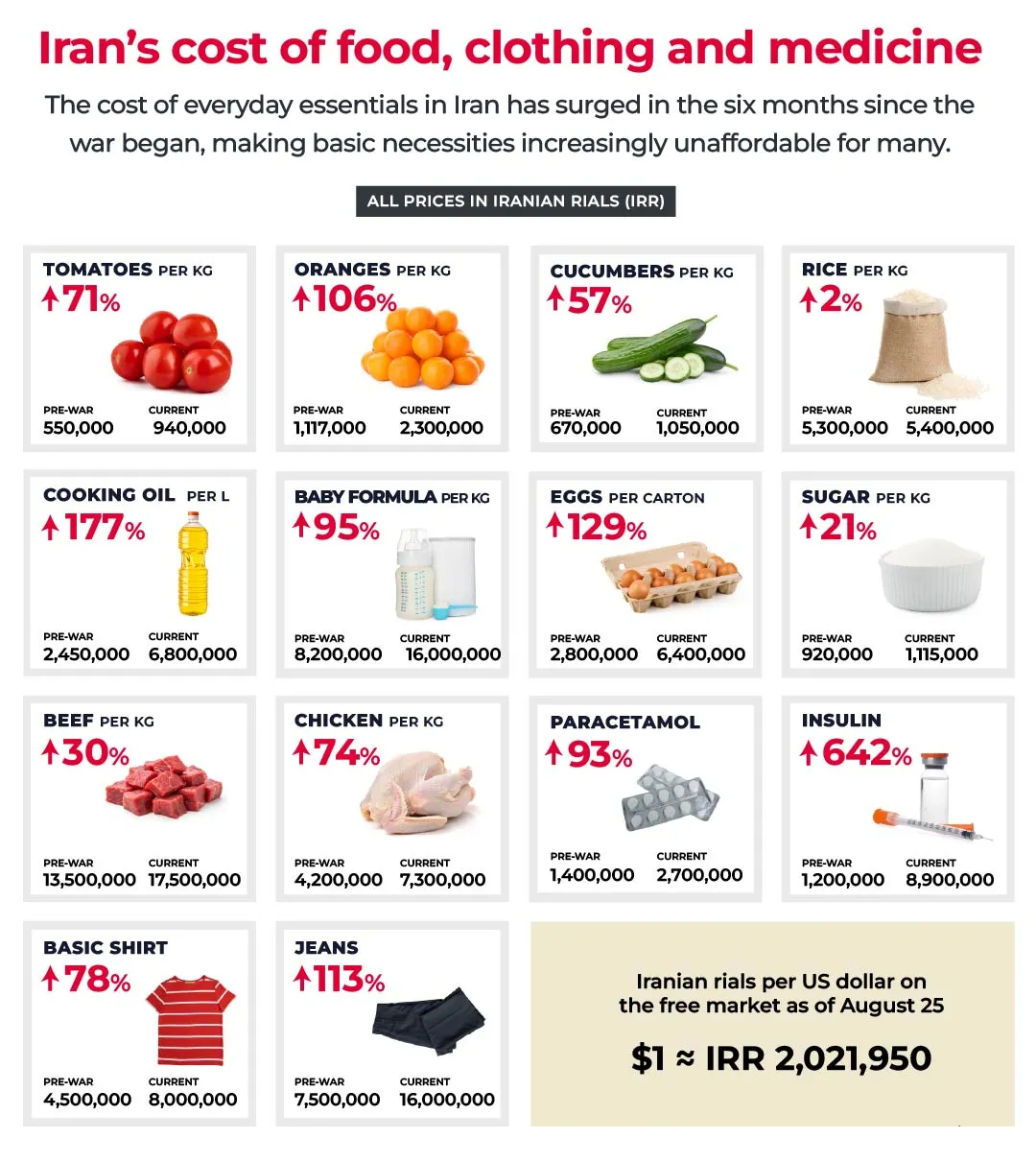
The Iranian rial has fallen to a new all-time low against the US dollar, dropping past 2 million rials to $1 on the free market after Washington launched its toughest sanctions yet in efforts to strangle Tehran’s economy.
Before the war, 2 million rials could buy about 4kg (9lb) of tomatoes, half a kilo (1lb) of chicken and a little less than a liter (34oz) of cooking oil.
Today, the same amount buys about half as much, with the average price of tomatoes increasing by 71 percent, chicken by 74 percent and cooking oil by 177 percent.
|
|
|
Trump says Iran has ‘massive inflation, economy falling apart’
Iran has “got massive inflation, their economy is falling apart”, Trump has said
|
|
|
Trump says both economic warfare and military strikes effective against Iran
Asked whether the US’s economic warfare against Iran would be more effective than its military attacks, Trump said: “I think they are both effective.”
Trump also reiterated his claim that the US is “winning very big” in the war and that Iran’s economy is “falling apart”.
|
|
|
Iranians will not back down in war with US: Pezeshkian
Iran’s president says the Iranian people will fight if necessary and will not back down in the war with the US.
Pezeshkian praised the June 17 MoU, which expired earlier this month, saying Iran was considered victorious because of it by the international community.
The president added that Iran’s problems stemmed from Washington’s economic sanctions, but that its people would not allow the US to succeed in its goals.
|
|
|
US wants to ‘portray progress’ resulting from its economic pressure on Iran
Abas Aslani, a senior research fellow at the Tehran-based Center for Middle East Strategic Studies, says that “the United States is insisting on economic suffocation and saying that there are no negotiations” with Iran, but at the same time, “they are sending regional mediators for back-channel messaging with Tehran.”
“This indicates that the US wants to somehow portray any progress in the negotiations as a result of the pressure coming from the US side,” he said.
“Trump needs a victory out of this, so in addition to the exit, I think it is an issue for him on how to spin it as a victory and sell it to the public,” Aslani continued, adding that Trump’s erratic negotiation style makes it difficult to predict how soon the war will end.
“There is no clear picture of what can unfold in the days or weeks to come because the US president is not a stable or predictable figure.”
|
|
|
‘Makes sense’ for US to try economic coercion to end Iran war
The Trump administration has “deployed three broad tools in regard to the Iranian question: diplomacy, economic pressure and military action”, Richard Weitz, a senior fellow at the NATO Defense College said, adding that the results have been varied.
“He [Trump] has not been able to achieve the negotiated settlement he wants,” Weitz continued, saying that “it makes sense now” for Washington to try economic coercion as it is less costly for the US than using military force. The senior fellow said that economic pressure has proved effective in the past and “may” prove effective in the future.
When asked about Trump’s flip-flopping rhetoric on Iran, Weitz said that the president’s approach has “mixed results”.
He said that such equivocating could make the credibility of any commitment uncertain, adding that “the Iranians may discount what President Trump says with regard to any deal”. It also “causes uncertainty among US partners such as Oman”, Weitz said.
Speaking from Washington, Weitz hedged his views, saying that “the US has always had trouble dealing with Iran so perhaps this kind of daring rhetoric and uncertainty may produce better results than the past”.
|
|
|
Hegseth says military action still possible in US-Israel war on Iran
US Defense Secretary Pete Hegseth says military options have not been ruled out in the US-Israel war on Iran after Washington launched “unprecedented” sanctions to economically isolate Iran this week.
In an interview on US cable channel Newsmax, Hegseth said “economic pressure we know hurts them the most right now, but by no means are we foreclosing using kinetic strikes anywhere in the Strait of Hormuz”.
|
|
|
US strategy to isolate Iran will not work ‘without the obedience of other countries’
Abas Aslani, a Tehran-based senior research fellow at the Center for Middle East Strategic Studies, has questioned the Trump administration’s demands thatIran’s trade partners cut off Tehran.
“Without the obedience of other countries, this [US] policy will fail. And so far we have been publicly hearing from China – one of those major countries that can impact the process. They have been saying they will not adopt the unilateral sanctions. This could be a sign for the United States that the success of their new pressure campaign is under question.”
Aslani added that US economic pressure against Iran could spark a regional escalation.
|
|
|
US sanctions ‘state and economic terrorism’ against Iran: Iranian FM
Iran’s Foreign Minister Abbas Araghchi has called new US sanctions an “act of state and economic terrorism” in a letter to the UN secretary-general, the Security Council and all UN member states.
Araghchi says the US is seeking to “cut Iran’s lawful economic ties with other states” after failing to achieve its objectives through war or persuade other countries to join its campaign.
“The sanctions deliberately harm civilians by restricting access to food, medicine, medical equipment, energy and other essentials, violating rights including the rights to life, health, food and an adequate standard of living”, the letter reads.
Iran called on the Security Council and UN member states to condemn and reject the “unilateral coercive measures and secondary sanctions” of the US.
He also told member states not to recognise or implement US sanctions.
The US must “immediately stop coercing third countries to alter their lawful economic relations” with Iran, it said.
|
|
|
US resorted to economic warfare after depleting ‘strategic weapons’: IRGC
Brigadier General Hossein Mohebbi, a spokesman for Iran’s Islamic Revolutionary Guard Corps (IRGC), says the US has resorted to economic sanctions against Iran because it ran out of “strategic weapons”, according to Iran’s official news agency (IRNA).
“The United States has suffered shortages in strategic weapons following its recent war against Iran, and replenishing some of its depleted stocks could take years,” Mohebbi told reporters in the city of Isfahan.
“Washington had expected Iran’s missile stocks to run out over time, but Iranian missile operations continued”, he observed. “A reduction in US strategic weapons stocks was one of the reasons Washington retreated.”
|
|
|
Ghalibaf welcomes China’s stance against US sanctions
Iran’s parliamentary speaker and chief negotiator, Mohammad Bagher Ghalibaf, has welcomed China’s “principled statement” against US sanctions imposed on Iran.
Ghalibaf said in a post on X: “We welcome China’s principled statement rejecting illegal sanctions against Iran.”
“The Iran-China comprehensive strategic partnership is rooted in mutual respect, win-win cooperation, and a shared vision for a multipolar world. This relationship needs no one’s permission,” he said.
|
|
|
Iran determined to keep economy afloat despite US pressure
Iranian authorities are adamant that their country’s domestic capacities will be able to keep their economy afloat, despite new economic sanctions targeting Iran unveiled by the United States this week.
The US aims to use the sanctions to force Iran into submission in the six-month-long war between the two countries. But Iran’s government says it is prepared, with Economy Minister Ali Madanizadeh referring to a two-year plan on state television on Monday night.
“We have our own tools, and we also know the game,” Madanizadeh said, in reference to Iran’s years of experience in trying to circumvent sanctions. He added that Tehran could potentially “go on the offensive” in a world where the US was no longer the only dominant force, and was confidant that many countries would effectively reject US President Donald Trump’s threats to cut off all links with Iran.
Stockpiling essential goods, foreign currencies and gold has become a main tactic for Tehran. The government has also been forced to resort to rationing energy in one of the most resource-rich countries in the world.
|
|
|
Iran’s foreign ministry mocks US economic isolation plan, calling it ‘pure parody
Iran’s Foreign Ministry has described the US plan to isolate Iran, dubbed Operation Economic Outcast, as “pure parody”.
In a post on X, ministry spokesman Esmaeil Baqaei said Washington’s policy made no sense as it was announcing sanctions that already existed.
The US “turns to Bahrain – a country with virtually no meaningful economic exchange with Iran – to prove that its “coalition” is working”, Baqaei said.
Earlier today, US Treasury chief Scott Bessent said he spoke with Bahraini Finance Minister Sheikh Salman bin Khalifa Al Khalif about maintaining financial pressure on Iran.
|
|
|
| |
|
|
| |
|
|
US, Iran both inaccurate on Strait of Hormuz status
Neither Washington nor Tehran is being fully accurate about the status of the Strait of Hormuz, according to former US diplomat Joey Hood.
“Donald Trump does frequently say that the strait is open, and he’s not entirely correct in saying that,” Hood said. “And the Iranian side is not entirely correct in saying that they’ve closed it.”
Hood said Iran lacks the physical means to seal the waterway outright. “It’s not like a highway, where you can drag a gate across it or place some sort of obstacle to block shipping,” he said. Instead, Iran relies on coercion: “What they do is threaten and then fire missiles on commercial ships that are unarmed in order to try to enforce their will.”
Hood said not all shipping is complying. Some vessels are “turning off their transponders, going at night, hugging the coast of Oman”, he said, while the US military tries “to protect them with whatever assets it can”.
|
|
Only maritime tracking data can tell who's right.
|
Gulf of Oman sees surge in ship-to-ship oil transfers, says tracker
At least 20 sets of ship-to-ship (STS) transfer sessions have taken place in the Gulf of Oman, according to vessel-tracking service TankerTrackers.com, marking a busy day of operations in the area.
STS transfers involved pumping cargo directly from one vessel to another at sea, commonly used to obscure a cargo’s origin or avoid port calls in sanctioned or high-risk waters.
In a post on X, the firm reported a running count of 25 million barrels of crude oil and additional refined products originating from “almost every country in the region”, excluding Iran. TankerTrackers later noted that it has identified five additional transfer sessions, including one involving Iranian liquefied petroleum gas (LPG).
The Gulf of Oman has increasingly become a focal point for ship-to-ship transfers as regional shipping navigates around the Strait of Hormuz.
|
|
Q&A
If Ship-to-ship (STS) activities in the Gulf of Oman means that they are operations where crude oil, gas, or refined products are transferred directly from one tanker to another in open waters outside the dangerous Strait of Hormuz, and ships manage to transit Hormuz by turning off their transponders, what sense does Iran's blockade of Hormuz have?
Iran's partial blockade of the Strait of Hormuz still makes strategic and economic sense to Tehran because turning off transponders (AIS) and conducting ship-to-ship (STS) transfers is expensive, highly risky, and limited in scale. While these clandestine workarounds allow some regional oil to leak out, the blockade achieves core Iranian objectives.
- Moving oil via "dark transits" and open-water transfers requires smaller shuttle tankers, extra handling, and specialized logistics, vastly driving up freight, fuel, and insurance costs for rival Gulf states and Western buyers.
- Turning off responders does not make a ship invisible to military radar; ships still face the threat of sea mines, drone surveillance, and direct strikes by Iranian forces, which suppresses overall export volumes well below normal capacity.
- By asserting a stranglehold over the waterway, Iran creates a persistent geopolitical flashpoint that rattles global energy markets, driving up international oil prices as economic retaliation against U.S. and Israeli actions.
- Iran actively penalizes non-compliant vessels by blacklisting tankers, threatening detentions, and imposing fines on those bypassing its mandated transit corridors.
|
Iran-Oman talks on Strait of Hormuz do not mean reopening
Ongoing talks between Iran and Oman over managing the Strait of Hormuz should not be read as a sign Tehran intends to reopen it, according to Mokhtar Haddad, editor-in-chief of the Iranian newspaper Al-Wefaq.
“Iran and the Sultanate of Oman have been pursuing this matter for some time. But that does not mean Iran will open the Strait of Hormuz,” Haddad told Al Jazeera.
He said Tehran has kept the two issues separate.
“Iran has always stressed that this track is separate from the issue of reopening the Strait,” Haddad said, describing a process beginning with “an interim agreement, after which a final agreement would be announced.”
He suggest that any such deal would not extend to reopening shipping.
“Does that mean reopening the Strait of Hormuz? No, certainly not,” he said, adding that “Iranian officials have confirmed this.”
Haddad said Iran’s position would hold “unless the US accepts the Iranian conditions contained in the memorandum of understanding,” saying that Washington “must return to implementing the memorandum of understanding” for the Strait’s status to change.
|
|
|
Oil prices drop to $86.80 a barrel
Oil prices are continuing their downward trajectory, with Brent crude futures dropping $1.78, or 2.0 percent, to $86.80 a barrel as of 00:27 GMT.
US West Texas Intermediate (WTI) crude went down $1.49, or 1.8 percent, to $80.87.
The fall came on new hopes that the Strait of Hormuz could reopen after Iran said it had resumed talks with neighbor Oman on managing the strategic waterway, according to news reports. Both benchmarks lost more than 3 percent on Tuesday.
|
|
|
US can sustain naval blockade, sanctions on Iran indefinitely
Joey Hood, former US envoy to Tunisia, said that shipping companies appear to be accepting the risk of transiting the Strait of Hormuz rather than halting operations.
“They can’t shoot all of our ships, so let’s just send them through and accept the risk that we’re going to lose one or two from time to time,” Hood said, describing the calculation of the countries and companies involved. He added that they “are not going to accept Iran’s new regional order”.
Hood said that carrier deployments have returned to normal after an extended stint in the region.
“The United States usually has 10 or 11 aircraft carriers deployed around the world or in scheduled maintenance,” he said, noting they typically “rotate every six months or so”.
He said the USS Abraham Lincoln’s deployment had been an exception, extending “several months beyond that normal schedule, because Donald Trump launched the war in late February”.
With carriers now back on a standard rotation, Hood said the underlying pressure campaign remains durable.
“The naval blockade and the economic sanctions are things that the US government can continue to do almost cost-free to itself and to its people for a very long time,” he said, pointing out that sanctions have “been in place for more than 40 years” and have “gotten tougher and more comprehensive over time”.
|
|
|
Strait of Hormuz ship traffic holds at low levels on Tuesday
Shipping data shows traffic through the Strait of Hormuz held steady at five commodity vessels on Tuesday, remaining well below average despite staying broadly unchanged from a day earlier, Reuters reports.
Citing preliminary data from the ship-tracking firm Kpler, Reuters said two tankers carrying liquefied petroleum gas and one tanker carrying bitumen exited the strait, while two empty product tankers entered the waterway. This compares with just a single vessel recorded passing through the strait on Monday and is well below the 10-day average of 15 vessels.
The figures remain initial estimates and could be updated, as some ships typically switch off transponders during the voyage, the report said.
|
|
|
IRGC says Iran, Oman agree on share of Hormuz and revenues
An IRGC spokesperson says Iran and Oman have reached agreements on their share of the Strait of Hormuz and its revenues, the semi-official Tasnim news agency is reporting.
“We entered into negotiations with Oman about a month ago and have reached results that have been accepted by both sides,” the spokesperson said.
“Agreements have been reached on the share of each country in the waters of the strait and the share of Iran and Oman in its revenues.”
The spokesperson said the US was obstructing negotiations between Oman and Iran, leading to them being delayed.
|
|
|
Japan reveals plan to diversify fuel supplies amid Hormuz closure
Japan has announced a plan to decrease its reliance on the Strait of Hormuz and develop a more reliable energy supply chain.
In 2025, Japan received 93 percent of its crude oil through the strait.
The plan was explained at a government meeting on Wednesday and its specific measures are set to be finalised by the end of the year, Reuters reported.
It intends to cooperate with oil-producing countries in the Middle East on pipeline projects to bypass the strait, in a move to be financially supported by the Japan Organization for Metals and Energy Security.
|
|
|
Iran, Oman agreement on temporary Hormuz
Iran and Oman have agreed on a temporary maritime route for ships travelling through the Strait of Hormuz, Kazem Gharibabadi, Iran’s deputy foreign minister for legal and international affairs, said on Tuesday.
However, he warned that the waterway will not fully reopen until the United States fulfils its commitments under an interim peace deal signed in June, which has since lapsed.
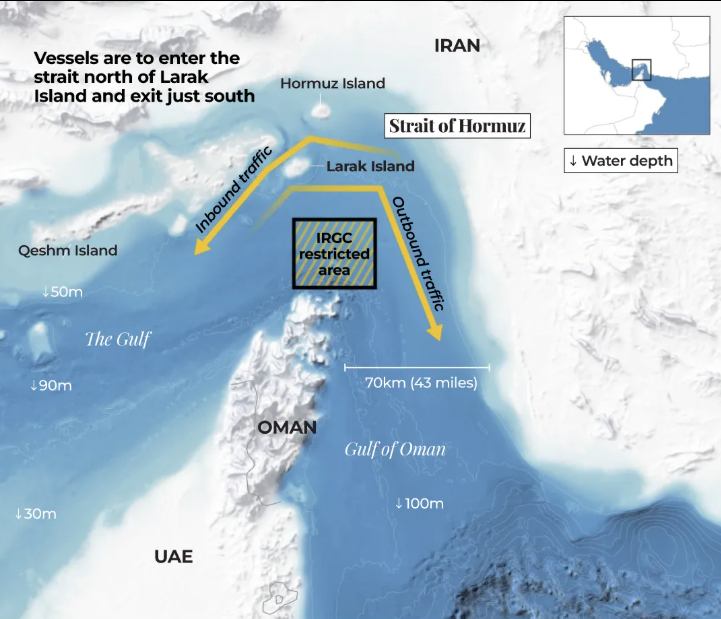
The US-Israel war on Iran, which began with strikes on Tehran on February 28, has effectively closed the Strait of Hormuz to shipping, sending global energy markets into crisis. The narrow waterway through which one-fifth of global oil and natural gas supplies from Gulf producers are shipped in peacetime has become a major bone of contention between Washington and Tehran, and disagreements over the critical channel continue to hinder any hopes of a lasting peace plan.
Since the US bombing of parts of Iran in July following more disputes over the strait, Iran has refused to hold direct talks with it. Even though active warfare has since paused again – replaced by a strategy of piling economic pressure on Iran – it has maintained that it will speak directly to only Oman about the future of the waterway, which passes through the territorial waters of the two countries.
|
|
|
Iranian warship confronts vessel attempting Hormuz transit: Fars news agency
Iran’s Fars news agency reports that a “large Iranian Warship” has confronted an Indian ship attempting to transit the southern route, also known as the “Oman corridor”, in the Strait of Hormuz.
“A few moments ago, an Indian oil tanker named ‘HAANA’ attempted to pass through the southern route of the Strait of Hormuz, known as the Oman corridor, but was deterred after receiving a warning,” reports Fars.
“No traffic has been observed on the southern route of the Strait of Hormuz in the past 24 hours”, it said.
|
|
|
Qatar’s PM to visit Tehran to discuss de-escalation, Strait of Hormuz
Qatar’s Prime Minister and Minister of Foreign Affairs Mohammed bin Abdulrahman bin Jassim Al Thani will arrive in Tehran on Thursday, where he will meet with a number of Iranian officials to discuss ways to de-escalate tensions and create conditions conducive to dialogue, the spokesperson for the Ministry of Foreign Affairs announced.
The visit comes in line with Qatar’s “firm position that the diplomatic path is the best means of resolving differences and promoting security and stability in the region,” the spokesperson said.
Discussions will also address freedom of navigation in the Strait of Hormuz and the need for it to return to the status quo prior to February 28.
|
|
|
Ships take big risks in Hormuz even as US claims strait was de-mined
US President Donald Trump has claimed that the US Navy has removed or detonated all sea mines in the Strait of Hormuz – the vital waterway in the Gulf, which Iran effectively closed after the US and Israel first launched attacks on the country nearly six months ago.
“Iran has been notified that any ship or boat placing new mines will be immediately and systematically destroyed,” Trump declared in a post on his Truth Social platform on Tuesday.
But on Wednesday, Iran’s Deputy Foreign Minister Kazem Gharibabadi said the strait remains closed, despite a temporary transit-route agreement with Oman, while he dismissed Trump’s claim that all mines had been cleared.
“No one except Iran knows the location of these mines,” Gharibabadi said, dismissing Trump’s comments as “only aimed at calming the markets” and warning that US mine-detection vessels entering the area would become “very good targets”.
|
|
|
| |
|
|
| |
|
|
US senator accuses Trump of profiting from Iran war via energy holdings
US Senator Chris Van Hollen has accused Trump of personally profiting from the war with Iran after a report by Democrats on the congressional Joint Economic Committee found that the president’s oil and gas holdings may have gained as much as $15.5m this year.
“Clearly, you’ve got a president who’s profiting from the illegal war that he started, along with Israeli Prime Minister Netanyahu,” the Democratic senator told MSNBC.
He said Trump had used the White House as a “pay-to-play casino” and had “pocketed over a billion dollars” since returning to office.
“He is grossly profiting off of a senseless war,” Van Hollen said.
|
|
|
US plans to restore diplomatic staffing at Middle East embassies
Reuters reports, citing sources familiar with the matter, that the US plans to restore diplomatic personnel to embassies across the Middle East after withdrawing them due to the war on Iran.
According to these sources, US missions in Israel, Jordan and Oman are expected to return to full staffing.
Staffing in the UAE, Saudi Arabia, Qatar and Lebanon is to be capped at 85 percent, and in Iraq, Kuwait and Bahrain at 75 percent.
“Based on our latest assessment, we are adjusting our staffing posture at certain posts in the Middle East to ensure we can continue advancing US foreign policy objectives while protecting the safety and security of our personnel,” a US State Department spokesperson told the agency.
Washington pulled staff out after joint US-Israel strikes on Iran began on February 28. Several Gulf missions came under Iranian fire, and the embassy in Kuwait closed for a period.
|
|
|
The Iran war is bringing cyber warfare into critical infrastructure
Media reports about a cyber attack that forced a British power plant offline for four days should be taken seriously far beyond the United Kingdom.
It gives us a glimpse of how the Iran conflict could develop, and signals to governments and businesses around the world that they need to be ready for a new battlefield.
This is the part of the Iran conflict that countries well beyond the Middle East need to consider. Geography offers far less protection in cyber warfare.
|
|
|
Iran will not wait out US election timeline for new fighting
Mokhtar Haddad, editor-in-chief of the Iranian newspaper Al-Wefaq, said recent US media reports regarding the US secretary of state’s remarks about not launching new strikes against Iran reveal a clear strategy to manage the current standoff through the midterm elections before resuming broader military action.
“He wants to say that the midterm elections matter to them. They want to get through this stage and then begin fighting,” Haddad said.
He said Iran would not wait for that timeline to play out.
“I do not think Iran will wait while America merely seeks to get past the election period and then return to broader fighting,” he said.
Haddad dismissed the announced blockade and sanctions as being substantively new.
“They are the same sanctions,” Haddad said, adding that anyone familiar with US policy “can see that this was nothing new”.
He said Tehran would respond if Washington fails to return to the memorandum of understanding.
“If it sees that America has not complied with the conditions and has not returned to the memorandum of understanding, Iran will take the necessary measures,” he said, pointing to “changes to Iran’s military outlook and doctrine during this period” as evidence of that posture.
|
|
|
Washington balances military pressure on Iran with diplomacy
Washington’s strategy on Iran runs on two parallel tracks: military pressure in the Strait of Hormuz and a standing openness to renewed negotiations, says Rob Arlett, former director of Trump’s 2024 campaign in Delaware.
“I believe that, ultimately, President Donald Trump has a clear strategy, operating on two tracks. The first is reopening the Strait of Hormuz, and the second is bringing Iran back to the negotiating table,” he said.
Arlett said the diplomatic option has remained available throughout the conflict, but he placed responsibility for the collapse of the memorandum of understanding on Tehran. “That memorandum was signed, but it was not implemented by Iran. Iran began targeting commercial vessels in the region, and that is what ended the memorandum,” he said.
“We must not forget that it was the regime that chose to end that memorandum.”
He said the Trump administration would judge Iran by its actions rather than its statements. “President Donald Trump is not focused on what Tehran says; he is focused on what Tehran does,” Arlett said, adding that it remains to be seen “whether Tehran is truly serious about returning to negotiations, or whether it is simply playing a game”.
Trump “will continue holding Iran accountable for what it does on the ground”, he said.
|
|
|
Iranian commander says army is increasing its defense capabilities
The commander of the army’s air defence force, Amir Alireza Elhami, says the wars Iran has recently experienced have provided the army with “good experiences” in terms of air defence.
He said that the country’s military has made some changes through the “valuable experiences” gained in the “40-day war” against Israel and the US, which started on February 28, adding that the knowledge gained was useful “in tactics, production of systems, arrangement and deployment of systems”.
“We are currently in a situation where we are relying on 100 percent Iranian capabilities, enhancing our systems and replicating the systems that proved successful in the 40-day war,” he added.
|
|
|
Iran says it upgraded military capabilities, rebuilt war-damaged infrastructure
Iranian army spokesperson Mohammad Akraminia says the country plans to shift to an offensive position rather than a defensive one to protect itself from the threat of more US attacks.
He added that Iran conducted several “preemptive operations” in the last phase of the war, adding that an Iranian strike on a US base in Jordan was an effective deterrent for US attacks.
Akraminia also said his government will give a financial reward to anyone who captures US soldiers if they enter Iran.
He announced that Iran has made significant progress in rebuilding infrastructure destroyed in the war and has received new military equipment.
As for the Strait of Hormuz, he said vessels will be subjected to Iranian surveillance before they arrive and will only be allowed to pass if Iran grants them permission.
|
|
|
Iran threatens ‘hostile media’ as ‘potential military targets’
Brigadier-General Abolfazl Shekarchi, the spokesperson for Iran’s armed forces, says hostile media outlets can be considered military targets, according to Iran’s state-run Fars news agency.
“Media outlets like BBC, Iran International, and Radio Farda are directly connected to [and supported by] Mossad, the CIA, and enemy intelligence organisations,” Shekarchi said.
He said individuals employed by these organisations “can even be included in the list of potential military targets because, in our view, these are not media outlets”.
“These pseudo-media outlets are the source of promoting, advertising, and spreading violence in the world, and they have disrupted the mental wellbeing of humanity,” he said.
|
|
|
Iran’s approach to US ‘cautiously calibrated’
It doesn’t seem like the Iranians have any sort of a timeline [for the war]. Iran has been practicing a sort of cautiously calibrated pragmatism.
On the one hand, Tehran says it is ready for diplomatic engagement. And over the past few days, there has been a lot of diplomacy.
High-ranking Iranian officials met a Pakistani delegation in Tehran this week, and an Omani delegation was in Tehran yesterday, discussing arrangements for the reopening of the Strait of Hormuz.
But on the other hand, Iran has been talking about military posturing, with officials even discussing preparations for another round of confrontation should diplomacy fail.
|
|
|
Dubai airport traffic plunges on back of Iran war
Passenger traffic at Dubai International Airport dropped by almost a third in the first six months of this year.
The airport’s operator confirmed on Wednesday that 31.5 million passengers arrived in the first half of 2026, compared to 46 million during the same period last year.
The US-Israeli war on Iran has significantly disrupted air travel in the Middle East, while pushing fares up globally due to rising fuel prices.
Tehran has repeatedly attacked its Gulf neighbours throughout the war in an attempt to further disrupt the global economy and put pressure on key US allies to lobby Washington to end the conflict.
|
|
|
Pezeshkian and Putin expected to meet next week
The Iranian and Russian presidents are planning to meet at the Shanghai Cooperation Organization summit (SCO) in Kyrgyzstan next week.
Iran’s ambassador to Russia, Kazem Jalali, said on Wednesday that Pezeshkian and Putin would meet on the sidelines of the summit, which will commence in the capital, Bishkek, on Monday.
|
|
|
The Bulgarian village that fears becoming an Iranian target
Bezmer, Bulgaria – The news landed on Saturday, bringing relief to nearby villagers: Two United States Air Force (USAF) refuelling aircraft had left Bulgaria’s Bezmer airbase.
The USAF said the Boeing KC-135 Stratotankers, intended to aid Washington’s war on Iran, had left to support “other operational requirements”.
The village had spent weeks worrying that the aircraft could make their area in southeastern Bulgaria a target for Iranian attacks.
|
|
|
‘Possible future war’ with US could spread across region: Iranian army spokesperson
Brigadier General Mohammad Akraminia told Mehr News Agency that Iran had previously said any “miscalculation” by its adversaries would draw an immediate response and could expand the geographical scope of the conflict.
“A possible future war could encompass new arenas,” Akraminia said, pointing to the Bab al-Mandeb Strait and a US base in Syria, saying both had become part of the conflict despite previously being outside its geographical scope.
Akraminia said a possible future war could also involve new areas of confrontation, including energy and communications infrastructure across the region.
|
|
|
Trump says he's ‘not in a hurry’ over talks with Iran
Trump has said that both economic and military action “are effective” and he is “not in a hurry” when it comes to negotiations with Iran.
“I have no time schedule; I’m not in a hurry.”
|
|
|
Washington ‘prefers diplomacy’ with Iran, US energy secretary says
US Energy Secretary Chris Wright says Washington “prefers diplomacy” with Iran but will destroy Tehran’s nuclear facilities “if necessary”.
Flanked by International Atomic Energy Agency chief Rafael Grossi, Wright made the comments just hours after Trump said that he is “not in a hurry” in negotiations with Tehran aimed at ending the US-Israel war on Iran.
“Iran has a nuclear weapons program, and our goal is to stop it,” Wright said in Washington, DC, at a maritime nuclear energy launch event, adding: “An agreement must be reached with Iran under which it renounces nuclear armament.”
This week, Washington launched an economic offensive against Tehran, dubbed “Economic D-Day” by Treasury Secretary Scott Bessent. It is intended to cripple Iran’s will to fight although US Defense Secretary Pete Hegseth says military options have not been ruled out.
The US has repeatedly used military force during periods when diplomatic negotiations were under way, striking dozens of targets as recently as July as mediators tried to wrangle the countries into a deal.
|
|
|
Ghalibaf defends negotiations with US in public letter
Iran’s parliamentary speaker and chief negotiator Mohammad Bagher Ghalibaf has defended talks with the US, saying negotiations are not a sign of retreat, but resistance if national interests are served, in a letter published by Iran’s state-run news agency IRNA.
“I must say that any rational action, any authoritative dialogue, or any attempt to take the nation’s rights from the enemy should not be incorrectly defined as compromise and passivity,” Ghalibaf wrote in response to criticism of the talks expressed in Iranian daily newspaper Kayhan.
“We must shoulder the responsibility of safeguarding and protecting the instruments of power so that we can consolidate the achievements of the war and safely lead the country through the serious disasters that the enemies have planned,” he said, adding that it would be wrong to evade the responsibility of negotiating with the US and to call every achievement of the negotiating team a betrayal.
|
|
|
Gulf countries foresee extended conflict as Trump downplays talks to end US war on Iran
Abdulla Banndar Al-Etaibi, an assistant professor in international affairs at Qatar University, says that “Trump is trying to show that he has the upper hand when it comes to the war, and he wants to reflect that he has the strategic patience that the Iranians practiced from day one.”
“So for the regional countries, it shows that this war is not ending soon,” Al-Etaibi said. “This could also be a signal by Donald Trump that he is in control, because if you look at the sanctions that the US Treasury forced, it was an escalation, but it was the first step in terms of capacity and the economic power that the US could reflect.”
The professor added that despite the US’s launch of Operation Economic Outcast, to isolate Iran economically, there is an opportunity for diplomacy after high-level regional visits to Tehran.
|
|
|
Trump says he thinks Iran’s supreme leader ‘seriously wounded’ but not dead
The US president has said he does not think Iran’s Supreme Leader Mojtaba Khamenei is dead, following months of speculation about his health.
“I don’t think he’s dead, and if he is, they [Iranian officials] are putting on a pretty good show because they talk about going back to talk to him all the time to get a final blessing on things,” Trump said in an interview with US commentator Glenn Beck.
Trump said he believes Iran’s supreme leader is “very seriously wounded”.
Mojtaba Khamenei has not been seen publicly since the US launched attacks on Iran on February 28, killing his father, longtime Supreme Leader Ali Khamenei.
|
|
|
Iran’s nuclear chief says attacked nuclear sites not secure for IAEA inspection
Iran’s atomic energy chief Mohammad Eslami has said the International Atomic Energy Agency (IAEA) would not be able to inspect Iranian nuclear sites that have suffered attacks in recent months until it develops a specific inspection protocol for such sites and their security is ensured.
In comments carried by Iran’s IRNA news agency, Eslami said that that Iran is still in a wartime situation and does not believe security of attacked nuclear sites is fully restored.
Eslami accused the US and Israel of pressuring the IAEA to inspect these facilities to assess the damage caused by their military operations.
|
|
|
War on Iran ‘game’ of who can endure pain longer
Tehran has “planned for a long-term war”, Mostafa Khoshcheshm, a professor at the University of Applied Sciences and Technology in Tehran, has said, adding that the country is prepared for a “war of attrition”.
“Iran is working on different ways to bypass the blockade” by opening up multiple roads and corridors in the east, north and central areas of the country, the professor said.
Tehran has returned to selling “one million barrels of crude oil per day”, circumventing Washington’s naval blockade on the Strait of Hormuz, Khoshcheshm noted.
The professor, citing data from the Central Bank of Iran, said Tehran’s crude revenues have increased by 50 percent between Nowruz, Persian New Year, and July compared to the same period last year.
When asked about the impact of sanctions on Iranian society, Khoshcheshm said “sanctions hurt, but they are not killing people”.
“This is actually a game of who can endure the pain for a longer time,” he said, adding, “Iranians believe they can do that because they have long endured such pains and worked out ways in order to diffuse the pressure of the sanctions”.
Even so, Tehran will “go for military action” if Washington insists on “making the situation harder”, the professor said, asserting that Trump cannot “kill Iran through such economic measures” and that the US president is just wasting time to “bring food prices down” and “refill American oil reserves”.
“Americans are addicted to sanctions,” Khoshcheshm said, adding that Tehran has been working for two decades on forming a “sanctions club” between countries that Washington has censured, including North Korea, Cuba, Russia and parts of the Chinese military.
|
|
|
Iran-Qatar talks to focus on mediation efforts: Iranian FM spokesman
Iran’s Foreign Ministry spokesman Esmaeil Baghaei says talks with Qatar’s top diplomat in Tehran on Thursday will focus on Qatari mediation efforts and initiatives, as well as other regional developments.
Qatari Prime Minister and Foreign Minister Sheikh Mohammed bin Abdulrahman bin Jassim Al Thani’s visit is “taking place within the framework of continuous Iran-Qatar consultations to expand bilateral relations and strengthen regional peace and security”, Baghaei said in a post on Telegram.
He said the Qatari diplomat will “discuss and exchange views with [Iranian] officials on the continuation of Qatar’s mediation efforts and initiatives and other developments in the region”.
|
|
|
Iran claims USS Abraham Lincoln failed mission of US power projection
Iran’s Foreign Ministry spokesman has suggested crew on board the troubled USS Abraham Lincoln are “tired” after its lengthy mission in the Middle East.
In a post on X, Esmaeil Baqaei said, “The Americans sent the USS Abraham Lincoln to the region to project power.
He then suggested the US aircraft carrier failed in its mission, saying, “After months of war – and more than 200 days without a single port call – it is now heading to Thailand for crew [rest and relaxation].”
Thai officials said the USS aircraft carrier is set to make a brief stop after more than 250 days at sea.
The prolonged mission raised concerns about the wellbeing of the ship’s crew, with families of the sailors reporting a deterioration in the mental health of the crew and shortages of essential supplies, including food and hygiene products.
|
|
|
