| Highlights from yesterday |
|
Comments |
- Qatar’s Prime Minster Sheikh Mohammed bin Abdulrahman bin Jassim Al Thani has met with officials in the Iranian capital to discuss critical issues such as the Strait of Hormuz, amid international hopes for renewed dialogue between the US and Iran to end the conflict.
- Iran says it is preparing a list of conditions to open the Strait of Hormuz following mediator requests, pointing out that the US must first take practical steps to fulfill these demands before the waterway reopens.
- A US government source told said that any agreements between Iran and Oman are of no interest to the US. The source reiterated that the Strait of Hormuz is open and all mines have been removed, while adding that there are no ongoing or scheduled negotiations with Iran and that the naval blockade remains in place.
- Iran’s chief negotiator and Parliament Speaker Mohammad Bagher Ghalibaf told Qatar’s prime minister that the Trump administration makes incorrect decisions driven by misinformation, which wastes US resources and destabilizes the region.
- Pakistan says it does not consider itself bound by US sanctions on Iran because Washington’s unilateral measures do not adhere to international law, pointing out that issues should be resolved through dialogue.
- US Central Command (CENTCOM) stated that American forces have redirected 75 commercial vessels, disabled three and boarded two others to ensure compliance with the ongoing naval blockade.
- The UN nuclear watchdog chief Rafael Grossi said that there is no solid evidence indicating Iran is rebuilding its nuclear facilities following US and Israeli attacks, pointing out that talks on Tehran’s program remain stalled because of the war.
|
|
|
| |
|
|
| |
|
|
Qatar PM meets Iranian officials in Tehran amid a flurry of diplomatic efforts
Thursday was another busy day of diplomacy here in Tehran, highlighted by the visit of Qatar’s Prime Minister Sheikh Mohammed bin Abdulrahman bin Jassim Al Thani.
Iran’s security chief, Mohsen Rezaei said that Iran and Oman have basically agreed on the outline of a temporary shipping corridor that would pass through the Strait of Hormuz, partly through Omani waters and partly through Iranian waters.
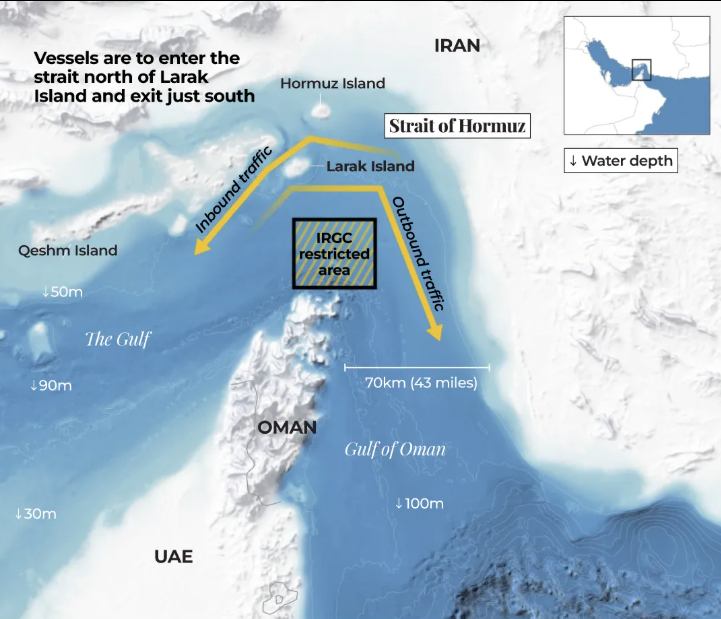
Crucially, however, that does not mean the threat to Hormuz is easing or that it is reopening soon. Iranian officials say mediators have asked Tehran to spell out exactly what it wants in return, and the Iranian side is said to be preparing that list of conditions. These include ending the war in the region, lifting US sanctions on Iranian ports, economic relief and compensation.
This is why Qatari diplomacy has become very important. Qatar’s prime minister met Iran’s Foreign Minister Abbas Araghchi and other senior officials in the capital on Thursday and discussed the temporary shipping corridor.
This route is crucial for other Gulf nations and their energy exports, as well as for creating a platform for dialogue between Tehran and Washington.
|
|
|
US military says no Iranian port activity without approval since blockade renewal
Admiral Brad Cooper, commander of the US Central Command (CENTCOM), has provided an update about the US military’s activities in the Middle East region amid the ongoing tensions with Iran.
- No ships have entered or exited any Iranian port without US permission since the renewal of the naval blockade.
- Over the past several months, US forces have assisted almost 1,500 commercial vessels in transiting the strait, carrying nearly 750 million barrels of crude oil destined for global energy markets.
- International navigation channels in the Strait of Hormuz separate ship traffic travelling in both directions to ensure safe passage.
- The US military has successfully removed sea mines planted by the Islamic Revolutionary Guard Corps (IRGC) in the Strait of Hormuz.
|
|
|
Iran’s fishermen caught between sanctions and Strait of Hormuz tensions
Seafood is a staple of local cuisines in Iran’s southern coastal cities. But the conflict and US sanctions have made life more difficult for fishermen, and driven costs up for everyone.
In Bandar Abbas, on the Strait of Hormuz, fishermen face multiple threats: US and Israeli bombing, sea mines and a US naval blockade. Fish market workers say fishermen are afraid to go out due to security concerns, while equipment such as nets and boat gear has become much more expensive.
Less fuel is reaching the boats, making matters worse, resulting in fewer fish being caught and driving up prices. Until the dispute over the Strait of Hormuz is resolved, there is much on the line for many in Iran’s southern coastal communities.
|
|
|
Crude slips towards weekly losses as oil benchmarks retreat
Crude benchmarks trended downwards on Friday, heading towards consecutive weekly losses despite a brief rebound in the previous session.
Brent crude futures shed 25 cents, or 0.3 percent, to trade at $89.45 a barrel as of 00:35 GMT. Meanwhile, West Texas Intermediate (WTI) contracts dropped 22 cents, also 0.3 percent, reaching $83.31.
The downwards movement places both benchmarks on track to close the week lower, with Brent declining 5.3 percent and WTI falling 4.3 percent overall.
|
|
|
Strait of Hormuz ship traffic drops as regional tensions persist
Strait of Hormuz shipping traffic remained low on Thursday amid ongoing tensions between Washington and Tehran, according to preliminary shipping data cited by Reuters.
Data from Kpler showed that only five commodity vessels transited the waterway, down from 17 a day earlier and below the 10-day average of 15.
Among the five vessels that transited were two medium-range tankers and one very large gas carrier, initial data from Kpler showed at 02:25 GMT.
The figures could change as some ships typically switch off transponders during the voyage.
|
|
|
US Treasury Secretary says naval blockade will crush Iranian economy
US Treasury Secretary Scott Bessent says the US naval blockade of Iranian ports will further weaken Iran’s economy, claiming Washington had helped move 130 million barrels of oil through the Gulf over the past 14 days.
In a post on X, Bessent wrote: “The Blockade and Operation Economic Outcast will crush the failing Iranian economy.”
“The USA has guided 130 million barrels out over the past 14 days. Iran: 0,” he added.
|
|
“The USA has guided 130 million barrels out over the past 14 days. Iran: 0,” he added."
Between August 14 and August 28, 2026, crude oil exports from the Persian Gulf rose as regional producers expanded workarounds to bypass blockades, reaching an estimated 6 million to 8 million barrels per day (bpd)
Workarounds means that oil from VLCC tankers are loaded into smaller tankers, a high seas operation better known as ship-to-ship or STS. They are very risky and very expensive.
No 130 million but 6 to 8 million barrels were not guided but pumped over onto smaller tankers.
Then, the video he uses does not contain evidence supporting his claim. It's a propaganda video.
|
Number of ships sailing through Hormuz remains low since Iran war began
Traffic through the strait, which normally carries about one-fifth of global oil supplies, has plunged since the US-Israel war on Iran began on February 28, according to ship traffic trackers.
|
|
|
Iran uses Hormuz as ‘geographical nuclear bomb’
Iran’s use of the Strait of Hormuz as a bargaining “chip” on the table had not been the case in previous tensions with the US and has become a “global problem” beyond the two sides, Ali Hashem says.
“The main point that everyone is turning around and circling around is opening the strait, while when the war started it was the nuclear file, it was the missiles program, it was Iran’s proxies or allies in the region.”
Whatever the situation was before the war will not be the same after it, Hashem said, adding that this “confrontation has gone to another level”.
“With the Strait of Hormuz, it’s clear that Iran has discovered a leverage and even some analysts describe it as Iran’s geographical nuclear bomb because by activating it and using it there’s actually no choice but to take it into consideration.”
|
|
|
Shipping traffic via Strait of Hormuz slips below 10-day average, data shows
Seven commodity vessels transited the Strait of Hormuz on Thursday, down from 17 a day earlier and below the 10-day average of 15, preliminary shipping data showed on Friday.
Among the seven vessels that transited were two medium-range tankers, one very large gas carrier (VLGC), one Ultramax vessel, one intermediate tanker and two chemical tankers, initial data from ship tracker Kpler showed at 03:15 GMT.
Four of the vessels were exiting the strait, including the two chemical tankers, the medium range and intermediate tanker. The VLGC, Ultramax and the other medium-range tanker were entering the strait.
The figures could change as some ships typically switch off transponders during the voyage.
|
|
|
White House official: US naval blockade ‘in full force’
The White House’s deputy press secretary Anna Kelly has said that the US’s naval blockade against Iran “remains in full force and effect”.
Kelly also said the US’s economic campaign against Iran, termed Operation Economic Outcast, “is under way to sever every remaining economic lifeline sustaining the regime”.
|
|
|
US-Israeli war on Iran war could hit global food production
The effects of the war on Iran are reaching far beyond energy markets. The cost of fertilizer, a key input for farmers worldwide, is being pushed up as a result of disruptions to gas supplies and shipping routes.
Higher costs could force some farmers to reduce fertilizer use, which could potentially affect crop yields and food supplies.
|
|
|
White House official: No talks with Iran ongoing or scheduled
US deputy press secretary Anna Kelly also reiterated US claims that the Strait of Hormuz is open and fully de-mined and that Washington is not engaged with any discussions with Iran.
“There are no talks or conversations going on, or scheduled, with the Islamic Republic of Iran,” said Kelly.
|
|
|
| |
|
|
| |
|
|
Iran continues supply of goods, energy despite pressures: Deputy speaker
Iran has continued supplies of basic goods, fuel and energy despite economic and security pressures, according to Deputy Parliament Speaker, Ali Nikzad, cited by IRNA news agency.
Nikzad said measures taken by the government had prevented disruption and instability in vital sectors as the country faces security threats and economic pressure.
His comments come after the United States this week announced a new campaign to intensify economic pressure on Iran, imposing further sanctions and threatening secondary sanctions against countries that continue doing business with Tehran.
|
|
|
US cannot ‘cut off Iran’s links with the outside world’
The war has changed the strategic landscape in the Middle East and convinced Iran that making concessions to US President Donald Trump would be a mistake, according to Tehran-based analyst, Ali Akbar Dareini.
“Iran has learned through war if you give any concessions to someone like Trump, you are done,” Dareini, of the Centre for Strategic Studies, said.
Iran had sought to increase the costs of conflict for the United States, while Washington was now “trying to suffocate Iran economically”.
“Trump was believing that if he shows strength and threatens military action, Iran will back down. Iran didn’t,” he said, adding that US envoy Steve Witkoff had acknowledged Trump was frustrated.
Iran would “not surrender” in the face of secondary sanctions, arguing that Washington would be unable to isolate the country completely. “You cannot cut off Iran’s links with the outside world, a country that has land and sea borders with 15 countries,” Dareini added.
|
|
|
Iran warns implementation of US sanctions amounts to complicity in ‘state terrorism’
Iran’s Foreign Ministry has condemned the United States’ latest campaign of economic pressure against Tehran, warning all countries that participation in them amounted to complicity in imposing one state’s unlawful will on independent states.
In a statement, the ministry argued that US sanctions violated the UN Charter and described Washington’s declaration of economic war as a continuation of the military conflict waged against Iran by the US and Israel.
It referred to the move as reprehensible “state terrorism” and a crime against humanity, saying they put the health and livelihoods of millions of civilians at serious risk.
It also accused the UN system and member states of failing to respond adequately to what it described as violations of international law by Washington and Israel, warning that this had encouraged further violations.
The ministry said Iran remained determined to use all available means to defend the country against what it characterized as a combined US-Israeli military and economic campaign.
|
|
|
Enforcing sanctions on Iran lies in US ability to pressure trading partners
When it comes to enforcing the latest sanctions on Iran, the difference this time is secondary sanctions. The US isn’t just saying Iran can’t use our system. It’s telling foreign banks, companies and governments that helping Iran can cost them access to the dollar system.
The US Treasury has said it has mapped out Iran’s evasion networks. The department says it has identified the facilitators, shell companies, shipping routes and financial channels that Iran uses, and it’s promising faster, more systemic enforcement against them.
But the enforcement challenge is, in fact, real. Iran has decades of experience evading sanctions, and China still buys the bulk of its oil.
So, the fundamental question now is whether Washington can persuade, or coerce, enough of Iran’s remaining trading partners to make those workarounds economically untenable.
We know that President Trump has been involved in a pressure campaign all week long, calling foreign leaders and turning up the heat.
|
|
|
Trump’s economic war against Iran is ‘more sound bite than sound policy’
Former senior US diplomat Alan Eyre says President Donald Trump’s economic campaign against Iran is “unlikely to yield the results” he wants.
“We’ve been sanctioning Iran for decades, so I find it hard to believe that there’s a whole level of sanctions pressure that we haven’t used until now,” Eyre, who helped negotiate the 2015 Iran nuclear agreement, said.
Eyre said the sanctions the US is introducing are essentially “secondary sanctions” that will test whether Washington can exert enough pressure on China to stop it from dealing with Iran. “And the answer is most probably no,” he said.
“So, this latest initiative by the [Trump] administration is more sound bite than sound policy.”
|
|
|
Iranian exports and imports decrease by up to 35 percent due to US sanctions, says Pezeshkian
Iran’s exports and imports have decreased by 25 to 35 percent because of US sanctions and blockade against the country, said Iranian President Masoud Pezeshkian in a sit-down interview for Government Week, a nationwide observance of government initiatives and achievements.
If the sanctions continue, the price [of goods] will increase as importers have to transport more expensively, he added.
He said the country has sold about 90 million barrels of oil during the implementation of the memorandum of understanding with the United States signed in June.
Pezeshkian demanded the US lift the sanctions on Iran and force Israel to stop its campaign against Lebanon.
Under the interim agreement, the banking sanctions and petrochemical embargo were to be lifted. If the US and Israel do not fulfill their commitments, neither will Iran, he said.
In the interview, Pezeshkian spoke about resource management and reducing fuel consumption as a part of the government’s agenda. 10 percent energy savings are equivalent to 900,000 barrels of oil per day, he said.
|
|
|
| |
|
|
| |
|
|
Trump keeps ‘all options’ open for Iran, says White House press secretary
White House Press Secretary Karoline Leavitt says Trump “continues to retain all options on the table” with regard to Iran.
“We’ve had Operation Epic Fury to destroy their military. Now we have Operation Economic Outcast to destroy their economy,” Leavitt said in an interview with Fox News.
“No negotiations are happening right now, and this will continue until the president feels that maybe they come to the table in a meaningful way,” Leavitt said. “We have not seen that yet.”
|
|
|
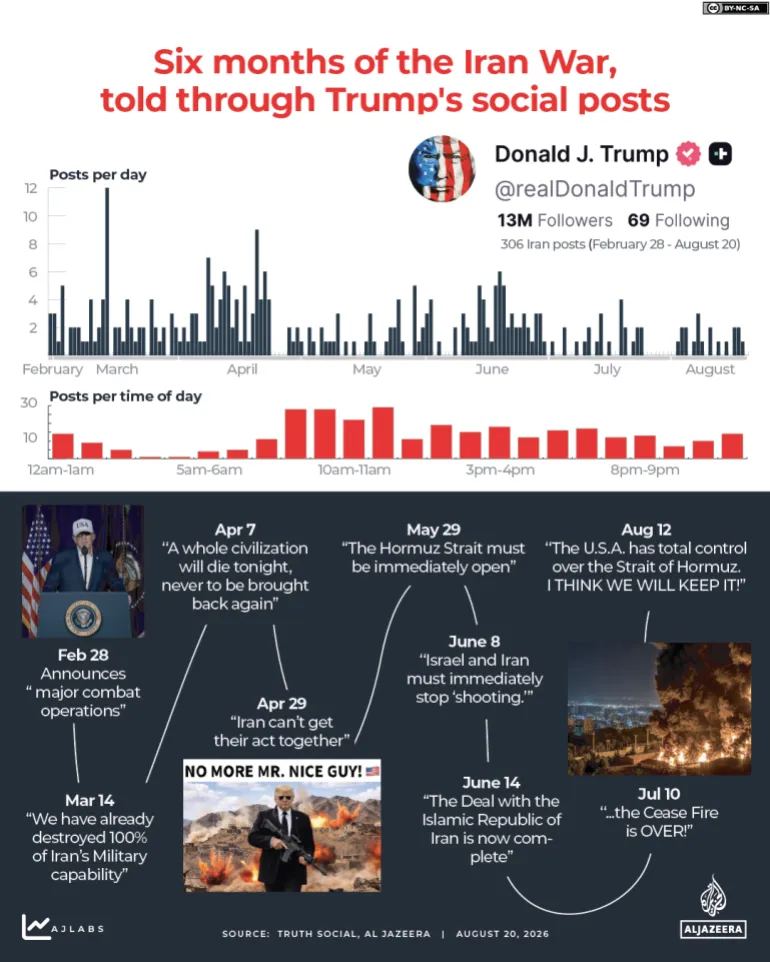
Six months of the Iran war – as told through Trump’s social media posts
This week marks six months since the United States and Israel launched joint strikes on Iran.
In that time, US President Donald Trump has published at least 319 posts mentioning Iran on Truth Social, his social media platform – roughly one every 14 hours.
Between February 28 and August 25, Trump posted at least 4,189 times on Truth Social, an average of 24 posts a day, or one every hour. One in every 13 mentioned Iran – 319 posts in total, or one every 14 hours.
While he posted at all hours, the most common time for his Iran posts was the morning in Washington, between 8 and 11am (13:00-16:00 GMT), corresponding to early evening in Tehran.
|
|
|
Six months of war between Iran, US leave Arab states facing tough questions
Analysts broadly agree the United States and Israel’s war on Iran will not see regime collapse in Tehran or a definite victory for Washington, but rather a dragged-out affair of stagnation and attrition.
The hope among the US leadership at the start of the war, which began after surprise Israeli and US attacks on February 28, was that mounting economic and military pressure on Iran would force a structural shift in Tehran. Six months on, it is clear this vision will not come about, and instead many are preparing for a protracted war and managed fallout.
Oil-dependent economies are still absorbing supply shocks after traffic in the Strait of Hormuz slowed to a trickle of pre-war levels following Iran’s attacks on shipping and a US blockade on Iranian ports.
|
|
|
War on Iran puts US relations with UN under strain
Six months after the United States and Israel launched military strikes on Iran, the war continues to strain relations between Washington and the United Nations.
UN Secretary-General Antonio Guterres condemned the strikes from the outset, but the organization faces limits in containing the crisis without US cooperation.
The tensions highlight the difficult relationship between Washington and the UN as the conflict continues.
|
|
|
| |
|
|
| |
|
|
Iran eager to maintain new ‘balance of power’, US wants return to status quo
Cyrus Schayegh, professor of international history and politics at the Geneva Graduate Institute, says that compared with other US wars in Afghanistan and Iraq, the war with Iran is “more important” as it has shifted the balance of power.
“This is the basic problem that we are facing right now in different chapters. There was a war, then military confrontations, now there are economic sanctions, then there are diplomatic attempts,” Schayegh said.
“But throughout, the basic problem is that Iran wants to keep the changed balance of power that is now a bit better for it than it was before,” he said.
Schayegh explained that the US wants the situation to go back to how it was.
“What happens in the Gulf and between the US and Iran is central for the Gulf and beyond, but it is also central for the presentation and the shape of US power all around the world,” he said.
|
|
|
Araghchi says US-Israel war failed, and has revealed US bases don’t ensure security
Statements Iranian Foreign Minister Abbas Araghchi made at the International Conference on Islamic Unity.
- Araghchi said the US and Israel thought the most recent war would be over in a few days, and have failed to reach their goals.
- The US and Israel “targeted the supreme leader of Iran and the country’s commanders, thinking that the Islamic Republic depends on individuals; while this system is like a sturdy tree whose roots are deep in the country’s society and history,” he said.
- Araghchi defended attacking US bases and targets in neighboring countries, saying Iran had announced they were a legitimate target in response to US attacks, and that Iran “never attacked Muslim countries or our neighbors”.
- The foreign minister said the most important result of the war is that countries have realized that “American bases on their soil have failed to ensure their security and are designed mostly to support” Israel.
- Iran wants “good relations with all Islamic countries, especially neighboring” ones. Araghchi said there “is no basis for disagreement” with Egypt, and
- Tehran is ready to restore relations when Cairo is.
- He said Iran wants good relations with “all groups and factions” in Lebanon, adding, “Of course, we do not like some of the policies of this government, we hope that the Lebanese Ministry of Foreign Affairs will show some more rationality.”
|
|
|
| |
|
|
| |
|
|
US senator says Trump is struggling to find exit from Iran conflict
US Senator Mark Kelly says President Trump is struggling to find an exit from the conflict with Iran, telling ABC News that Americans are paying the price through higher petrol and food costs.
The former Navy combat pilot argued the president faces a narrow set of options: escalating with ground troops, which he warned could cost thousands and thousands of American lives; walking away entirely; or applying economic pressure while trying to rebuild coalitions with European allies that he said have eroded over the past year and a half.
“This is a crisis of his own making,” Kelly said, adding that the president’s insistence he “knows more about everything than everyone” has left him with limited good options.
Kelly said dropping bombs that, in some cases, killed “innocent Iranian kids” was “not a good plan”. Still, Kelly said, “an economic approach and rebuilding our alliances” is a better way than just “escalating a kinetic action and certainly better than putting troops on the ground”.
|
|
|
Iranian official calls Trump schizophrenic after US territory claim on Strait of Hormuz
Iranian deputy foreign minister, Kazem Gharibabadi, suggested Trump suffers from schizophrenia after he posted on Truth Social last night that the Strait of Hormuz was a US territory.
“Its most common symptom is also #hallucinations and #delusions. Psychologists recommend that such patients should be under 24-hour supervision and receive treatment,” Gharibabadi wrote on X.
|
|
|
IRGC navy claims ‘decisive control’ over Hormuz
Iran’s IRGC has rejected the US’s repeated claims that the Strait of Hormuz is open, saying US officials are continuing to “lie” about the status of the waterway to influence the price of oil and “cover up their failures”.
In a statement carried by Iran’s IRIB broadcaster, the IRGC navy said that “the dominance of the fighters of Islam over this strategic waterway is completely decisive”.
“With all power and in complete authority, the Strait of Hormuz is closed to all ships that intend to transit without coordination with the Islamic Republic of Iran,” the statement added.
|
|
|
Iran’s FM says returning to diplomacy ‘isn’t impossible’ but depends on US
Iranian Foreign Minister Abbas Araghchi says diplomacy can get back on track if the US recognizes that “pressure doesn’t work.”
In a post on X, Araghchi said, “the US should build trust, speak respectfully, acknowledge our rights, and uphold commitments.”
Araghchi also said he had held what he described as “creative discussions” with Qatar’s Prime Minister and Foreign Minister Sheikh Mohammed bin Abdulrahman bin Jassim Al Thani.
|
|
|
Iran’s Araghchi says US and Israel unable to counter its missiles
Iran’s Foreign Minister Abbas Araghchi has said the United States and Israel were “powerless to counter” Iran’s missiles, which were developed using “indigenous technology”.
“This is not a slogan, but a reality; the images of targeted American bases, as well as targets in the occupied territories [Israel], showed the world the fact that they are unable to counter Iranian missiles,” he said, according to the state-run IRNA news agency.
|
|
|
| |
|
|
| |
|
|
For regional states, best way out of Iran war remains negotiations
Rashid Al Mohannadi, vice president at the Center for International Policy Research, says that while the war has affected regional economies in countries like Qatar and the United Arab Emirates, there are “a lot of financial buffers”.
“States have planned for similar scenarios. Qatar has been through years of a blockade. Qatar planned for the closure of the strait, military attacks, but, of course, the military term is that no plan survives first contact. But in this case, most of the plan did survive,” Al Mohannadi said.
“The position of regional states is that the negotiation table is the way to go. The Strait of Hormuz has to be reopened as soon as we can,” he said.
Al Mohannadi added that the war was not a regional but a global issue, with 20 percent of global fertilizer coming out of the Gulf.
“The only reasonable way forward is at the negotiation table. It’s obvious that the battlefield did not reap benefits for both parties,” he said.
|
|
|
Running out of options on Iran, Trump content to stick with ‘economic blockade’ strategy
The White House’s official position, outlined by Trump, is that the US is in control of the Strait of Hormuz, that Iran is not paying its soldiers and that Trump has no interest in talking at this stage.
The US president appears to be content to maintain this economic blockade – the economic strangulation of the Iranian state.
But Trump appears to have essentially run out of options. He has been through military conflict, he has gone through economic blockades and he has gone through attempts to create popular unrest and division within Iran.
And yet six months after the beginning of a foreign war, which Trump said during his campaign he would not commit the US to.
|
|
|
US escalates economic pressure while diplomacy falters, says military options remain on the table
Over the course of the last six months, week after week, month after month, the same question has been posed to US officials and US diplomats at the State Department: Where do these negotiations stand? What is it going to take to get Tehran and Washington back to that negotiating table?
From an outsider’s perspective, it really does appear as if diplomacy has lost momentum. There’s quite a bit of attention being placed on this six-month mark of this conflict between the United States and Iran. A lot of that has to do with domestic pressure. This is a widely unpopular war here in the United States.
There is also a lot of pressure from a diplomatic perspective. International partners are pressuring the United States also to bring this conflict to an end. On one hand, you have partners in the Gulf, the Middle East region, who would stand to benefit from a weaker Iran, but they also want to see this war come to an end.
We shouldn’t forget that the United States didn’t go into this conflict alone. There is pressure from the Israelis for the United States to maintain that maximum pressure campaign when it comes to Iran, to ensure that Iran is unable to develop a nuclear weapon, to ensure that its ballistic missile program remains impaired.
But the Trump administration, at this point, at least from the perspective of US officials at the State Department, is continuing to mitigate all these different pressures while also continuing to pursue and carry out its own strategy which at the moment has moved away from that kinetic force and towards economic sanctions, economic pressure against Iran, and we heard that from the Treasury Department earlier this week, the announcement of Operation Economic Outcast.
|
|
|
US force posture in the Middle East not expected to change anytime soon
The United States has the largest military buildup in the Middle East in decades, consisting of more than 50,000 service members and 20 warships.
US officials said the nation’s force posture will continue to be reassessed and re-evaluated. They added that it is not expected to change anytime soon. The US recently sent another aircraft carrier towards the Middle East, in addition to bringing in more aircraft and weapons into the region.
US President Donald Trump laid out four goals for the US-Israel war on Iran, which include destroying Iran’s nuclear program and ballistic missile capabilities, annihilating the navy and cutting off Tehran’s support for proxy groups.
Trump has claimed the US has “completely annihilated” the Iranian navy and has destroyed about 90 percent of Iran’s missile capabilities. He has also said the US will continue to keep the military option on the table.
|
|
|
US Democratic senator condemns war on Iran, calls for force withdrawal
Influential US Democratic Senator Adam Schiff has criticised the Trump administration’s war on Iran.
In a post on X, Schiff spelled out the cost of the drawn-out conflict to mark its six-month anniversary.
“Six months with no strategy and no end in sight. Six months of higher costs across the board. Six months of our service members being away from their families.”
He called for an end to the war and demanded: “bring our troops home.”
The US is heading towards midterm elections in November, and the fallout of the war is expected to feature high on the campaign trail.
|
|
|
Schumer calls Iran war a ‘failure’ that has drained US military resources
US Senate Democratic leader Chuck Schumer said six months of US war on Iran have drastically weakened the US militarily.
In a post on X, Schumer said, “War in Iran has accomplished nothing but the depletion of American stockpiles and the weakening of our military standing.”
Schumer blasted “Trump’s war”, calling it “disastrous” and a “failure”.
He reposted an Associated Press exclusive saying US Patriot missile stocks in Europe are severely depleted due to the US-Israeli war in Iran.
The Iran war will be an issue in the upcoming US midterm elections.
|
|
|
No sign of opportunity for renewed dialogue between US, Iran
The fact remains that there is no sign of any breakthrough that could create an opportunity to reopen dialogue between the US and Iran.
Trump insists that he is content to wait as long as necessary and is in no rush to do anything. Some of his advisors might not feel the same way. They continue to measure the impact of this war on the US people and the impact on upcoming midterm elections in November.
|
|
|
Iran says it has changed regional ‘power equations’
Iran’s acting Defense Minister Majid Ibn al-Reza says the country has “changed the regional power equations” and demonstrated that the era of “hit-and-run” attacks and threats against Iran is over.
In a post on X, later cited by Iran’s state-run IRNA news agency, Ibn al-Reza said a “ridiculous media show does not change the reality on the ground and the victorious side”.
He also urged Iran’s adversaries to read the country’s “several-thousand-year history”, adding that they would then understand that “one must speak to the Iranian nation in the language of respect”.
|
|
|
Gulf states deepening defence ties with Pakistan; Islamabad’s gains remain unclear
Pakistan and Kuwait signed a new defence agreement on Thursday, which Pakistan’s Ministry of Defence says significantly enhances a military cooperation framework in place since 2023.
Defence Minister Khawaja Asif and his Kuwaiti counterpart, Sheikh Abdullah Ali Abdullah Al-Salem Al-Sabah, signed the “Protocol Agreement-2026” in Rawalpindi.
Under the deal, Pakistan’s armed forces will help train Kuwait’s military, build its defence capacity and assist with border management, the ministry said in a statement.
The deal builds on an underlying agreement signed in June 2023 but only formally ratified by Kuwait last month.
|
|
|
Gulf countries seeking new security models
While the US-Israel war on Iran has crystallized existing divisions between the Gulf countries, they also came together and are trying new security models, according to Muhanad Seloom, a senior fellow at the Middle East Council of Global Affairs.
“The current model” of US bases in the region in return for security “has been tested under fire and did not deliver what the parties signed up for,” he said.
Some countries have since made “bilateral security and defence agreements, such as Qatar with NATO, Qatar with Turkiye, Kuwait with Pakistan”, he said, adding that Saudi Arabia, Turkiye and Pakistan now have a trilateral agreement. However, these new kinds of agreements still need to be tested.
The Gulf countries have also been affected differently by the war, he explained. The UAE, Kuwait, Bahrain and Qatar’s economies have suffered, whereas “Oman, Saudi Arabia did not suffer as much,” he said.
“But overall, I think what happened since last June made it clear to all these countries that they have became not only at the front line and the battlefield, but also they became the bank that paid the heaviest price for this war,” Seloom added.
|
|
|
| |
|
|
| |
|
|
Former US diplomat: Netanyahu sees ‘political value’ in Turkiye as enemy
Former US Ambassador to Turkey Francis J. Ricciardone says that Netanyahu sees “political value” in labeling Turkey as Israel’s latest enemy, in the run-up to legislative elections in October.
|
|
|
US imposes Iran-related sanctions on another individual, company
The US Treasury Department has announced two more Iran-related sanctions – one targeting an individual it says is linked to Iran’s Bank Melli, and another targeting a Hong Kong-based company.
The sanctions come after Treasury Secretary Scott Bessent earlier this week threatened an “economic onslaught against Iran’s financial connections around the globe”.
|
|
|
US Treasury secretary comments on penalties on Egyptian bank over links to Iran
US Treasury Secretary Scott Bessent says an Egyptian bank operation in the UAE is being punished for doing business with Iran.
In a post on X, Bessent said “Banque Misr UAE decided to find out the hard way, and today, we are taking the first step in holding it accountable for its continued, egregious support of the Iranian regime.”
Bessent said under Operation Economic Outcast, aimed at economically isolating Tehran, banks had been warned not to do business with Iran.
“We also warned that Iran’s enablers cannot continue to enjoy access to the U.S. dollar and the global financial system,” Bessent said.
Bessent reposted a Treasury Department statement announcing the sanctions on Banque Misr UAE.
|
|
|
Iranians will never ‘forget’ or ‘forgive’ Minab school attack: Iran’s FM
Iran’s Foreign Minister Abbas Araghchi has visited a Tehran art exhibition dedicated to the victims of the US’s deadly attack on the Minab school last February, reports Iran’s IRIB broadcaster.
Speaking at the exhibition, Araghchi said the Minab school students have become a “heroic symbol” for Iran and that the Iranian people will never “forget” or “forgive” the attack.
|
|
|
Iran’s supreme leader says actions harming ‘social cohesion’ forbidden
Iranian state media has released a statement from Supreme Leader Mojtaba Khamenei urging public unity.
In the statement, Khamenei called for Iranian authorities to avoid any “discouraging statements that weaken national and public motivation”.
“I declare unequivocally: engaging in anything that harms social cohesion is prohibited,” he continued.
|
|
|
More from Iran’s supreme leader
In his statement published by Iranian media, Supreme Leader Mojtaba Khamenei praised the government’s efforts to supply basic goods, repair damaged infrastructure and manage the country’s energy resources, despite mounting sanctions and other pressures.
He said the government should continue working towards a “stronger Iran”, including by tackling inflation and unemployment, managing imports wisely, boosting investment and reducing the role of the US dollar in the economy.
Khamenei said that while “the enemy’s conduct … is not without effect”, Iran could advance toward economic growth and prosperity through intelligent management of its affairs, greater reliance on domestic production and by drawing on the capabilities of the Iranian people.
|
|
|
Iran’s parliament speaker reiterates supreme leader’s call for ‘social cohesion’
Iran’s parliament speaker and top negotiator, Mohammad Bagher Ghalibaf, has posted a message endorsing a statement by Iran’s supreme leader warning against jeopardizing “social cohesion”.
“Any action that harms social cohesion is, for all of us, both nationally and religiously forbidden,” said Ghalibaf in a post on X.
“We pledge to the people and to the leader that, until our last breath, we will devote ourselves to serving the people and the progress of Iran,” he added.
|
|
If the Supreme Leader's call addresses an internal matter, why is the parliament speaker posting a similar message on X? Because most Iranians do not have access to that platform.
|
Trump ‘likely trying to avoid’ military escalation ahead of midterms
Trump is unlikely to pursue military escalation with Iran before the midterms for fear of the potential negative economic consequences, according to former US diplomat Alan Eyre.
“Once the midterms are over, that could be another event, even though military escalation against Iran is unlikely to achieve the goal he wants,” Eyre said.
“And let’s not forget the military maxim: ‘The enemy gets a vote,'” he added.
“Just because the US is trying to avoid military action before the midterms, doesn’t mean Iran is also. And in fact, it’s in Iran’s interest to strike before the midterms to increase the pain on Trump.”
|
|
|
Iran security chief echoes Khamenei’s call for social cohesion
Another Iranian official has issued a call for unity as the US-Israel war on Iran hits its six-month mark.
Mohsen Rezaei, the secretary for Iran’s Supreme National Security Council, echoed an appeal made by Supreme Leader Mojtaba Khamenei earlier on Friday, when he warned that any acts that harm “social cohesion” are banned.
In a post on the social media platform X, Rezaei called national unity a key part of Iran’s security strategy. His remarks discouraged antigovernment sentiment amid the ongoing war.
“The explicit emphasis of the Supreme Leader of the Revolution on refraining from ‘discouraging speech’, ‘illusory dichotomies’, and the fact that ‘committing anything detrimental to social cohesion is forbidden’ serves as a clear and unambiguous strategy for all,” Rezaei wrote.
“Today, national unity and social cohesion are among the most fundamental components of national power and security.”
|
|
|
Gulf states ‘have the most to lose’ as conflict drags on
Nawaf Obaid, former advisor to the Saudi government, has said Gulf states should consider working towards a “new security architecture” to bolster their defence as the US-Iran conflict drags on.
“We are already seeing the beginnings of it in the Mecca accord [between Saudi Arabia, Turkiye and Pakistan],” said Obaid, adding that smaller Gulf countries should also consider “some sort of union with Saudi Arabia”.
“The ones that have the most to lose and have lost the most so far are the Gulf states,” Obaid continued, adding that the US appears to be “very far away” from reaching an agreement with Iran and has “no strategic vision” in the conflict.
“They [Gulf states] have to think about what’s best for them going forward and what’s feasible,” he added.
|
|
|
US seeks $80bn more for war on Iran after spending $36bn
Washington has spent more than $36bn on the war against Iran and is seeking another $80bn from Congress.
Petrol prices remain elevated in the United States, while allies around the world remain rattled by the conflict.
Tens of thousands of American troops are still deployed across the Middle East with no clear end date in sight.
|
|
|
US Democrats are ‘squandering’ their Iran war political windfall
Democrats are failing to capitalise politically on President Trump’s missteps in Iran, Brian Katulis, senior fellow at the Middle East Institute, has said.
“[Donald Trump] has an advantage here. The Democrats actually do not have a focused message in any clear way on these sets of issues,” Katulis said.
Right now, the Democratic Party “doesn’t know what it stands for”, Katulis said.
Some members of the party are avoiding the Middle East entirely, while others prefer to speak exclusively about Israel and Palestine.
Three months out from crucial midterm elections, the “number one issue” in the US is inflation of petrol and food prices driven up by the war.
“We don’t have an opposition party that is actually framing it in this way,” Katulis said.
|
|
|
