Summary of developments in Palestine: July 7, 2026. 

Highlights from yesterday   Comments
  • Israeli forces launch drone attacks on Gaza, killing at least two people, as Palestinians stage protests outside al-Shifa Hospital in Gaza City, demanding Israel fulfill commitments to allow medical evacuations.
  • A four-month-old Palestinian boy has died in the occupied West Bank after Israeli forces at a military checkpoint west of Ramallah prevented his transfer to a hospital.


Palestinian prisoners released from Israeli prison

Yesterday, so on Sunday, several prisoners arrived at Al-Aqsa Hospital in Deir el-Balah, reuniting with their families following their release from Israeli prison.


Dr Hussam Abu Safia’s life in ‘grave danger’

An Israeli rights group is warning that the life of detained Gaza hospital director Dr Hussam Abu Safia, who was abducted from Gaza in 2024, is in “grave danger”.

Dr Hussam Abu Safia reportedly told his lawyer during his latest prison visit that “this is the last time you’ll see me”.

His family says his health has sharply deteriorated, while Palestinian prisoner authorities say he has been tortured in Israeli detention.

  • Abu Safia’s lawyer, Nasser Odeh, visited his client at the underground Rakefet interrogation facility in Nitzan Prison last week and reported a severe deterioration in his health “to the point of tangible danger to his life”, according to Physicians for Human Rights Israel (PHRI).
  • The group said lawyer Odeh documented severe injuries – including fresh bruises and wounds on Abu Safia’s head, eyes, ears and neck – as well as difficulty breathing and repeated loss of consciousness.
  • The wounds were so severe that Odeh struggled to recognize the doctor, the group said.
  • In June, Israel’s Supreme Court rejected an appeal by Abu Safia and ordered the doctor to remain in detention under Israel’s Unlawful Combatants Law without criminal charge.
  • The director of Gaza’s Kamal Adwan Hospital, who is 53 years old, has endured multiple stints in solitary confinement and is “suffering from critical health conditions”, according to his family. But Israeli authorities have denied him medical care.
  • He was abducted from the Kamal Adwan Hospital on December 27, 2024, after he had led the hospital through an 85-day siege by Israeli troops.
  • During the offensive, Israeli forces cut off supplies of food and water to the Palestinians in the area, while launching air attacks and shelling. Hundreds of civilians were killed, including Abu Safia’s son, Ibrahim, who died in a drone attack at the gate of the hospital.
  What does international law say about the Israeli Unlawful Combatants Law without criminal charge?

The "Unlawful Combatant" Category: International law, specifically the Geneva Conventions, divides captives into two clear, exhaustive categories: lawful combatants (who are entitled to Prisoner of War status) and civilians. Legal experts and human rights organizations argue that IHL does not recognize a separate legal limbo category of "unlawful combatant" to justify indefinite detention without trial.

Arbitrary Detention: Both the International Covenant on Civil and Political Rights (ICCPR) and IHL strictly prohibit arbitrary detention. Under IHL, internment is an exceptional security measure strictly for imperative reasons of security, not a punitive measure. The law’s failure to stipulate a maximum detention limit or require a standard criminal charge renders it unlawful arbitrary detention.

Denial of Due Process: Recent amendments to the law that expand the period before a detention order is issued (up to 45 days) and deny legal counsel for up to 90 days are cited by watchdogs as severe violations of fair trial guarantees and codification of incommunicado detention, which facilitates abuse.


What does international law say about the Israeli Unlawful Combatants Law without criminal charge, which is used against the Al-Shifa Hospital Director Dr Hussam Abu Safia?

Breach of Protected Status: Medical personnel, such as the directors of major healthcare facilities, are explicitly protected under the Geneva Conventions and international humanitarian law. Targeting, abducting, and holding them without charge subverts these protections.

Arbitrary Detention: The use of "secret evidence," denial of access to legal counsel, and prolonged administrative detention violate the fundamental human rights against arbitrary deprivation of liberty under the International Covenant on Civil and Political Rights.

Prohibition of Torture: Rights groups report that detainees held under this legislation—including prominent physicians—face inhumane conditions, enforced disappearances, and physical abuse, which constitute violations of the absolute prohibition on torture under the UN Convention against Torture.


‘I don’t see myself surviving, this is the end’: Dr Hussam Abu Safia

“They brought me here to kill me. I don’t see myself surviving. This is the end.”

Dr Hussam Abu Safia saved hundreds of lives during Israel’s genocide in Gaza.

Now, he’s in immediate danger after Israel transferred him to a notorious underground prison without charge or trial.


Instagram video

UN human rights group demands immediate release of Gaza doctor

A UN human ⁠rights ⁠body has called Israel’s detention of Gaza Dr ⁠Hussam Abu Safiya arbitrary and seeks his immediate release ⁠as rights groups and his lawyer warn his life is in imminent danger.

In its finding, ‌the UN Working Group on Arbitrary Detention said Israel’s actions contravened multiple articles of the Universal Declaration of Human Rights, as well ⁠as the International Covenant ⁠on Civil and Political Rights.

“The appropriate remedy would be to release Mr Abu Safiya immediately and accord him an enforceable right to compensation and other reparations, in accordance with international law,” it said.

It also voiced broader concerns ⁠the case, one of several it ⁠received, “may indicate a widespread or systematic practice of arbitrary detention in the country”.

The Israel Prison Service has rejected allegations ⁠that Abu Safiya and other doctors have ⁠been mistreated in ⁠prison despite mounting evidence otherwise.


Houthi official says US, Israel assassinated Khamenei over his support for Palestine

Mohammed al-Bukhaiti, a spokesman for Yemen’s Houthis, has told Iranian media that the US and Israel killed Iran’s supreme leader because of his efforts to support the liberation of Palestine.

Al-Bukhaiti described Khamenei as a symbol of resistance and freedom for nations seeking independence from the US and Israel’s domination, according to Iran’s Press TV.

“His intellectual and political vision across the Islamic world, together with his efforts to liberate Palestine, were among the main reasons the West became determined to assassinate him,” al-Bukhaiti said.


The United States was not part in the execution of the assassination of the Iranian Supreme Leader, as that took place before Trump decided to join the resumption of Netanyahu's preemptive 12-day war on Iran the same day of February 28, 2026.

The United States was only part in the preparation of the covert activity, which took place during the second half of 2025.

Palestinians in Gaza protesting over medical evacuations

Palestinian protesters gathered outside al-Shifa Hospital in Gaza City to demand that Israel allow evacuations for those who need urgent medical treatment abroad.

  • Under the US-brokered “ceasefire” agreement, about 21,000 Palestinians, including patients and their companions, should have been allowed to leave Gaza for medical care.
  • Only 7,500 people have been allowed to leave so far.
  • According to the World Health Organization, more than 18,500 Palestinians, including about 4,000 children, require urgent medical evacuation for life-saving treatment that is currently unavailable in Gaza.
  • Some 1,200 Palestinians have died while waiting for evacuation since Israel seized the Rafah crossing in May 2024, according to health authorities in Gaza.
  • Israeli forces destroyed 94 percent of Gaza’s hospitals during their genocidal war on the Strip, and killed at least 1,772 healthcare workers since October 2023.
   

Four people killed in Israeli drone attack on southern Gaza

At least four Palestinians have been killed and 16 wounded in an Israeli drone attack on a vehicle along al-Rashid coastal road in the al-Mawasi area of Khan Younis governorate in southern Gaza, according to medical sources at Nasser Hospital and al-Hilal Hospital.


Iran’s Ghalibaf says US memorandum is ‘difficult but possible’ to enforce

The Iranian parliament speaker and top negotiator says Iran remains deeply at odds with the US despite the recently signed memorandum of understanding, describing its implementation as “difficult, but possible”.

Ghalibaf made the comments during a meeting in Tehran with Mohammad Darwish, head of Hamas’s leadership council, who traveled to Iran to attend Khamenei’s funeral ceremonies.


Israel carries out more than 11,000 West Bank attacks in 2026

The Colonization and Wall Resistance Commission says Israeli forces and settlers have carried out 11,074 attacks across the occupied West Bank in the first half of 2026.

The sharp escalation reflects Israel’s campaign to expand settlements and force Palestinians from their communities, the Palestinian commission said in a report. It also said:

  • Israeli attacks were concentrated in the Hebron governorate, which recorded 2,224 assaults, followed by Ramallah and el-Bireh with 2,175, Nablus with 2,095 and Bethlehem with 1,137.
  • The group said Israel has moved beyond occupation and is now engaged in annexation to impose permanent control over Palestinian land.
  • Israeli colonists carried out 3,488 attacks in the first six months of the year, which killed 17 Palestinians: nine in Ramallah governorate, three in Nablus, two each in East Jerusalem and Hebron, and one in Salfit.
  • Colonist violence caused serious damage to 26 Bedouin communities.
  • Colonists established 42 new outposts on Palestinian land.
  • Israeli soldiers and settlers cut down or damaged 45,195 trees, including 26,395 olive trees.
  • Israel green lighted 34 new colonies in the first half of 2026, bringing the total approved by the current government to 103.
  • Israeli authorities seized about 4.4sq km (1.7sq miles) of Palestinian land and carried out 341 demolitions.


Smotrich says Israel begins ‘revolution in settlement’

Israeli Finance Minister Bezalel Smotrich says Israel has begun what he calls a “revolution in settlement”, adding that the push would not be limited to the occupied West Bank.

“I have news for you: we have just begun the revolution in settlement. We will also reach the Negev and the Galilee,” the far-right minister wrote on Instagram.

The comments come after the Israeli cabinet approved a plan on Thursday to establish 13 new settlements in the central West Bank.


Israeli soldier filmed tossing stun grenade into Palestinian vehicle

CCTV surveillance footage circulating on social media appears to show an Israeli soldier throwing a stun grenade into a vehicle carrying young Palestinian men.

The soldier stops their car at gunpoint, tosses the grenade inside, and then forces the driver’s door shut as the Palestinians attempt to escape before it detonates.

The attack occurred in Qalandiya camp, north of occupied East Jerusalem.


2 more Palestinians killed, others wounded in Israeli strikes on Gaza

Two Palestinians have been killed and others injured in a strike on a tent sheltering displaced people in al-Mawasi near southern Khan Younis city, the Nasser Hospital reports.

Local media, quoting medical sources, reported two people were killed and 15 wounded in the Israeli bombing.

In Khan Younis, two people killed when a vehicle on al-Rasheed Road was struck by a missile.

Elsewhere, three Palestinian fishermen were injured after an Israeli quad-copter drone dropped a grenade on their boat in waters off northern Gaza City.


Gaza emergency committee says it will dissolve

Gaza’s Governmental Emergency Committee says its leadership has submitted its resignation and is ready to fully hand over administration to the National Committee for the Administration of Gaza.

It said the move comes in response to the “higher interests” of Palestinians in Gaza citing the “continuing war, blockade, delayed reconstruction, and Israel’s refusal to withdraw from the territory”.

Preparations for the transfer of authority have been completed and the committee called on mediators to press for the National Committee to enter Gaza immediately and begin carrying out its duties, “thereby strengthening the resilience of our people and helping to heal their wounds”.


The resignation of the entire committee the failing and refusing to commit to the 20-point proposal for a ceasefire, which Trump had introduced in October 2025.


Hamas says handover made to stop Israel’s ‘war of extermination’

Hamas announced the dissolution of the body that governed Gaza for nearly two decades, clearing the way for a committee to implement civilian rule.

The move marks a significant political shift by Hamas, which has run Gaza since 2007 after winning legislative elections the previous year.

Since a “ceasefire” took effect in Gaza last October between Hamas and Israel, the group has repeatedly said it is prepared to step aside from day-to-day governance.

“The head of the government’s emergency committee, Mohammed al-Farra, has officially submitted his resignation,” Ismail al-Thawabta, head of Hamas-run Government Media Office, told AFP.

“He has also decided to dissolve the committee to facilitate the administrative and governmental transition to the National Committee for the Administration of Gaza [NCAG].”

The NCAG was created by the Board of Peace that Trump established when he brokered the “ceasefire” between Hamas and Israel in October 2025.

“Hamas has taken a new step in that it will no longer be in charge of the Gaza Strip in order to remove any pretexts for the occupation, which continues its aggression and war of extermination,” Hamas spokesman Hazem Qassem said.

“We hope for the swift entry of the National Committee for the Administration of Gaza, and Hamas affirms its readiness to hand over governmental responsibilities to the committee to ensure its success.”


At least 6 killed as Israeli attacks continue across Gaza

Ongoing Israeli strikes throughout the war-battered Palestinian territory despite a US-brokered “ceasefire”:

  • Israeli attacks continue across the Gaza Strip, with at least six Palestinians killed and more than 20 wounded.
  • At least two Palestinians were killed in an Israeli drone attack on a vehicle along al-Rashid Street in Khan Younis, according to medical sources.
  • A source at Nasser Hospital said two other Palestinians were killed in an attack on a tent sheltering displaced people in al-Mawasi near Khan Younis.
  • At least two Palestinians, a married couple, were killed in an Israeli drone attack on an apartment in Gaza City, according to a source at al-Shifa Hospital.
  • The latest attacks come amid tightening Israeli restrictions on Gaza and severe shortages of medical supplies.


Hamas says Interior Ministry staff to remain in place for security

Ismail al-Thawabta, director of the Government Media Office in Gaza:

“All Ministry of Interior employees will continue their work to ensure there is no security vacuum.”

The move comes after Hamas announced the dissolution of the body that governs the Gaza Strip and handed over the territory’s leadership to a team of technocrats, as stipulated by the US-brokered “ceasefire”.


Gaza national committee says ready to assume responsibilities

Ali Shaath, head of the National Committee for the Administration of Gaza, says the committee is fully ready to carry out its national responsibilities once the necessary means and conditions for its work are made available.

The committee is a temporary governing body authorised under UN Security Council Resolution 2803 to oversee day-to-day civil service and administration in Gaza after the war. It is appointed by, and accountable to, the Gaza Peace Council.

Shaath’s comments come after Gaza’s Governmental Emergency Committee said it would dissolve and hand over administration to the national committee.


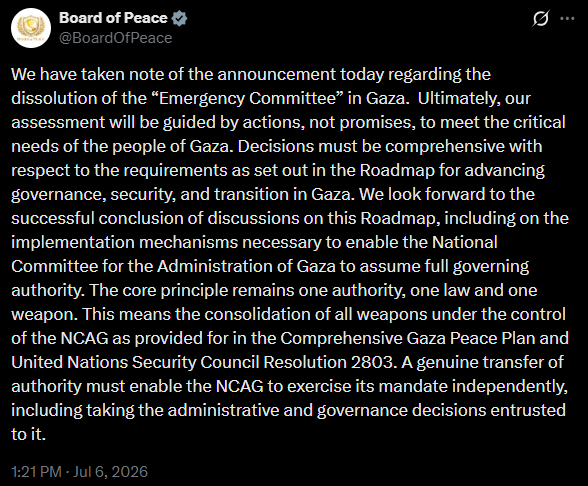
Gaza Board of Peace demands ‘actions, not promises’ from Hamas

The Board of Peace, controlled by President Trump and allies and with no Palestinian representation, reacted to the announcement in a post on X.

“We have taken note of the announcement today regarding the dissolution of the Emergency Committee in Gaza,” it said.

“Ultimately, our assessment will be guided by actions, not promises, to meet the critical needs of the people of Gaza.”


This so-called Board of Peace rarely condemns Israel’s daily violations of the ceasefire agreement signed last October. Israel continues to kill and wound Palestinians in Gaza on a daily basis.

Israeli officials dismiss Hamas announcement as a diversion

There is no official Israeli statement yet but senior officials have been speaking to the Israeli media.

They described the Hamas announcement as a media stunt, a diversion, a way for Hamas to buy time and avoid being blamed, according to the Israeli perspective, for not fulfilling the ceasefire agreement and the Trump plan.

Of course, Israel views its air strikes, its destruction, its continued expansion of the area it controls under its occupation in Gaza all as part of sanctioned activity, according to the Trump plan.

In fact, the Israeli prime minister recently said there would be no reconstruction in Gaza – nothing would move until and unless Hamas completely disarms. So it’s not just about civilian control over the Strip. Israel wants to see Hamas dismantled altogether.


The way how the Israelis describing Hamas' announcement as "diversion" is exactly an attempt to divert attention away from the fact that they systematically ignore their obligation when they sign a binding agreement, which the October 2025 ceasefire agreement is.

Hamas decision opportunity to move forward with ceasefire talks

Hamas is stepping back from directly governing civilian activities across the Strip and paving the way for the national technocratic committee to arrive as soon as possible and assume authority and responsibility, to try to reduce the expanding power vacuum that has been caused by the ongoing attacks by Israel.

A lot of people are seeing this as a move that is important at a critical time and shows responsibility on the part of Hamas, giving opportunity for the National Committee’s leadership and also responding to the demands of many of the regional countries as well as the mediators.

This gives them the opportunity to move forward with the ceasefire talks and hopefully transitioning to the second phase of the truce.


UN welcomes Hamas’s dissolution of Gaza governing body

The UN has “taken note” of Hamas’s dissolution of the body that has governed Gaza for nearly two decades.

The UN welcomes “any step that contributes to the implementation of the ceasefire agreement and advances the objectives reflected in relevant Security Council resolutions”, Stephane Dujarric, spokesman for the UN secretary-general, said.

“We continue to support efforts toward unified Palestinian governance under the Palestinian Authority,” Dujarric added.


Number of people killed in Israeli attacks on Gaza rises to 73,098

Gaza’s Health Ministry has released its latest daily update on the number of casualties in Israel’s genocidal war.

In a statement, the ministry said five people were killed and seven wounded in the latest 24-hour reporting period. Three people were recently killed and two bodies were recovered, it added.

The figures bring the number of those killed in Israeli attacks since the start of the war to at least 73,098, with 173,571 wounded.

Israeli attacks on Gaza since the “ceasefire” came into effect in October last year have killed at least 1,072 and wounded 3,463.


Scorching heat worsens suffering in Gaza’s displacement camps

After Europe, the heat wave has moved into the Middle Eats. Extreme summer temperatures now grips southern Gaza. Families sheltering in tents in Khan Younis are struggling to cope without electricity, fans or reliable water.


Developments in the occupied West Bank

  • Israeli forces have arrested four Palestinian workers at a landfill in Beit Anan, northwest of Jerusalem, and created a temporary military checkpoint in the area to search residents’ vehicles.
  • In occupied East Jerusalem, Israeli police and soldiers have stormed the town of Jabal Mukaber and distributed demolition orders against several citizens’ homes.
  • The Israeli army has fired tear gas and rubber-coated bullets in the towns of Beit Rima and Kafr Ein, northwest of Ramallah, while soldiers have raided the village of al-Mughayyir to the city’s northeast.
  • Settlers have attacked Palestinian vehicles with stones while gathering under the Yabrud bridge on the road leading to Silwad.
    Israeli forces have bulldozed land and paved a settlement road in the Nablus village of al-Lubban Ash-Sharqiya, razing land owned by Palestinians
  • Soldiers have stormed the Satah Marhaba neighbourhood in Al-Bireh.
   

Genocides the UN has ultimately failed to act on

The UN General Assembly is holding a plenary session on Monday to discuss nations’ responsibility to prevent genocide, war crimes, ethnic cleansing and crimes against humanity.

But the meeting comes amid Israel’s genocide in Gaza, the Rapid Support Forces’ and allied militias’ ongoing genocide in the Darfur region of Sudan, and other humanitarian crises around the world, which many critics say the international community has done very little to address.

While the UN meeting may result in protocols that countries need to follow to prevent future genocides, observers are skeptical that these will make much difference to victims on the ground.


Israel parliament advances bill for inquiry into October 7 attacks

Israel’s parliament has approved a bill in its first reading today to set up a commission of inquiry into the security failings that led to the October 7 attacks.

“The purpose of the proposed law is to bring about a full, thorough, and independent investigation of the events of the … October 7 massacre” and the genocidal wars that followed, an explanatory note to the bill said.


Israeli restrictions, closures continue to block aid into Gaza

Israel is restricting the flow of goods into Gaza at the Karem Abu Salem crossing, UN’s humanitarian agency (OCHA) reports.

Last week, only 42 percent of supplies routing through Egypt and 65 percent of those from Ashdod port could be offloaded at the crossing, which sits at the intersection of Egypt, Israel and Gaza and is known to Israelis as Kerem Shalom, OCHA said in its latest update.

The UN and its partners managed to deliver a total volume of about 42,000 pallets to Gaza in June, down from about 46,600 in May.

All other crossings remain closed for cargo, and restrictions on specific types of supplies persist, OCHA added.


Israeli forces fire tear gas during raid in West Bank

Several Palestinians experienced suffocation evening after Israeli forces fired tear gas during a raid on the West Bank city of Qalqilya, Wafa news agency is reporting.

Sources said Israeli troops entered the city through its main eastern entrance and fanned out into the northern area, including the Al-Marj and Al-Naqqar neighbourhoods.

Troops fired sound bombs and tear gas canisters toward a cafe near a checkpoint in the north of the city, causing several people to experience suffocation.


: July 7, 2026. 


Highlights from yesterday   Comments
  • Hamas announces the dissolution of its governing body in Gaza after nearly 20 years in power, paving the way for a technocratic committee to implement civilian government.
  • Israeli forces continue their attacks on Gaza, killing at least six Palestinians and wounding 20 others.
  • A UN human rights body has called Israel’s detention of Gaza doctor Hussam Abu Safia arbitrary and demanded his immediate release as concerns grow over risks to his life.


Hamas cedes Gaza governance as Israel’s deadly attacks continue

Hamas is dissolving its civilian governing body in Gaza after nearly 20 years and transferring its responsibilities to a new National Committee for the Administration of Gaza.

If implemented, the move would represent a significant shift in Gaza.

But since the announcement, Israeli air strikes have shown no sign of easing.

Attacks continued across the Strip throughout the day on Monday, and medical sources say at least six Palestinians have been killed. Among them were a husband and wife killed when an Israeli rocket struck their apartment building.

The proposal by Hamas leaves many questions unanswered: How the National Committee would be formed, who would oversee it, and whether it would gain broad public and international support remain unclear.

Those issues are expected to feature prominently in discussions on any broader agreement on Gaza’s post-war future.

The announcement may signal that Hamas is willing to step back from directly governing Gaza. Whether that evolves into a genuine transfer of power – or remains part of the ongoing negotiations – will depend not only on Hamas, but on the outcome of ceasefire talks and the broader political consensus over who will take their place once the fighting ends.

For Palestinians here, the debate over Gaza’s future is unfolding under the threat of military operations. Their reality remains defined by air strikes, displacement, and a humanitarian crisis that political proposals have yet to resolve.


Israeli officials dismiss Hamas dissolution as a ‘media stunt’

Israeli media is quoting senior officials as saying that the Hamas announcement (of the dissolution of its governing committee) amounts to a “media stunt”, a diversion, an attempt to deflect from Israel’s accusation that Hamas is not dismantling itself.

It is not disarming and thus not implementing the Trump plan for Gaza.

Over the past months, Israel has expanded its occupation of territory in Gaza to reach more than 70 percent of the Strip. Israeli Prime Minister Benjamin Netanyahu recently said there would be no reconstruction, no withdrawal, no talk of any of that until and unless Hamas completely disarms.

It is not clear how Israel wants that disarmament to happen without the presence of the local governance committee set up by the Board of Peace, a committee that has welcomed that announcement (by Hamas) for now.

And the fear, the anticipation, or the trepidation, rather, in Israel right now is that this announcement may open the door for pressure on Israel to implement more of its obligations under the ceasefire.


Hamas accuses Israel of trying to engineer ‘administrative vacuum’ in Gaza

The Palestinian group – which has announced the dissolution of its governing body in Gaza – says Israel is trying to engineer an “administrative vacuum” in the territory by continuing to block the UN-backed technocratic committee from taking over governance of the Strip.

Hamas said the dissolution of its governing body was a necessary step to facilitate the transition of power to the National Committee for the Administration of Gaza, or NCAG, which was formed in January but has been blocked by Israel from entering the Strip.

“The movement remains fully committed to implementing all provisions of the Gaza ceasefire agreement until administration is fully transferred to the National Committee,” Hamas said.

It added that Israel is attempting to obstruct the implementation of the US-brokered ceasefire agreement and create “a reality of administrative vacuum” in Gaza to deepen Palestinian suffering and undermine efforts to restore normal life in the territory.

Hamas went on to urge international mediators to pressure Israel to stop obstructing the handover.


Dissolution of Hamas’s governing body marks ‘important step’ for Gaza

The dissolution of [Hamas’s] emergency committee, the resignation of its head, Mohammed al-Farra, and the handover of all files, including the security file, mark important steps towards reorganizing Palestinian internal affairs.

Gaza’s Government Media Office is not simply announcing this; it is framing these measures as closing off pretexts for the occupation and clearing the way for the national committee, headed by Ali Shaath, to take over administration of the Gaza Strip.

Hamas welcomed the move and underscored its commitment to handing over all governance files, with full authority to the national committee.

Observers believe the success of this step will depend on the ability to overcome the obstacles imposed by the Israeli occupation, starting with the mediators pushing to allow the national committee’s entry into the enclave.

This marks the first time an effective dissolution of a governmental body run by Hamas has ever been announced, in a step paving the way for the transfer of the Strip’s administration to the national committee.

The real test remains whether this step translates into practical reality to pave the way for the national committee to ease the suffering of Palestinians in the Strip first, and help mend the political rift second.


Hamas urges mediators to press Israel on Gaza committee’s entry

Hamas spokesperson Hazem Qassem has told Al Jazeera that mediators and guarantor states must now pressure Israel to allow a transitional Palestinian technocratic committee to enter the Gaza Strip and take over the enclave’s administration.

“There was a meeting with the Palestinian factions, all of which welcomed this decision,” Qassem said, referring to Hamas’s move announced on Monday to dissolve its Government Emergency Committee and hand administration of Gaza to the National Committee for the Administration of Gaza (NCAG).

“There was also a meeting with civil society forces and with international parties, all of which welcomed this decision and considered it a step in the right direction,” he added. “Now the ball is in the court of the mediators and the guarantor states to pressure the occupation to allow the national committee to enter the Gaza Strip.”

The NCAG, a non-political body composed of Palestinian public figures, says it is responsible for the territory’s day-to-day civil affairs. It has operated out of Cairo since mid-January but has not yet been able to enter Gaza.


The latest on the ‘ceasefire’ in Gaza

  • Under the US-brokered deal last year, the last captives held in Gaza were freed in exchange for the release of hundreds of Palestinian prisoners, but Israel continues to flout its commitments, including restricting the entry of humanitarian aid and medical evacuations of thousands of sick and wounded people.
  • Israel also continues its near-daily attacks on Gaza, killing more than 1,000 Palestinians since the truce, and expanding its control to more than 70 percent of the territory.
  • Humanitarian conditions in Gaza remain dire, with the vast majority of its 2 million people living in overcrowded and squalid tent camps, infested with rodents, and with little access to healthcare.
  • Hamas has refused to disarm, citing Israel’s continued violations and warning that stripping weapons from an occupied people would make them an “easy victim to be eliminated”.
  • The technocratic committee to govern Gaza, led by former Palestinian Authority minister Ali Shaath, was formed in January, but it has not been able to enter Gaza.
  • A multinational International Stabilization Force is preparing to deploy between Israeli– and Palestinian-controlled areas in Gaza and has said that its first tactical vehicles have arrived at a base outside the Strip.
   

Palestinian FM presses UK to take tougher steps against Israel

Palestinian Foreign Minister Varsen Aghabekian Shahin has met UK Foreign Secretary Yvette Cooper in London and pressed the UK to take firmer action against Israel over its policies in the occupied Palestinian territory, the Wafa news agency reports.

Shahin thanked the UK for recognizing the state of Palestine, saying the move should mark the start of a clear policy towards ending the occupation, including of East Jerusalem. She welcomed recent UK measures, including sanctions on hard-line Israeli colonist groups, restoring funding for the UN Palestinian refugee agency, UNRWA, and easier UK medical travel for wounded and sick Palestinians from Gaza, according to Wafa.

But she said the measures were not enough given what she described as ongoing Israeli “crimes” in Gaza after more than 1,000 days of war.

Shahin also raised concerns about East Jerusalem, citing curbs on Palestinian residents and pressure on the city’s Christian community and churches, including high taxes on church-affiliated land. She urged London to impose comprehensive sanctions on illegal Israeli settlements and block settlement goods from UK markets, saying there was “no such thing as a good settlement and a bad one”, according to Wafa.


US lawmaker demands release of abducted Gaza hospital director

US Congresswoman Delia Ramirez has called for the release of Dr Hussam Abu Safia, the director of Gaza’s Al-Shifa Hospital, who was abducted by Israeli forces on December 27, 2024.

Ramirez said the doctor has been detained “for 18 months without charge or trial”, and cited reports that he is now in “critical condition after being beaten” by Israeli soldiers.

“We must put an end to the impunity and violations of US and international law. We must defend our shared humanity,” she wrote on X.

Ramirez also urged support for her Block the Bombs Act, which seeks to prohibit the US from selling, transferring, or exporting specific offensive weapon systems to Israel.

Her appeal follows a warning from Abu Safia’s lawyer, Nasser Odeh, who said the doctor’s health condition is in serious decline, posing a “tangible danger to his life”.

Odeh, who visited Abu Safia last week at the underground Rakefet interrogation facility in Nitzan prison, documented fresh bruising and wounds to his head, eyes, ears, and neck, along with breathing difficulties and repeated loss of consciousness.


  What does international law say about the Israeli Unlawful Combatants Law without criminal charge?

The "Unlawful Combatant" Category: International law, specifically the Geneva Conventions, divides captives into two clear, exhaustive categories: lawful combatants (who are entitled to Prisoner of War status) and civilians. Legal experts and human rights organizations argue that IHL does not recognize a separate legal limbo category of "unlawful combatant" to justify indefinite detention without trial.

Arbitrary Detention: Both the International Covenant on Civil and Political Rights (ICCPR) and IHL strictly prohibit arbitrary detention. Under IHL, internment is an exceptional security measure strictly for imperative reasons of security, not a punitive measure. The law’s failure to stipulate a maximum detention limit or require a standard criminal charge renders it unlawful arbitrary detention.

Denial of Due Process: Recent amendments to the law that expand the period before a detention order is issued (up to 45 days) and deny legal counsel for up to 90 days are cited by watchdogs as severe violations of fair trial guarantees and codification of incommunicado detention, which facilitates abuse.


What does international law say about the Israeli Unlawful Combatants Law without criminal charge, which is used against the Al-Shifa Hospital Director Dr Hussam Abu Safia?

Breach of Protected Status: Medical personnel, such as the directors of major healthcare facilities, are explicitly protected under the Geneva Conventions and international humanitarian law. Targeting, abducting, and holding them without charge subverts these protections.

Arbitrary Detention: The use of "secret evidence," denial of access to legal counsel, and prolonged administrative detention violate the fundamental human rights against arbitrary deprivation of liberty under the International Covenant on Civil and Political Rights.

Prohibition of Torture: Rights groups report that detainees held under this legislation—including prominent physicians—face inhumane conditions, enforced disappearances, and physical abuse, which constitute violations of the absolute prohibition on torture under the UN Convention against Torture.


Amnesty condemns ‘terrifying’ treatment of detained Gaza doctor

Erika Guevara Rosas, Amnesty International’s senior director for research, advocacy, policy and campaigns, has taken to X to condemn Israel’s abuses against detained Palestinian doctor Abu Safiya.

In her post, Guevara Rosas described the emerging accounts of his detention as “terrifying” following reports from his lawyer that he has been subjected to “torture, severe abuse, and prolonged solitary confinement”, which have left his life at “imminent risk”.

She further asserted that a doctor “who refused to abandon his patients during Israel’s Gaza Genocide‌ should never have been imprisoned in the first place”, emphasizing that he must be released immediately and that “states cannot remain silent while his life hangs in the balance”.


EU ministers to discuss trade measures against Israeli colonies

The European Commission will present an options paper this week outlining possible trade measures targeting products from illegal Israeli colonies, ahead of a meeting of EU trade ministers next week, according to spokesperson Olof Gill.

The paper is set to be discussed by EU member states at the Economic and Financial Affairs Council, which is scheduled for July 10.

The discussion comes in response to requests from the EU’s foreign policy chief, Kaja Kallas, and several member states to assess possible measures related to goods produced in Israeli settlements, which are deemed illegal under international law.

Israel’s trade with the EU exceeds 43 billion Euros ($49.2bn) annually, making the bloc its largest overall trading partner and accounting for roughly 32 percent of its global goods trade.

According to the legal nonprofit Global Echo, Israeli exporters routinely declare fruit and vegetables grown in illegal settlements in occupied Palestinian land and the occupied Syrian Golan Heights as produced in Israel in order to ship them to European markets.


Baby dies after Israeli troops block emergency journey to hospital

Four-month-old Palestinian baby Ahmad Marouf Zeid died on Sunday after his family’s urgent attempt to reach hospital was blocked by Israeli forces at a military checkpoint in the occupied West Bank.


Israeli forces arrest two Palestinians in occupied West Bank

Israeli forces have arrested two people during a raid on the city of Salfit in the occupied West Bank, according to the Palestinian Wafa news agency.

Citing local sources, it said that troops arrested Mahmoud Al-Bar, head of the workers’ unions in Salfit Governorate, and resident Islam Hassan Wael Yassin after raiding and searching their homes.

Israeli forces also stormed the city of Nablus at dawn and raided several homes in different areas of the city. They also raided the town of Doha, west of Bethlehem, this morning and raided a number of Palestinian homes, Wafa reported.


Over 1,500 patients have died due to critical shortages in Gaza

Gaza Health Ministry Director General Munir Al-Bursh tells Al Jazeera that healthcare facilities are enduring “bitter conditions,” revealing that more than 1,500 patients who needed to be transferred abroad for treatment have died since Israel’s genocidal war on Gaza began.

“We lose patients every day,” Al-Bursh says, adding that the ministry has “lost more than 50 percent of kidney patients due to the lack of medical supplies that the occupation has prevented from entering the strip to this day”.


Palestinian injured by Israeli bullets in Al-Ram, occupied West Bank

A Palestinian man has been injured by Israeli forces near the apartheid wall in the town of Al-Ram, north of occupied Jerusalem, Wafa news agency reports.

According to local sources, troops shot at Adham Salah Abu Fadala, 24, from the town of Burqin, south of Jenin, while he was in the vicinity of the apartheid wall this morning.

He was hit by two bullets in the feet, and was later transferred to the Palestine Medical Complex in Ramallah for treatment.


Several injured in settler attack in occupied West Bank

A number of people have been injured in an attack by Israeli settlers in the Hawara area east of Masafer Yatta and south of Hebron in the occupied West Bank, the Wafa news agency reports.

Local sources told Wafa that settlers attacked homes, beat residents and sprayed them with pepper spray.

The sources added that Israeli soldiers also arrested an elderly man identified as Ibrahim Ismail al-Jabour from the Hawara area. The detention coincided with the settlers’ attack.


Israeli drone strike kills one person in Al-Mawasi

One person was killed, and others were injured after Israeli bombing in the Al-Mawasi area of Khan Younis, southern Gaza Strip.

A medical source at Nasser Hospital in Khan Younis told Wafa news agency that several were wounded in the attack, including some in critical condition, and were brought to the hospital as a result of an Israeli drone strike on a group of Palestinians.


Israeli attack west of Gaza City kills one Palestinian

Israeli attacks have killed another person in Gaza, bringing the death toll to two, with several others wounded.

One person was killed, and others were injured in an Israeli strike that targeted a tent west of Gaza City, according to our correspondents on the ground.

Earlier, one person was killed in an Israeli attack that targeted the entrance to Al-Sumoud camp for displaced people, west of Khan Younis.


Palestinian Red Crescent Society says it assisted Gaza evacuation of patients

The charity has announced that it has, in coordination with the World Health Organization, participated in the evacuation of patients and their family members for treatment outside Gaza, Wafa reports.

The society explained that the process involved 31 patients and 60 companions, who were gathered at the association’s al-Mawasi field hospital in Khan Younis before being transferred and escorted to the Rafah crossing point.

It added that the operation falls within the framework of ongoing efforts to facilitate the evacuation of patients who need to complete their treatment outside Gaza, in light of difficult health conditions and a severe shortage of medical resources in the Strip.


One thousand days of genocide in Gaza

This week marks 1,000 days since Israel’s genocidal war began.

Gaza’s Government Media Office says more than 90 percent of the strip has been destroyed.

As of Monday, Gaza’s Ministry of Health put the Palestinian death toll since an October “ceasefire” at 1,072 with the cumulative figure since the start of the war in October 2023 reaching 73,098.

The killings did not pause for the anniversary. Israeli forces killed at least three Palestinians in a drone attack near al-Hilu station on July 1 and at least seven more over the following 48 hours.

Among them was a child killed by a quadcopter-dropped bomb at the Shujayea junction and 10-year-old Tareq Sabah, killed near Khan Younis, according to local field reports. Attacks on tents sheltering displaced people in al-Mawasi, which Israel designated a “humanitarian zone”, recurred throughout the week.


The way we determine whether the Israelis are committing genocide is by putting acts and activities in certain groups. Unfortunately, it has led to 94 groups and main groups. You can also say "main categories," "categories," and "subcategories."

The way we determine genocide is by sorting out collected and documented videos, photos, reports, screenshots, etc, to add to:

  • starvation: 15 related categories
  • killings: 19 related categories

The Israelis can claim as much as they like, the evidence that they commit genocide is simply there.

Israeli forces arrest seven fishermen off Gaza coast

The Israeli army has arrested seven fishermen while they were working off the coast of az-Zawayda town, in the central Gaza Strip, according to Palestinian news agency Wafa.

Israeli forces intercepted the fishermen at sea west of the town, before arresting them and taking them to an unknown location, local sources were quoted as saying.


India’s Modi reaffirms commitment to two-state solution despite Israel bonhomie

Prime Minister Narendra Modi has reaffirmed India’s traditional support for a two-state solution between Palestine and Israel during a visit to Indonesia.

New Delhi has for decades backed a two-state solution, pressing for Israel and a sovereign Palestinian state to coexist side by side.

But under Modi, India has veered sharply towards Israel. The prime minister has visited Israel twice, including on the eve of the war launched on Iran in February. Modi’s government has also on multiple occasions abstained from votes critical of Israel at the United Nations and has refused to criticise Israel’s genocidal war on Gaza.

Critics, including India’s opposition parties, have in recent years repeatedly accused Modi of abandoning India’s traditional support for a Palestinian state.


Three Palestinians killed in Israeli attacks in Gaza

Israeli attacks killed at least three Palestinians in Gaza on Tuesday, according to health officials in the territory.

A man was killed and two children injured in an air strike on the al-Mawasi area in Khan Younis.

Another Israeli attack also in Khan Younis killed another man, according to medics.

And a separate attack near Gaza City killed one person and injured five others when tents housing displaced Palestinians were targeted by Israel.


Israel’s far-right national security minister boasts about “starving Palestinians”

Israel’s far-right national security minister, Itamar Ben-Gvir, has boasted about starving Palestinian in Israeli detention facilities.

In a video released from a seminar held in Israel, Ben-Gvir said, “They wanted me to hand sandwiches to those terrorists. They used to come out fat; today they come in fat and leave thin. That’s how terrorists should come out.”

The far-right settler has been accused of abusing Palestinians held captive by Israel as well as foreigners who were detained by Israeli forces aboard international flotillas that were attempting to break the Israeli siege of Gaza.

In a post on X on Tuesday, Ben Gvir said the Israeli government had approved a budget of 500 million shekels or $1.6m for the country’s internal security agency, Shin Bet to establish a dedicated department to “fight against crime in Arab society”.


Israeli forces kill four people in Gaza

At least four Palestinians were killed by Israeli gunfire in several areas of the coastal enclave since morning, medical sources are saying.

At least 15 others were wounded, they added.


Germany warns Israel over continued settlement expansion

Germany’s foreign minister has warned Israel against continued settlement expansion in the occupied West Bank.

“We view continued settlement construction with great concern,” Wadephul said while standing next to Israeli Foreign Minister Gideon Saar in West Jerusalem.

“A de facto annexation of parts of the West Bank cannot be accepted internationally, and Germany cannot see how it would be legal,” Wadephul said.

He also urged Israel to release Palestinian tax and customs revenue it has withheld, saying weakening the Palestinian Authority does not serve Israel’s security.


Israel approved plans for 40,064 new illegal settlement housing units in 3 years

Israel’s government has approved plans for 40,064 new settlement housing units over the past three years, according to a report published by the Israeli peace advocacy group Peace Now and the Israeli rights group Kerem Navot.

The report said Netanyahu’s government “advanced de facto annexation” of the occupied West Bank at an “unprecedented pace” since taking office in December 2022.

The new settlement units could potentially house up to 200,000 people, according to the report.

Israeli settlements and outposts on occupied land are illegal under international law.


Israel demolishes six Palestinian houses in occupied West Bank

Israeli occupation forces have destroyed at least six houses and a shelter tent owned by Palestinians in the occupied West Bank.

Palestinian officials and witnesses said two houses that were being built in Shuqba, west of Ramallah, were demolished by Israeli bulldozers.

Israeli officials said these structures were being constructed in the so-called “Area C” without permits.

A three-storey house was demolished in the village of Jit, east of Ramallah. The home belonged to Khalaf Yamin, according to locals speaking to Anadolu Agency.

In Nablus, Israeli forces blew up a home belonging to the al-Zagha family in the area behind the National Hospital.

Two houses were destroyed by Israeli bulldozers in Hebron, where a residential tent sheltering five members of the Radi al-Jabareen family was also destroyed.


At least 6 people killed in Gaza by Israeli attacks

At least six people have now been reported killed and 20 wounded by Israeli gunfire across the coastal enclave.


An endless cycle of displacement and bombardment in Gaza

It’s been a dramatic period of escalation in Gaza, marked by a remarkable intensification of Israeli strikes.

These attacks have not only targeted what is left of standing structures, but have concentrated on makeshift tents. These encampments for the displaced are now effectively tent cities, where tens of thousands of displaced Palestinians have taken shelter.

The situation here remains bleak for many, despite Hamas announcing it was preparing to transfer authority to a new technocratic setup. For the civilians, there is no respite or an end to their misery, as they are still living under the threat of Israeli air strikes.

Despite being bombarded on a daily basis, people continue to move towards so-called Israeli military-designated safe areas. The displacement and the bombing fuels an endless cycle of fear and trauma for those still alive.


Child among seven people killed by Israeli attacks in Gaza

A child is among those killed by Israeli strikes on the Tal al-Hawa neighborhood southwest of Gaza City, the Palestinian Red Crescent Society says, according to Wafa news agency.

At least seven people have been killed in Israeli attacks since this morning.


Irish parliament passes bill banning goods from occupied Palestinian territories

A bill banning the trade of goods from the occupied Palestinian territory has been passed by the lower house of the Irish Parliament, the Press Association is reporting.

It was passed despite the opposition arguing that it did not go far enough to combat Israeli settlements on Palestinian land by omitting services.

Several amendments to the bill, including an amendment to include services in the ban, were voted down.

The bill prohibits the import of goods from “certain Israeli settlements”, in line with its international obligations as set out in the advisory opinion from the International Court of Justice from July 2024.


Rate of land seizure in occupied West Bank ‘unprecedented’

A transformation of the land is taking place in the occupied West Bank through Israeli land seizures and the forced expulsion of Palestinians. That’s the conclusion of a new report by Peace Now and Kerem Navot.

The organizations say that between 2023 and 2025, the Israeli government approved the construction of 185 illegal settlement outposts.

These outposts are spread across the West Bank and encroach on Palestinian communities. In just two years, 223km [138 miles] of new roads for settlers were built across the occupied territory. So-called agricultural and herding outposts, though small in size, took over nearly 1,000sq km [386sq miles] of Palestinian land during the same period.

Meanwhile, 118 Palestinian communities were forcibly displaced to make way for these rapidly expanding illegal outposts.

The rate of land seizure is unprecedented since the occupation began in 1967. According to the rights groups, it is further evidence of the Israeli government’s ongoing annexation of the occupied West Bank.


UN rights body calls for immediate release of Gaza’s Dr Hussam Abu Safia

The UN Working Group on Arbitrary Detention has called for the immediate release of doctor Hussam Abu Safia from Israel’s “arbitrary detention”.

In its finding, the UN human rights body found Israel’s detention of the Palestinian doctor “contravened multiple articles of the Universal Declaration of Human Rights as well as the International Covenant on Civil and Political Rights”.

“The appropriate remedy would be to release Mr. Abu Safia immediately and accord him an enforceable right to compensation and other reparations, in accordance with international law,” the findings said.

The director of Kamal Adwan Hospital in Beit Lahiya, northern Gaza, has been in Israeli detention since December 2024.