| Highlights from yesterday |
|
Comments |
- The US and Israel continue to bombard Iran, with explosions reported in Qom and Tehran, hours after Israeli attacks on oil facilities caused toxic smoke across the Iranian capital.
- An eighth US soldier has been confirmed killed in the Gulf region as Iran pledges to intensify its counterattacks, a day after US President Donald Trump paid tributes at a ceremony honoring US soldiers who died in the conflict.
- Saudi Arabia says two people have been killed and 12 others wounded in the central governorate of Al Kharj after a projectile fell on a residential area. Explosions were also heard in Iraq’s Erbil.
- The Arab League Council has held an emergency meeting to address the escalating conflict, with Qatar condemning Iranian retaliatory attacks on the region, and Oman calling for restraint from all sides as well as a ceasefire.
|
|
|
|
|
|
|
| |
|
|
Qatar sends alerts over ‘elevated’ threat
The Qatari Ministry of Interior has urged residents to stay indoors due to an elevated security threat.
|
|
|
Saudi Arabia intercepts drone heading towards Shaybah oilfield
The Saudi Ministry of Defense says its air forces have intercepted and destroyed a drone over the country’s Rub al-Khali desert that was heading towards the Shaybah oilfield.
The oilfield has the capacity to produce 1 million barrels of crude a day, according to Saudi Aramco.
The announcement came hours after the ministry said it had foiled ballistic missile attacks on the Prince Sultan airbase as well as drone attacks on Riyadh. At least two people have been killed in Saudi Arabia amid the Iranian counterattacks.
|
|
|
Qatar foils missile attack
The Qatari Ministry of Defense says the country’s armed forces have intercepted a missile attack that targeted the Gulf state.
The announcement came after the Qatari Ministry of Interior sent an alert to residents, urging them to stay indoors amid an elevated security threat.
|
|
|
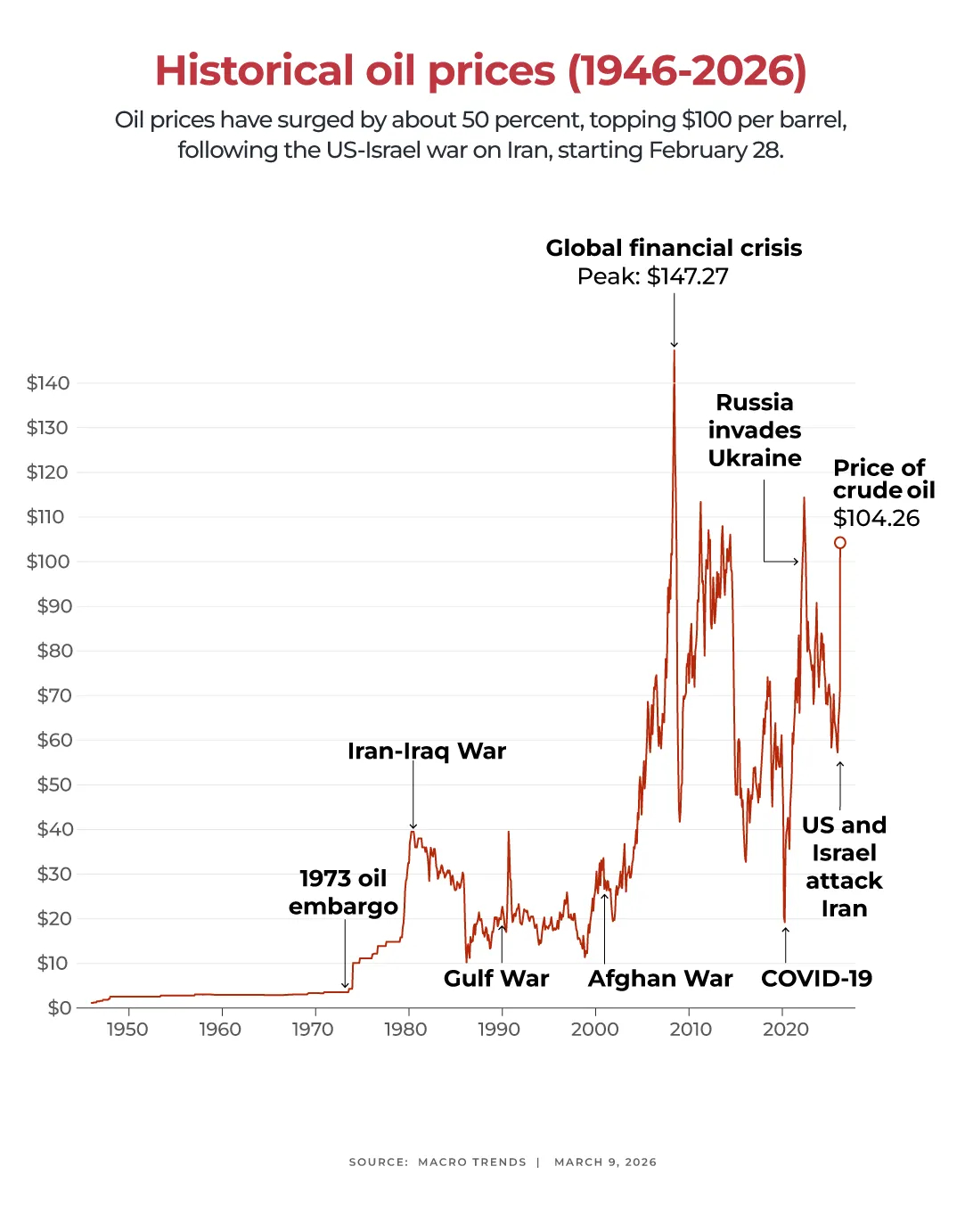
Oil prices soar over $100 a barrel
The price for a barrel of Brent crude has jumped to $108.77, marking the biggest daily gain since the start of the pandemic in 2020 and on top of a 28 percent rise last week.
The surge comes as the US and Israel’s war on Iran continues, and traffic through the vital Strait of Hormuz remains at a near halt, with Iranian forces attacking ships that dare to pass through.
“The global economy remains dependent on the concentrated flow of Mideast oil and natural gas through the Strait of Hormuz,” said Bruce Kasman, chief economist at JPMorgan.
“The near-term scenario is a near-term spike towards $120 bbl followed by moderation as the conflict soon subsides,” he told the Reuters news agency. “But absent a clear and decisive political resolution, Brent crude oil prices are expected to settle at an elevated $80 bbl through mid-year.”
According to Kasman, such an outcome could cut global economic growth by an annualized 0.6 percent for the first half of this year and push consumer prices up by 1 percent. He warned that if the conflict widens and drags on, oil prices could surge past $120 a barrel, potentially tipping the world into recession.
|
|
|
Asian shares slide as price of oil surges
Japan’s benchmark Nikkei 225 index has plunged by more than 6 percent after oil prices soared to more than $100 a barrel due to disruptions from the war in the Middle East.
The Nikkei was down by 6.2 percent at 52,166.92 shortly after trading began this morning. South Korea’s Kospi sank 6.3 percent, and shares in Australia and New Zealand fell by more than 3 percent.
The futures for the S&P 500 and the Dow Jones Industrial Average sank by 1.9 percent.
|
|
|
US Embassy in Riyadh orders nonemergency employees, families to leave
The diplomatic mission says the US Department of State has ordered the departure of nonemergency government employees as well as the family members of all workers from Saudi Arabia “due to safety risks”.
According to US media, the advisory marks the first time the agency has issued a mandatory departure order in Saudi Arabia since the US and Israel launched their war on Iran on February 28.
It comes amid a surge in Iranian attacks on Saudi Arabia.
Earlier, Saudi authorities said at least two people were killed when a projectile fell on a residential building in Al Kharj and announced foiling several missile and drone attacks on the capital, an airbase and an oilfield.
|
|
|
Bahrain says 32 people wounded in Iranian drone attack
The official Bahrain news agency says four of the victims were in critical condition and include children who require surgery.
It cited the country’s Ministry of Health.
It said the injuries were caused by an Iranian drone attack on the Sitra area, south of the capital, Manama.
|
|
|
Saudi Arabia says Iran will be ‘greatest loser’ if attacks continue
The Saudi Ministry of Foreign Affairs has condemned Iran’s “heinous” attacks on the kingdom and on other Gulf, Arab and Islamic countries.
The ministry said attacks on civilian sites, including airports and oil facilities, “indicates nothing other than a determination to threaten security and stability and constitutes a flagrant violation of international charters and international law”.
It also pushed back on Iran’s justifications for the attacks, dismissing as false Tehran’s claims that Saudi Arabia had allowed fighter jets and refueling aircraft to operate from its territory for the war. The ministry clarified that the aircraft in question were conducting aerial patrols to protect Saudi and GCC airspace from Iranian missiles and drones.
It also warned that continued Iranian attacks “signifies further escalation” and will have a profound impact on current and future relations.
“We emphasize that Iran’s current actions toward our nations do not reflect wisdom or an interest in avoiding the expansion of the cycle of escalation, in which Iran would be the greatest loser,” the ministry said.
|
|
|
Saudi Arabia downs four drones heading towards Shaybah oilfield
The Saudi Ministry of Defence says it has intercepted and destroyed four drones over the country’s Rub al-Khali desert that were heading towards the Shaybah oilfield.
This is at least the fourth such attack on the field in recent hours.
|
|
|
UAE responding to Iranian missiles and drones
The Emirati Ministry of Defense says the country’s air defences are responding to incoming missile and drone threats from Iran.
It said the sounds heard are the result of the interceptions.
|
|
|
Qatar, Bahrain, Saudi Arabia and UAE targeted in wave of attacks
Qatar was subjected to an Iranian missile attack.
The threat level was raised at about 3am local time, and roughly 10 minutes later, missiles were intercepted. There where 12 loud booms heard over the skies of Doha.
Bahrain state media say 32 Bahrainis were injured in a drone attack in the Sitra area. In Saudi Arabia, the Defense Ministry says several drones, targeting the Shaybah oilfields in the Empty Quarter, were intercepted. That is a facility run by Aramco, and it normally produces more than a million barrels of oil a day. The Defense Ministry also says it shot down two drones north of the capital, Riyadh, and took down some kind of projectile that was targeting the diplomatic area of the city.
The UAE has not escaped Iranian attacks either. They have said they are dealing with some kind of large fire in the Fujairah area caused by debris from some kind of projectile that was intercepted.
|
|
|
Qatar arrests 313 people for disseminating ‘misleading information’
The Qatari Interior Ministry says these people were arrested for “filming, disseminating and publishing misleading information”.
Those taken into custody were of various nationalities, it said.
|
|
|
IMF head warns of impact of prolonged war on global energy prices and inflation
Kristalina Georgieva, the director of the International Monetary Fund, has warned the war is testing “global economic resilience”.
Speaking at an event in Thailand’s capital, Bangkok, Georgieva said the conflict, “if proven to be prolonged, has obvious potential to affect global energy prices, market sentiment, growth and inflation”.
“And it would place new demands on the shoulders of policymakers everywhere,” she added.
|
|
|
Saudi Arabia says it intercepted drone heading towards oilfield
Saudi Arabia’s Defense Ministry says a drone heading towards the Shaybah oilfield was intercepted and destroyed.
|
|
|
Wave of attacks targets Gulf countries
At around 03:15 local time (00:15 GMT), the threat level was elevated here in Qatar.
A few minutes after that, we started to hear the sound of explosions that were due to interceptor missiles that were countering those missiles coming in from Iran. There where around 12 to 13 explosions. Then, about 10-15 minutes after that, the threat level was lowered again, with the alerts saying the threat had been eliminated.
The Ministry of Defense also issued a statement saying the armed forces had intercepted a missile attack targeting Qatar.
Beyond what’s happening in Qatar, there’s also been another wave of attacks in other countries throughout the region emanating from Iran.
In Bahrain, at least 32 citizens, including children, were injured in an Iranian drone attack on Sitra, an area south of the capital, Manama, according to state media.
In the United Arab Emirates, it’s been another busy night and morning for them countering attacks, with the Ministry of Defense saying air defences were responding to incoming missile and drone threats from Iran.
There was a fire in the Fujairah oil industry zone that was the result of debris falling from an intercepted drone.
|
|
|
Trading suspended in Pakistan Stock Exchange as market plunges
The week began on a grim note at the Pakistan Stock Exchange (PSX), as escalating Middle East tensions triggered a massive sell-off, sending the benchmark index plunging by more than 9,000 points in early trading.
According to a statement by the PSX authorities, a 5 percent decrease in the index resulted in a trade suspension in the market for 45 minutes.
The benchmark index shed a massive 9,780 points in its opening session to reach 147,715.95 points, reflecting a negative change of 6.21 percent compared with the previous close.
|
|
|
Asian markets take huge hits as economic fallout from conflict widens
All of the Asian markets have basically been heading in the wrong direction, mainly over fear of escalating oil prices.
These fears are being felt most in the big industrial giants of Eastern Asia – countries like Japan and South Korea that depend so much on importing energy for their massive industrial infrastructure.
Tokyo’s Nikkei index fall a full seven percentage points. The Nikkei is a big market, so it requires an awful lot of selling to go down a full seven percentage points.
Neighbouring South Korea’s KOSPI index also took an 8 percent drop. The government there has been looking into taking the unusual step of capping the price of oil to put a bit of stability back in the market. They haven’t done that for 30 years.
As all of the markets stay in the red, no one seems to be very reassured by words coming out of the White House in the US that this is a short, sharp shock and that oil prices will come down again.
|
|
|
G7 to discuss joint release of emergency oil reserves: Report
The finance ministers of the G7 will discuss today a joint release of oil from emergency reserves coordinated by the International Energy Agency, according to a report by the Financial Times.
Three G7 countries, including the US, have so far expressed support for the idea, the British publication reported.
The G7 is a group of leading advanced economies, comprising Canada, France, Germany, Italy, Japan, the United Kingdom and the US.
|
|
|
UAE says air defense systems responding to Iranian missiles and drones
UAE’s Ministry of Defense is saying that the country’s air defences are currently responding to incoming missile and drone threats from Iran.
It said the sounds heard in various parts of the country are the result of the systems intercepting ballistic missiles, as well as jets intercepting drones and munitions.
|
|
|
Trade continues through all but war-affected land corridors of Iran: Official
Amir Roshanbakhsh Ghanbari, deputy director of the Trade Promotion Organization of Iran, has been quoted by the Fars news agency as saying that import-export is ongoing through almost all land corridors, “except for some borders that are affected by war conditions”.
“We have also facilitated the trade process based on a directive we received from the Supreme National Security Council. In the field of exports, restrictions have also been imposed on some goods that the country needs in wartime,” he said.
|
|
|
Bahrain says Iranian attack sparked fire at Maameer facility, no injuries
Bahrain News Agency says an Iranian attack targeting a facility in the village of Maameer has sparked a fire.
The assault resulted in no casualties, the report said.
Efforts to put out the blaze are ongoing, it added.
|
|
|
Crude oil prices spike above $115 a barrel as Iran war impedes production, shipping
Oil prices spiked to nearly $120 per barrel before falling back slightly on Monday as the Iran war intensified, threatening production and shipping in the Middle East and pummeling financial markets.
The price for a barrel of Brent crude, the international standard, surged to $119.50 per barrel but was later trading at $112.98. West Texas Intermediate, the light, sweet crude oil produced in the US, spiked to $119.48 per barrel but fell back to $110.17.
About 15 million barrels of crude oil – approximately 20 percent of the world’s oil – are typically shipped every day through the Strait of Hormuz, according to independent research firm Rystad Energy.
The threat of Iranian missile and drone attacks has all but stopped tankers from traveling through the strait, which is bordered in the north by Iran, carrying oil and gas from Saudi Arabia, Kuwait, Iraq, Qatar, Bahrain, the United Arab Emirates and Iran.
Iraq, Kuwait and the UAE have cut their oil production as storage tanks fill due to the reduced ability to export crude. Iran, Israel and the US have also attacked oil and gas facilities since the war started, exacerbating supply concerns.
|
|
|
Bahrain’s Bapco Energies declares force majeure
Bahrain’s Bapco Energies has announced force majeure on group operations, according to state media.
Force majeure is a clause that frees parties from liability if any failure to meet supply obligations is due to events beyond their control.
The announcement comes after thick smoke was reportedly seen rising from the direction of the Bapco oil refinery in the country.
A witness told Reuters that smoke surrounded the facility after the government earlier said injuries and damage were sustained in the Sitra area as a result of an Iranian drone attack.
Bapco is Bahrain’s main oil refinery and a key facility in its energy sector.
|
|
|
Allowing Iranian ship to dock was right thing to do: India
Iran had sought India’s permission for three of its ships to dock at its ports, which was granted on March 1, India’s foreign minister says, adding that the government believed that it was the “right thing to do”.
One of the three ships docked at India’s southern port of Kochi on March 4, and its crew was at Indian naval facilities, Subrahmanyam Jaishankar told parliament on Monday.
|
|
|
Sirens activated in Bahrain, people urged to head to ‘nearest safe place’
The Interior Ministry says sirens have been activated in Bahrain.
“Citizens and residents are urged to remain calm and head to the nearest safe place,” it said in a brief statement.
|
|
|
Trading.com CEO warns oil price likely to hit $150
Peter McGuire, CEO of Trading.com Australia, says the speed and volatility in the oil price hikes are “dramatic”.
“The most important thing at the moment is the velocity of what we have seen as far as movements to the upside,” McGuire said, noting that as recently as Thursday, oil prices were between $75 and $80, before suddenly jumping to $90 and then spiking as high as $116 in Asian trading today.
While the price has fallen back to about $106, “the volatility swings over a given hour is just dramatic. This will impact consumers and, in the long run, inflation, if this was to last for weeks, or possibly a month or more”, he said.
Markets are reacting both to supply losses and to fears of escalation in the Middle East, where oil shipping through the Strait of Hormuz has come to a halt.
If more countries in the Gulf declare force majeure and shut down oil and gas production, “then you are going to see a spike to the upside, and $140-$150 [per barrel] is very achievable”, McGuire said.
He also said that reports that G7 finance ministers are discussing a possible joint release of oil from reserves through the International Energy Agency, as reported by The Financial Times, could calm market sentiment and reduce volatility.
|
|
|
Over 1,255 people killed, 12,000 injured in Iran in past 9 days: Official
Ali Jafarian, Iran’s deputy health minister, said that in Iran during the past nine days:
- More than 12,000 people have been wounded, and 1,255 people have been killed
- The victims’ ages ranged from eight months to 88 years old
- 200 women are among those killed
- 168 children were killed in the Minab elementary school
- 55 healthcare workers were wounded and 11 killed, including four physicians, two nurses and three emergency workers.
- The majority of those killed in US-Israeli attacks on Iran have died in explosions.
- The injured people mostly have two types of injuries: burns and crush injuries.
- Iran’s health system is strong enough for the country’s needs.
- Iran has medical universities that cover both health and education. Each province has a system that can work independently if needed. The Ministry of Health is supporting them.
- Pharmaceutical companies are working and producing all the medicines the country needs.
|
|
|
Qatari PM describes ‘big sense of betrayal’ over Iranian attacks
In an interview with Sky News, Qatari Prime Minister Sheikh Mohammed bin Abdulrahman bin Jassim Al Thani has described a “big sense of betrayal” by the Iranian leadership following Tehran’s attacks on Qatar.
“Just maybe an hour after the start of the war, Qatar and other Gulf countries were attacked right away,” Sheikh Mohammed said, adding that the assault took place despite statements from several countries in the region that they were not going to take part in any war against Iran, and despite concerted efforts to find a diplomatic solution.
Iran’s “miscalculation” to attack Gulf countries “has destroyed everything”, he said, adding that Qatar completely rejects the justifications and pretexts used for the escalation.
He also said it was shocking that Iran continued attacking Gulf countries even after President Masoud Pezeshkian apologized to them and said they would no longer be targeted as long as they did not attack Iran.
Still, he noted, Qatar “will continue talking to the Iranians and seek de-escalation”.
|
|
|
Two injured in Abu Dhabi as debris falls after interceptions
Abu Dhabi authorities say two people were injured in two separate locations by falling debris following an interception by the country’s air defense system.
A Jordanian national sustained minor injuries in the first incident, while an Egyptian national was moderately injured in the second, the Abu Dhabi Media Office said.
|
|
|
Gulf’s ‘haven status’ questioned amid regional crisis
Ahmed Helal, Middle East economics and political analyst in Qatar, has said that investors’ confidence will be shattered in the Gulf countries in the short term.
“The haven status of the Gulf has been called into question. The seal has been broken that the Gulf is insulated from regional conflagration,” Helal said, adding that the same happened in 2025, during the 12-day war with Iran, when Qatar was targeted and drawn into the conflict.
“I think this crisis will spare no economy in the region. If you’re an oil exporter, yes, in the short term, your coffers will be filled with a greater windfall. But to the extent that you can’t ship out your cargoes and you have to shut off your production, like in the case of Kuwait, which is one of the biggest OPEC producers – they’ve had to reduce their production by half,” he said.
Helal added that the net energy importers of the region will also be affected.
“If you look further afield to Turkey and to Egypt – large populations and large importers – energy accounts for a big proportion of their import bills. They will be suffering fiscally as well.
“Paradoxically, I think Israel will be more resilient in the short to medium term. The UAE, on the other hand, is very dependent on tourism, and that will come to a standstill completely,” he said.
|
|
|
Near-total internet blackout in Iran continues for 10th day
Iranians have now been cut off from the global internet for 216 straight hours, reports cyber security watchdog NetBlocks, saying connectivity is at just 1 percent of normal levels.
“Some 90 million Iranians are silenced and cut off from the global internet under a state-imposed shutdown,” NetBlocks said in its latest daily update.
|
|
|
EU oil and gas coordination groups to meet this week
Following the surge in oil prices, a spokesperson for the European Commission has said the EU’s oil and gas supply coordination groups will meet on Thursday.
The groups will monitor the energy impact of the conflict in the Middle East and EU countries’ latest assessments of their oil supplies. The bloc’s 27 member states are required to hold oil stocks covering 90 days’ worth of consumption.
The groups, which include representatives from EU governments, monitor the security of oil and gas supplies and coordinate response measures during crises.
|
|
|
Iranians ‘ready to defend their home soil’, Foreign Ministry spokesman
Iran’s Foreign Ministry spokesman Esmaeil Baghaei is now delivering a news conference.
He criticised comments from US President Trump about planning to exert influence over Iran, saying “the will of our people” will define Iran’s future.
“Iranian people are fully prepared to defend their home soil,” he said.
|
|
|
Iran’s Baghaei says US ‘torpedoed’ negotiations
Iran’s Foreign Ministry spokesman Esmaeil Baghaei accuses the US of having “torpedoed” diplomatic talks that were under way prior to its latest attacks on Iran.
“They waged a war while we were fully engaged in diplomatic discourse,” said Baghaei. “Therefore, we are … with one voice defending our country.”
|
|
|
Baghaei says US, Israel ‘violated all international norms’
Esmaeil Baghaei said the US-Israeli attacks on the country have put all international laws at risk.
“They have violated all international norms and practices,” he said.
|
|
|
US aim is to partition Iran to take ‘possession of our oil’: Baghaei
Baghaei accused the US of seeking to take control of Iran’s oil resources.
“Their design is clear; their enterprise is quite obvious. They aim at partitioning our country to take illegal possession of our oil riches,” he said.
“Their objective is to violate our sovereignty, defeat our people, and undermine our humanity.”
|
|
|
Ukraine says Russia, Iran represent ‘same threat’
Ukrainian Foreign Minister Andrii Sybiha has called on Kyiv’s allies to ramp up pressure on Russia amid the war in Iran, claiming that Moscow and Tehran are “working together” and pose a common threat to Europe, the US and the Gulf.
“The war against the Iranian regime and Ukraine’s defense against Russian aggression are two theaters of one war,” Sybiha wrote in a post on X.
“The same deadly buzz of ‘Shaheds’ over Ukraine and the Gulf reminds us that developments in Europe and the Middle East are not isolated from each other,” he added, referring to Iran-made drones that Russia has used extensively against Ukraine.
Sybiha called on Ukraine’s partners to take “resolute action against common threats both in Ukraine and the Gulf.”
“One thing that unites regimes in Moscow and Teheran [sic] is that they only understand the language of strength,” he said.
|
|
“The same deadly buzz of ‘Shaheds’ over Ukraine and the Gulf reminds us that developments in Europe and the Middle East are not isolated from each other”
The Ukrainian foreign minister resorts to conflation politics, as Russia uses Iran's Shahed 136 drones as a supplement to its war on Ukraine.
In the Gulf region and as the developer of the Shahed 136 drones, Iran is using these drones but in defensive response to air strikes, the US is carrying out from its bases in neighboring countries.
|
Baghaei says Iran ‘adamant to maintain friendly relations’ with countries in region
The spokesperson of the Iranian Foreign Ministry has insisted Iran is “adamant to maintain good and friendly relations” with countries in the region, many of which have been targeted by Iranian missiles and drones since the outbreak of war.
However, he insisted that Iran has the “right to defense” itself if other countries’ territories are used to launch attacks on Iran. “Our act of defense cannot be interpreted as an act of hostility towards any of these countries,” he said.
|
|
|
| |
|
|
Baghaei denies Iran launched attacks on Turkey, Cyprus, Azerbaijan
Iranian Foreign Ministry spokesperson responded to reports of Iranian munitions being launched towards Turkey, Cyprus and Azerbaijan in the last week, he said “no offensives were initiated from Iranian territory” towards these countries.
He also suggested some of the reported attacks may have been “staged”, saying “we have warned repeatedly that the enemy may stage certain attacks to drive a wedge between us and other countries”.
|
|
- 20260304 - The British Defense Ministry says a drone that targeted the UK’s Royal Air Force base of Akrotiri in Cyprus was not launched from Iran. It did not clarify where the attack came from.
- 20260305 - The General Staff of Iran’s Armed Forces has released a statement denying firing any missile towards Turkey, which yesterday said NATO defences downed a missile from Iran as it headed into its airspace.
- 20260305 - Deputy Foreign Minister Kazem Gharibabadi has denied that Iran has targeted Azerbaijan, which earlier said two Iranian drones had hit its autonomous Nakhchivan exclave, including an airport building.
- 20260305 - At a media briefing on Thursday on the US-Israel war on Iran, Admiral Brad Cooper, commander of CENTCOM, referred to a drone that the US military has been using in the conflict: LUCAS.
- 20260306 - Iran’s deputy foreign minister has unequivocally pushed back on Azerbaijan’s assertion that an Iranian drone targeted the autonomous Nakhchivan exclave.
|
| |
|
|
This is ‘not a war of choice, but of necessity’, says Baghaei
Asked about possible mediation efforts for a ceasefire, Baghaei said discussions around such a topic are “irrelevant” for the time being.
“As we speak, military confrontations are still under way,” the Foreign Ministry spokesperson told the news briefing in Tehran. “At this particular point, speaking of any matter other than defending our homeland is irrelevant.”
“We did not initiate or start this war,” he added. “It is not a war of choice. It is a war of necessity that was imposed on us.”
|
|
|
Baghaei says Iran ‘doing its best’ to protect diplomatic missions
Continuing to speak at the news conference, Iran’s Foreign Ministry spokesman, Esmaeil Baghaei, says, “We are doing our best to maintain the security and provide the necessary protection to all” diplomatic missions in the country, more than 100 of which, he says, still remain.
“However, the belligerent parties have crossed all red lines,” he added.
|
|
|
Baghaei concludes briefing with tribute to Iranian army
Baghaei ended his news conference by paying tribute to the country’s armed forces, who he said are shaping the country’s future.
“Your sacrifices will never be forgotten,” he said, praising them for their “bravery” and “steadfastness”.
“We are certain that you, the armed forces personnel … will be able to force the enemy out,” he added.
|
|
|
Baghaei’s speech seeks to show ‘no division or discrepancy’ in Iran’s establishment
From Tohid Asadi, Tehran:
"According to what we heard from the spokesperson for the Ministry of Foreign Affairs, Esmaeil Baghaei, during his weekly news conference that he just held, Tehran is trying to send a clear message from the Iranian perspective, as proof that there is no division or discrepancy within the system of governance, at least from the perspective of the political establishment.
We have heard support from various institutions within that establishment, including the military, the army, the IRGC, the presidency, the speaker of parliament, and many other bodies affiliated with the government and the state. All of them have expressed support for the new supreme leader.
They view him as the person who will have the final say on several key issues, particularly three important areas.
First is the trajectory of the war. He will be the one making the major decisions that will shape how the war unfolds.
Second is foreign policy. He will continue to play a central role, especially given Tehran’s disputes with the West, particularly the United States.
Third is the domestic situation, where the country faces serious challenges, especially the worsening economic conditions affecting the population."
|
|
|
| |
|
|
UK talking to partners about limiting economic impact of Iran war: PM
UK Prime Minister Keir Starmer says his government is talking to international partners about what can be done to reduce the economic impact of the Iranian crisis on people and businesses.
“The job of government is obviously to get ahead, look around the corner, to work with others,” Starmer said at an event in London, adding that the government was “talking to our international partners, as well, about what more we can do together to reduce the likely impact on people here”.
Since the outbreak of the US-Israeli war on Iran last week, UK government borrowing costs have soared by more than those of other European countries and the US, and investors have scaled back their bets on the Bank of England cutting interest rates this year.
Starmer said it was important to acknowledge that work was needed to try to limit the economic impact of the war, as oil prices surged on Monday.
“People will sense, you will sense, the longer this goes on, the more likely the potential for an impact on our economy,” he said.
|
|
|
US urges citizens to leave southeast Turkey, orders non-essential staff out of Adana consulate
Washington has advised non-essential staff to leave its consulate near the southern Turkish city of Adana, close to a key NATO base, and ordered US citizens to leave “southeast Turkey”, the US embassy in Ankara says.
“On March 9, 2026, the Department of State ordered non-emergency US government employees and US government employee family members to leave Consulate General Adana due to the safety risks,” it said on X, referencing a travel advisory saying: “Americans in southeast Turkey are strongly encouraged to depart now”.
|
|
|
Iran war’s effects already felt in Europe: EU chief
The ripples from war in the Middle East are already being felt in Europe, with rising energy prices and NATO allies targeted, according to EU chief Ursula von der Leyen.
“We are now seeing a regional conflict with unintended consequences. And the spillover is already a reality today,” the European Commission president told EU ambassadors in Brussels, ahead of a midday call with Middle Eastern leaders.
“Our citizens are caught in the crossfire. Our partners are being attacked,” she said, citing an Iranian-made drone hitting a UK base in EU-member Cyprus. She also mentioned trade disruptions and the “displacement of people”.
The “longer-term impact” of the war poses “existential questions” about the future of an international rules-based system and the 27-nation’s bloc place in the world, she said.
“The idea that we can simply retrench and withdraw from this chaotic world is simply a fallacy.”
|
|
|
IRGC claims to have hit Kuwait’s al-Adiri airbase
Iran’s IRGC says in a statement carried by local media that its navy targeted the al-Adiri helicopter airbase in Kuwait with drones and cruise missiles.
It claimed to have destroyed the base’s fuel and gas tanks, US helicopter ramps, logistics and support facilities.
|
|
|
Iran’s Larijani says Mojtaba Khamenei’s appointment causing US, Israel ‘despair’
Iranian security chief Ali Larijani has said that Mojtaba Khamenei’s selection as the next supreme leader has brought Iran “hope” and caused the US and Israel to “despair”.
In a statement shared on his X account, Larijani wrote: “Your selection by the Assembly of Experts as the leader of the Islamic Republic system has caused the hostile and warmongering enemies to despair.”
|
|
|
UAE says it intercepted 12 ballistic missiles, 17 drones launched from Iran
The UAE’s Defense Ministry says its air defense forces today detected 15 ballistic missiles, out of which 12 were destroyed, and three fell in the sea.
They also detected 18 drones, with 17 drones intercepted and 1 crashing in UAE territory, it said, without elaborating on the results.
The latest launches put the total number of missiles and drones launched at the UAE since the start of the war to 253 and 1,440, respectively.
Four people have been killed in the attacks since February 28.
|
|
|
Qatar warns of ‘elevated’ threat
The Qatari Ministry of Interior has urged residents to stay indoors due to an elevated security threat.
|
|
|
Qatar security threat ‘eliminated’
Qatari authorities sent an alert to residents’ mobile phones, saying the security threat in the Gulf country had been “elevated”.
A follow-up message has been sent just now, saying, “The security threat has been eliminated, and the situation has returned to normal”.
|
|
|
| |
|
|
Azerbaijan reopens Iran border to cargo traffic after drone incident: Report
Azerbaijan says it has reopened its border crossings with Iran for all cargo traffic, according to Russia’s state-run TASS news agency.
The border crossings, one of the shortest land routes connecting Iran to its ally Russia, were closed last week after what Baku described as an Iranian drone attack in the Nakhchivan exclave.
Late on Sunday, Iranian President Masoud Pezeshkian held a phone conversation with his Azerbaijani counterpart, Ilham Aliyev, telling him Iran had not been involved in the Nakhchivan incident and that Tehran was investigating it, Aliyev’s office said.
|
|
|
| |
|
|
Turkey's claim about Iran's missile attacks
|
|
|
| |
|
|
Turkey deploys F-16s, air defense systems to Northern Cyprus
Turkey's Defense Ministry says it has deployed six F-16 aircraft and air defense systems to the breakaway Northern Cyprus “in light of recent developments in our region”.
“Additional measures will continue to be taken based on further developments, if deemed necessary,” the ministry said in a statement.
|
|
|
Turkey claims ballistic missile fired from Iran ‘neutralised’
Turkey's Defense Ministry says a ballistic missile fired from Iran has been “neutralised” by NATO defences deployed in the eastern Mediterranean.
It said some debris from the missile landed in Gaziantep in south-central Turkey, but there were no casualties.
|
|
|
Turkey warns of ‘decisive’ measures to protect territory after latest ballistic missile incident
Turkey's Defense Ministry has warned it will take “all necessary measures” against any threat posed to its territory, after it said a ballistic missile fired from Iran was intercepted upon entering its airspace.
“Turkey places great importance on good neighborly relations and regional stability,” said the Defense Ministry. “However, we once again emphasize that all necessary measures will be taken decisively and without hesitation against any threat directed at our country’s territory and airspace.”
“We also reiterate that it is in everyone’s interest to heed Turkey's warnings in this regard.”
Last week, Turkey also accused Iran of firing a missile towards its territory, which Iran’s armed forces denied.
|
|
|
NATO confirms downing of missile launched towards Turkey
A spokesperson from NATO has confirmed its interception of a missile heading towards Turkey.
“NATO has again intercepted a missile heading to Türkiye,” Allison Hart posted on X.
“NATO stands firm in its readiness to defend all Allies against any threat,” she added.
|
|
|
Erdogan says ‘primary goal is to keep’ Turkey ‘away from fire’
Turkish President Recep Tayyip Erdogan says he and senior officials have assessed the potential effects of the Middle East crisis across a wide spectrum of areas from the economy and trade to border security.
“We have been on high alert with all our units since February 28. We have mobilized all institutions of our state,” Erdogan said after a cabinet meeting in Ankara.
“Our primary goal is to keep our country away from this fire,” he added.
The comments come after NATO air defences earlier intercepted a ballistic missile launched from Iran towards Turkey as concerns grow the US-Israel war against Iran will escalate regionally.
|
|
|
Iran warned after missile shot down over Turkey: Erdogan
The Turkish president has been speaking after meeting his cabinet in the Turkish capital.
Discussing the US and Israel’s war on Iran, he said “necessary warnings” to Tehran have been made after NATO air defences shot down a second Iranian ballistic missile that entered Turkey's air space.
Erdogan said Iran continues to “take wrong and provocative steps”.
The Turkish president said no step should be taken that would cast a shadow over his country’s “1,000-year neighborly, brotherly ties” with Iran.
Ankara will continue to take additional measures after deploying six F-16 jets to the Turkish Republic of Northern Cyprus on Monday, he added.
|
|
|
Turkey summons Iran envoy over missile that entered airspace
Ankara has called in Iran’s Ambassador Mohammad Hassan Habibollahzadeh over the ballistic missile fired from Iran that entered Turkish airspace earlier.
The Foreign Ministry said Habibollahzadeh was asked to provide an explanation regarding the incident.
A ballistic missile fired from Iran entered Turkish airspace and was shot down by NATO in the Eastern Mediterranean. Some fragments of the missile fell in an empty field in Gaziantep in eastern Turkey.
On March 4, another ballistic missile fired from Iran was heading towards Turkish airspace, but was intercepted by NATO air and ground defense systems.
|
|
|
| |
|
|
Iran to investigate ‘alleged’ missile attacks on Turkey
Iranian President Masoud Pezeshkian spoke to his Turkish counterpart and said Israel and the US are trying to create “discord” between Tehran and its neighbours.
According to the Tasnim news agency, Pezeshkian said that Tehran has always said it was ready to reduce tensions in the region if countries with US bases do not allow their territory to be used to attack Iran.
Iran is ready to form a joint team to investigate an “alleged” missile attack on Turkey, so relations between the two “friendly and brotherly countries are not always affected by news propaganda.
|
|
|
| |
|
|
Erdogan, Aliyev discuss regional escalation after attacks on Iran
Turkish President Recep Tayyip Erdogan has spoken by phone with Azerbaijan’s President Ilham Aliyev to discuss the regional conflict, according to a statement from Turkey's presidency on X.
During the call, Erdogan said Turkey would continue efforts to promote lasting peace and stability in the region.
He also noted that ballistic ammunition that entered Turkish airspace had been intercepted and neutralised.
Aliyev expressed his sympathies over the incident involving the projectile that was shot down after entering Turkey's airspace, it added.
|
|
|
| |
|
|
| |
|
|
| |
|
|
| |
|
|
| |
|
|
| |
|
|
Qatar says armed forces intercepted missile attack
Qatari Ministry of Defense following the to “normal” after authorities warned of an “elevated” threat.
In a brief statement, the ministry said the country’s armed forces had intercepted a missile attack targeting Qatar.
|
|
|
Macron suggests using 20-30% of oil reserves to combat high energy costs
As oil prices surge, so does anxiety over a possible oil crisis. That is why France, as head of the G7’s rotating presidency, has called an emergency meeting of the group’s finance ministers to discuss the impact of the war on energy and oil with the head of the International Energy Agency (IEA) .
One of the possible solutions being discussed to ease the burden of rising prices is the idea of releasing some of oil reserves.
Macron said that this could be a tool employed by the members of the IEA – they would be overseeing the process. They are looking at using perhaps 20 and 30 percent of those emergency reserves.
|
|
|
Collapse of world economy similar to 2008 crisis unlikely due to Iran war
The war in Iran is likely to reduce global growth but unlikely to trigger a collapse of the world economy on the scale of the 2008 global financial crisis, according to Nobel prize-winning economist Philippe Aghion.
“If the war lasts longer than several weeks, if the price of oil shoots higher than $150 per barrel, and we see inflation pick up a lot, then we’ll see a situation similar to the 1973 oil shock,” Aghion said on RTL radio.
An oil embargo by Arab members of OPEC on nations supporting Israel in the October 1973 war caused prices to shoot dramatically higher, causing a surge in inflation and economic stagnation.
Such a shock would require a coordinated policy response from European countries, the US and other developed countries, he said.
“A prolonged, widening conflict will reduce global growth,” said Aghion, who shared the 2025 Nobel prize in economics for his work on sustained growth through creative destruction.
“I see a possible slowdown”, but “I don’t see a collapse. I don’t see anything like the 2008 financial crisis, for example,” he said.
|
|
|
UK bracing for ‘tidal wave of inflation’ amid Iran war
A tidal wave of inflation is on the way due to this conflict in Iran.
The UK’s FTSE 100 Index fall almost 200 points, nearly 2 percent. It was worse in Germany. The DAX index went down 2.3 percent.
Markets are now pricing in a potential interest rate rise because of inflation.
A decision on that is to expect in the coming weeks and months from the Bank of England. That is going to make it more expensive for businesses to borrow, for homeowners to borrow. And it’s also becoming more expensive for governments to borrow money.
UK government bonds have gone up quite dramatically since this crisis started. That makes day-to-day business for the government even more tricky.
|
|
|
Germany’s Merz concerned by energy prices’ impact on economy
German Chancellor Friedrich Merz commented on the increasing energy prices as a result of the war.
“We are concerned about the development of energy prices,” Merz told a news conference.
“We know that this could potentially have an impact on the German economy,” he said.
Last week, Merz voiced support for the US-Israeli war on Iran during a visit to the White House. But he said he hopes it ends soon because the attack is hurting the global economy.
|
|
|
France will send two warships to Red Sea, Macron says
France will send two frigates as part of the European Union’s naval mission Aspides in the Red Sea, French President Emmanuel Macron says.
“We are in the process of setting up a purely defensive, purely escort mission, which must be prepared together with both European and non-European states,” Macron said after meeting with Cypriot President Nikos Christodoulides and Greek Prime Minister Kyriakos Mitsotakis in Cyprus.
|
|
|
US says attack aims to destroy Iran’s missile and naval capabilities
The United States says its military operation against Iran is aimed at dismantling the country’s ability to threaten the region and global security.
Secretary of State Marco Rubio described the operation as targeting what he called “the world’s leading hostage taker – Iran”, while he praised American forces involved in the mission.
“Take a moment to offer thoughts and prayers to brave Americans,” said Rubio. “We are all in awe of their service.”
Goals of the attack on Iran are to destroy its ability to launch missiles, to eliminate factories producing projectiles, and to target the country’s navy, he added.
The assault is intended to counter what he described as the threat posed by Iran’s clerical leadership to the region and the wider world.
|
|
|
Ukraine receives requests to counter Iranian drones
Ukraine says it received 11 requests from countries in the Middle East and Europe to receive security support to counter Iranian drone strikes.
“There is clear interest in Ukraine’s experience in protecting lives, relevant interceptors, electronic warfare systems, and training,” President Volodymyr Zelenskyy said.
“Ukraine is ready to respond positively to requests from those who help us protect the lives of Ukrainians and the independence of Ukraine.”
|
|
|
Qatar intercepts 17 ballistic missiles in latest attack
Doha’s Defense Ministry says it shot down 17 ballistic missiles and six unmanned aerial vehicles launched towards Qatar from Iran.
The interceptions resulted in no casualties during the midday strikes, it said in a statement.
|
|
|
‘The more effective Tehran is, the more support it could get from Moscow and Beijing’
Adlan Margoev, a research fellow at the Moscow State Institute of International Relations (MGIMO University), about how Russia and China are viewing the unfolding conflict.
He said:
“The very meaning of strategic when it comes to international partnerships is being tested the hard way in the Middle East. Both Russia and China have such agreements with Iran and several other countries of the region.
“Despite the fact that neither has mutual defense obligations towards Iran, unlike with the DPRK [North Korea], they are both invested in de-escalating the situation and stopping the war without direct interference. The longer and the more effective Tehran is, the more behind-the-closed-doors support I expect from the two capitals.
“For Moscow specifically, the case of Iran may be different from that of Syria’s because by the time the [Bashar al-]Assad government fell, the whole governance was bankrupt and hardly resilient on its own. So it happened to be prudent for Moscow to accept the realities on the ground and the incoming military forces as the new authorities in Damascus.
“Despite many internal problems, Iran is demonstrating the opposite, including its leadership that prefers to die defending their cause rather than secure a pleasant remainder of their life outside their homeland. Although Russia, like China and unlike the United States, takes into account its relations with other countries of the region and tries to avoid security imbalances in the region, I suspect Moscow will not overlook Tehran’s need for external support, especially later down the road.
“As to what kind of support was and is provided before and during the war, it is hard to tell other than state that such support has been provided.”
|
|
|
UAE says two soldiers killed as helicopter crashes after ‘malfunction’
The United Arab Emirates says two of its soldiers have been killed after a helicopter went down because of a “technical malfunction”.
“The Defense Ministry announces the martyrdom of two members of the armed forces following the crash of a helicopter due to a technical malfunction while performing their national duty in the country today,” it said in a statement.
|
|
|
For Iran’s leaders, this is ‘really a do-or-die moment’
Rob Geist Pinfold, a lecturer in international security at King’s College London, says Iran’s claim that it is targeting only US assets in the Gulf “has to be taken with far more than a pinch of salt”.
Pinfold said Iran’s targets “are in fact primarily large-sale infrastructure and civilian targets.
“This is not a mistake. This is by design,” he said.
Pinfold explained that Iran has been engaging in a “complete different approach to war fighting” than in the past when it seemed to opt for slow and steady escalation.
“What they’re doing now is trying to unleash as much chaos as possible to destabilize the region and global markets, hurt the economy, hurt the GCC states in order that the US will at some point decide that this conflict is no longer worth its while any more and will push for a ceasefire,” he said.
“And we’ve seen Iran is targeting every single GCC state. It is prepared to burn its bridges with all of them to pursue this very uncertain and high-risk strategy – and it really shows you how Iran feels like it’s facing an existential threat.
“For them, it’s really a do-or-die moment.”
|
|
|
US military says Iran drone attack on Bahrain wounds 32
US Central Command (CENTCOM) has refuted media reports suggesting a misfired Patriot missile slammed into a residential neighborhood in Bahrain and caused dozens of casualties.
CENTCOM said in a statement that Russian and Iranian news reports on this are a “lie”, and that the attack, which wounded 32 people, including children, was a suicide drone launched from Iran.
|
|
Video that has been documented:
20260308 - Manama, Bahrain - A Patriot missile went off course and hits an unknown location in the city. (Video shows very clear that a Patriot missile went off course.)
CENTCOM distorts the fact by trying to put attention on this documented video:
20260309 - Manama, Bahrain - A residential tower has been hit. (Video only shows some debris on the street, no presence and activities by first responders.)
|
IEA urges joint release of emergency oil stocks at G7 online meeting: Japan
After G7 ministers held an online meeting to discuss the impact of the war on markets, which saw oil prices soar to more than $119 a barrel, Japanese Finance Minister Satsuki Katayama said the International Energy Agency (IEA) called for a coordinated release of emergency oil reserves during the meeting.
“IEA called for each country to do coordinated release of oil reserves,” Katayama said.
|
|
|
UAE condemns ‘Iranian missile attempt targeting Turkey’
The United Arab Emirates has condemned what it describes as an Iranian ballistic missile attack targeting Turkey, calling it a dangerous escalation.
In a statement, the UAE Ministry of Foreign Affairs said NATO air defences intercepted and destroyed the missile after it entered Turkish airspace.
The ministry said the incident marked the second attempt to target Turkey in less than a week, describing the strike as a “blatant violation of state sovereignty” and a threat to regional security.
It added that continued attacks on neighbouring and friendly countries were unacceptable and warned they risk further escalating tensions across the region.
As we reported earlier, Iran’s Foreign Ministry has denied targeting Turkey last week. There was no immediate comment by Iran on today’s latest incident.
|
|
|
France considers Strait of Hormuz ‘escort mission’ with naval ships
France is deploying naval vessels, including its aircraft carrier strike group, to the Mediterranean, Red Sea and potentially the Strait of Hormuz as part of “defensive” support to allies in the Middle East.
Speaking in Cyprus after it was hit by drones last week, President Emmanuel Macron said: “When Cyprus is attacked, then Europe is attacked.”
In all, France will deploy eight warships, the aircraft carrier group and two helicopter carriers to the region. That could ultimately include the Strait of Hormuz to support commercial vessels, Macron said.
“We are in the process of setting up a purely defensive, purely escort mission, which must be prepared together with both European and non-European states and whose purpose is to enable – as soon as possible after the most intense phase of the conflict has ended – the escort of container ships and tankers to gradually reopen the Strait of Hormuz,” Macron said.
|
|
|
Iran’s war strategy
Rob Geist Pinfold, a lecturer in international security at King’s College London, said Iran keeps firing missiles and drones in an attempt to cause instability and chaos.
“There’s been all sorts of speculation it might run out of ballistic missiles or the ballistic missile launchers can get taken out by the US and Israel, which is very much the target, the focus of those strikes,” Pinfold added.
He noted, however, that in such a scenario, Iran could still keep launching its low-cost, easy-to-manufacture Shahed drones, which don’t require a specialist launch platform.
He also said ending both the conflict and the instability would require an agreement with a ruling authority in Iran, adding this is why the GCC states are not jumping into the fight.
“They know this needs to end with a deal. For them, even if those drones and missiles and rockets are intercepted, that’s still not acceptable because it continues the spiral of chaos.
“They need stability as soon as possible. This is what Iran is banking on, and this is specifically why they are not just targeting the GCC assets but civilian assets within the GCC states.
“This is a function of Iran’s strategy. It’s not a mistake or a blip.”
|
|
|
Iran’s Larijani says Strait of Hormuz unsafe ‘amid fires ignited by the US and Israel’
Iran’s security chief Ari Larijani says security in the Strait of Hormuz cannot be restored as long as the war with the US and Israel continues.
He made the remark on social media in response to Macron, who was saying that France and its allies were preparing a “defensive” mission to reopen the strategic waterway.
“It is unlikely that any security can be achieved in the Strait of Hormuz amid the fires ignited by the United States and Israel in the region,” Larijani said.
|
|
|
WHO chief warns of health risks from escalating Middle East war
The head of the World Health Organization warns the escalating conflict in the Middle East is posing serious risks to public health across the region.
WHO Director General Tedros Adhanom Ghebreyesus said damage to petroleum facilities in Iran could contaminate food, water and air, posing particular dangers to children, older people and those with existing health conditions.
“Rain laden with oil has been reported falling in parts of the country,” Tedros said in a post.
He also said attacks are impacting healthcare services in Lebanon, where nine health workers have been killed since February 28.
|
|
|
‘Without desalinated water, there is nothing’
Attacks on water systems are uncommon in wartime, but they have appeared in the war in the Middle East with strikes on desalination plants, critical infrastructure for millions of people.
Iran has accused the US of setting a precedent by attacking a desalination plant on Qeshm Island that supplies 30 villages with drinking water.
Bahrain said an Iranian drone attack damaged a water desalination plant, accusing Tehran of “randomly” targeting civilian infrastructure.
Such attacks have been limited so far, but “the first side that dares to attack water triggers a war far more enormous than the one we have today”, water economist Esther Crauser-Delbourg said.
Desalinated water provides 42 percent of drinking water in the United Arab Emirates, 70 percent in Saudi Arabia, 86 percent in Oman and 90 percent in Kuwait, according to a 2022 report from the French Institute of International Relations think tank.
“Over there, without desalinated water there, there is nothing,” Crauser-Delbourg said.
|
|
The attack by the United States on the freshwater desalination plant in Qeshm Island was on March 7, 2026. Iran responded with a similar air strike but on Bahrain.
|
Ready to support energy supplies, including stockpile release: G7
The finance ministers of the Group of Seven countries say they’re ready to take “necessary measures” to support the global supplies of energy, which could include the releasing of stockpiles.
The announcement came after 10 days of war in the Middle East, which has caused oil and gas prices to rise.
“We stand ready to take necessary measures, including to support global supply of energy such as stockpile release,” the ministers said in a statement after France hosted a video call.
|
|
|
‘Coercive settlement rather than a ground war’
Andreas Krieg, an associate professor at King’s College London, says that after 10 days of bombing of Iran, the most practical option for the US remains a coercive settlement rather than a ground war.
Krieg said the US could still be open to an understanding with elements of the Iran’s ruling system, including IRGC-linked actors, if they were willing to protect the state while conceding enough on missiles, nuclear restrictions and regional behavior to let Trump claim success.
He noted the option of Kurdish rebels mounting a ground offensive remains a possibility but called it more of a “contingency than a central plan” due to its politically risky nature, which could draw in Turkish intervention.
“A full US ground deployment would be the most escalatory option and, in my view, the least likely one unless the war widens dramatically or Washington convinces itself that airpower alone cannot produce an acceptable end state,” Krieg said.
“So if I had to rank it, I would put insider bargaining first, continued air and intelligence pressure second, Kurdish mobilizations as a risky auxiliary option and US ground troops as the least attractive path,” he added.
|
|
|
China’s foreign minister calls for ceasefire
Wang Yi, the foreign minister of China, has held separate phone calls with his counterparts in Bahrain and Kuwait.
According to a statement from the Chinese Foreign Ministry, Wang expressed to Bahrain’s foreign minister, Abdullatif bin Rashid al-Zayani, China’s deep concern about the rapidly escalating situation in the region, adding it would play a constructive role in maintaining peace and stability in the region.
In a separate call with his Kuwaiti counterpart, Jarrah Jaber Al-Ahmad Al-Sabah, Wang called for a ceasefire in the Gulf as soon as possible, the statement said.
The minister also stressed that the sovereignty, security and territorial integrity of Gulf countries should be fully respected.
|
|
|
Kuwait’s emir warns of unprecedented escalation in region
Kuwait’s emir says his country has been attacked by a neighbouring state it considers a sister nation despite not allowing its territory or airspace to be used against it.
In remarks on escalating regional tensions, Sheikh Meshal Al Ahmad Al Jaber Al Sabah said authorities have directed that the level of preparedness be raised while maintaining public reassurance.
Urging vigilance, he warned that the region is witnessing rapid developments and an unprecedented escalation.
The emir also called on the public to avoid spreading rumours or incitement that could fuel unrest.
|
|
|
Kuwait asserts its right to self-defence under UN Charter
Kuwait’s emir says the country reserves the right to respond after what he describes as a violation of its sovereignty.
In further remarks, the emir said Kuwait asserts its right to self-defence under Article 51 of the UN Charter, adding any response would be proportionate to the violation.
|
|
Article 51 of the UN Charter guarantees a member state's inherent right to individual or collective self-defense if an armed attack occurs, until the Security Council takes the measures necessary to maintain international peace and security.
Kuwait cannot claim this right, as the US attacks Iran from its soil. Kuwait is in violation with
Article 2 (5) of the UN Charter: All Members shall give the United Nations every assistance in any action it takes in accordance with the present Charter, and shall refrain from giving assistance to any state against which the United Nations is taking preventive or enforcement action.
|
HSBC affirms confidence in GCC’s economic prospects
Banking giant HSBC has affirmed its confidence in the GCC members’ economic prospects amid the US-Israeli war on Iran and its impact on the region.
“HSBC remains steadfast in our confidence in the GCC and in the long-term strength, resilience and promise of the region. Our conviction in the GCC’s fundamentals and its future is unchanged,” HSBC’s CEO Georges Elhedery said in a statement.
“We continue to believe that the years ahead will bring renewed stability, growth, and prosperity,” he said.
Iranian attacks on countries across Bahrain, Kuwait, Saudi Arabia, Qatar, Oman and the UAE have seriously disrupted oil and gas exports, triggering a surge in prices.
|
|
|
Putin says Russia to continue to supply energy to ‘reliable partners’
President Vladimir Putin says Russian companies need to “take advantage” of the current situation after the impact the war is having on global oil and energy markets.
Putin said at a meeting at the Kremlin that the war has triggered an energy crisis worldwide and warned that oil production dependent on transport through the Strait of Hormuz could soon come to a complete halt.
Russia is ready for European buyers to engage in “long-term work without politics”, he said, adding Moscow will continue to supply energy resources to “reliable partners”.
Russia is the world’s second largest oil exporter and has the world’s biggest reserves of natural gas.
|
|
|
Iran says it ‘does not want to harm ordinary Americans’
In a post on X, Iranian Foreign Minister Abbas Araghchi says: “Iran does not want to harm ordinary Americans who overwhelmingly voted to end involvement in costly foreign wars.”
He added: “Blame for surging gas prices, costlier mortgages, and pummeled 401(k)’s lies squarely with Israel and its dupes in Washington.”
|
|
|
Qatar’s emir, German chancellor emphasize ‘diplomatic solutions’ to end war
Qatar’s Emir Sheikh Tamim bin Hamad Al Thani spoke to German Chancellor Friedrich Merz in a phone call and discussed the ongoing situation in the Middle East.
According to a statement from the office of Qatar’s ruler, the two reviewed the latest developments in light of the “continued blatant Iranian aggression against Qatar and other countries in the region, and the regional and international efforts being made to contain the escalation and enhance security and stability”.
“Both sides emphasized that the current phase necessitates intensifying international efforts aimed at de-escalation and prioritizing diplomatic solutions to halt the escalation and maintain peace and stability,” the statement read.
De-escalation efforts are in line with the United Nations Charter, which outlines the settlement of disputes via peaceful means and the respect for territorial integrity, it said.
|
|
|
De-escalation best way to ensure lower energy prices: UK
A rapid de-escalation in the Middle East is the best way to protect Britain from rising energy prices, Chancellor of the Exchequer Rachel Reeves says.
“I am clear that the best way to keep prices at the pump low is rapid de-escalation, and I will continue to monitor prices as the situation develops,” Reeves told lawmakers.
She added that she asked regulators to be vigilant on prices for essentials such as road fuel. “I will not tolerate any company exploiting the current crisis to make excess profits at consumers’ expense,” she said.
|
|
|
US goals in Iran war remain unclear making it ‘more dangerous’
Phyllis Bennis, co-director of the New Internationalism Project at the Institute for Policy Studies, says there is growing uncertainty about the United States’ objectives in the war with Iran.
Speaking about the conflict, Bennis said observers can see the administration’s tactics, but its overall goals remain unclear.
US officials have cited several potential objectives including destroying Iran’s navy or its missile capabilities, which could allow Washington to claim success and end the war, she said.
However, Bennis warned the lack of a clearly defined goal makes the situation “more dangerous, particularly for Iran”.
|
|
|
Iran reiterates regional attacks ‘defensive’ in nature
Foreign Minister Abbas Araghchi says Iran will continue to try and prevent the United States from striking his country from its bases across the Middle East.
He reiterated that Tehran’s actions are “defensive” and not directly targeting neighbouring countries, but rather the source of US attacks originating from those nations.
|
|
|
Three students killed in US-Israeli attacks on Iran
Three students have been killed during the US and Israel’s attacks on Iran’s Lorestan province, state news agency Tasnim reports.
According to the report, Mohammad Saleh S Saket, a fourth-grade student at Azadegan Elementary School, Amir Ali Cheraghi, a seventh-grade student at Ostad Ovesta High School, and Anahid Rashno, a second-grade student at the late Rahimi School, were killed in strikes.
Rashno was killed along with her mother, it said.
|
|
|
US restricts movement of embassy personnel in Pakistan
Ahead of major religious processions expected across Pakistan on March 10, the US embassy in the country has issued a security alert, restricting the movement of personnel at the embassy and US consulates.
The consulate in Karachi was attacked by protesters soon after the US-Israel war on Iran broke out, leading to a deadly pushback from security forces.
The US has since stopped all consular operations at the embassy in Islamabad, and the consulates in Lahore, Karachi and Peshawar.
|
|
|
EU warns long war risks ‘stagflationary shock’ to world economy
A long war in the Middle East could unleash a “substantial stagflationary shock on the global and European economy”, EU official Valdis Dombrovskis says.
“In a more benign scenario where the conflict is contained within a couple of weeks, one can expect that it would not have major effect on the global and European economy,” the EU economy commissioner told reporters.
But, he said, if it becomes “more protracted” with continued maritime disruption and attacks on Gulf energy infrastructure, it could result in a “stagflationary shock”, with higher energy prices.
|
|
|
Qatar takes ‘temporary measures’ to protect energy workers from attacks
During a video conference, representatives from Qatar, Jordan, Egypt, Syria, Iraq, Lebanon, Turkiye, Armenia and the European Union discussed the developing situation in the Middle East and its repercussions.
According to a statement, Qatar’s Prime Minister Sheikh Mohammed bin Abdulrahman bin Jassim Al Thani condemned Iran’s targeting of Qatari territory, calling it “a flagrant violation of our national sovereignty, a direct aggression on our security and the safety of our lands”.
Sheikh Mohammed said in his address that Qatar is “fully prepared” to defend its territory and protect its people and denounced Iranian attacks on Saudi Arabia, Bahrain, Kuwait, Oman, Jordan, the United Arab Emirates, Iraq, Lebanon, Turkey, Azerbaijan and Cyprus.
On the impact of the war on energy markets, he said Qatar is committed to its obligations and is a “dependable supplier to its partners around the world”.
“However, the current circumstances – including attacks on our facilities and the challenges facing maritime navigation in the Gulf – require us to take temporary measures to protect the safety of workers in our energy infrastructure and its supporters,” Sheikh Mohammed said.
Full production will resume once the conflict stabilizes, he added.
|
|
|
Iran’s parliament speaker threatens ‘harsh response’ to US attacks
Iran’s parliament speaker has vowed a “harsh response” to US strikes on Iranian civilians as escalation continues to flare up across the Middle East.
“The killing of people and attacks on residential areas will have uncontrollable consequences, and we will also respond harshly and without any considerations,” Mohammad Bagher Ghalibaf said on X.
Trump said on Saturday that he will expand the scope of targeted areas in Iran as the US and Israel continue to attack.
More than 1,200 people have been killed and about 10,000 others injured in the US-Israeli war, according to Iranian authorities.
|
|
|
Saudi Arabia says three drones intercepted near Shaybah oilfield
Saudi Arabia’s defense ministry says it intercepted and destroyed three drones heading towards the Shaybah oilfield in the Empty Quarter desert area.
In a post on X, the ministry’s spokesperson said the drones were detected and shot down before reaching the site.
|
|
|
Kuwait defends against missile, drone attacks
Kuwait’s army is currently intercepting missile and drone attacks, it has said.
|
|
|
Starmer says UK PM decides when British military is used
Prime Minister Keir Starmer says it’s a “fundamental principle” that the decision to deploy the British military rests with the UK’s leader.
The remarks come after the prime minister was criticised again by US President Donald Trump over the weekend for his stance on the Middle East.
Speaking in London, Starmer addressed his decision not to allow the US to use British bases to strike Iran, as well as the subsequent move to permit only “defensive” strikes.
“Those decisions about what’s in Britain’s best interests are decisions for the prime minister of Britain,” he said.
“That’s how I’ve approached all of the questions and all the decisions that I’ve had to make. It is really important. That’s a fundamental principle – that the UK prime minister would make the decisions, using our values, our principles, in the best interests of our country. And it’s really important that we are very, very clear about that principle.”
|
|
|
| |
|
|
What has been reported about Trump today
|
|
|
| |
|
|
White House says Trump, energy team ‘to continue to review all credible options’
Statement from the White House as surging oil prices triggered by the war continue to ripple across markets.
“The White House is in constant coordination with the relevant agencies on this important issue, as it is a top priority to the President,” spokeswoman Taylor Rogers said.
She added Trump and his energy team have had a “strong game plan to keep the energy markets stable” well before the attacks on Iran began, adding that “they will continue to review all credible options.”
Rogers reiterated Trump’s claim that “this is a short-term change in oil prices, which will drop dramatically” once the objectives of the operations are achieved.
|
|
|
Trump to hold press conference at 21:30 GMT
US President Donald Trump has announced he will give a press conference at 5:30pm (21:30 GMT) today.
“Many important meetings and phone calls [are] taking place today,” Trump said on his Truth Social platform, adding he’ll speak to reporters after attending a Republican fundraiser.
While the president did not say what the conference will be about, it is scheduled for after the US stock market closes. Oil prices surged and stock markets slid on Monday.
The war has choked off major supplies of oil and gas to world markets, led foreigners to flee from business hubs and prompted millions to seek shelter as bombs hit sites like military bases, government buildings, oil and water installations, hotels and at least one school.
|
|
|
Trump calls choice of Iran’s new supreme leader ‘a big mistake’
The US president says Iran has “made a big mistake” by choosing Mojtaba Khamenei as the new supreme leader after his father was killed in the US-Israel attack.
“I think they made a big mistake” in selecting Mojtaba Khameini, Donald Trump told NBC News.
He earlier described Ayatollah Ali Khamenei’s son as a “lightweight”.
Trump also said it’s “too soon to talk about” seizing Iran’s oil, but he “doesn’t rule it out”.
|
|
|
Trump reviewing all options to control oil prices: White House
The White House says Donald Trump is reviewing “all credible options” for controlling oil prices after the stock market opened to a surge in prices that Washington called “short term”.
“President Trump and his entire energy team have had a strong game plan to keep the energy markets stable well before Operation Epic Fury began, and they will continue to review all credible options,” White House spokeswoman Taylor Rogers said in a statement.
|
|
|
Trump, Putin discuss ‘quick political and diplomatic end’ to Iran war
Russia’s President Vladimir Putin and US President Donald Trump have discussed the Iran war and Ukraine conflict during a “frank and constructive” telephone call, according to the Kremlin.
“The accent was placed on the situation surrounding the conflict with Iran and the bilateral negotiations under way with the representatives of the United States on settling the Ukrainian question,” Putin’s diplomatic adviser Yuri Ushakov was quoted as saying by Russian news agencies.
Ushakov said Putin “expressed several thoughts aimed at a quick political and diplomatic end to the Iranian conflict, including contacts that have taken place with leaders of Gulf states, the president of Iran and leaders of other countries”.
He also said the two presidents discussed the situation in Venezuela in the context of global oil markets.
|
|
|
Trump says war on Iran could be ‘short-term excursion’
US President Donald Trump says the US-Israel war on Iran could be a “short-term excursion”.
He made the remarks at a Republican gathering in Doral, Florida in the United States.
In an earlier interview with CBS, Trump said: “I think the war is very complete, pretty much. They have no navy, no communications, they’ve got no air force.”
The US military is “very far” ahead of its initial four-to-five-week estimated timeframe to wrap up the assault on Iran, he added.
|
|
|
‘We haven’t won enough,’ says Trump on Iran war
Earlier, Trump was saying the war on Iran would be a “short-term excursion”.
However, he later added in a speech to Republican politicians that the attack will continue “until the enemy is totally and decisively defeated”.
“We took a little excursion because we felt we had to do that to get rid of some people,” Trump said of the US-Israel strikes that have killed more than 1,200 Iranians in 10 days of war.
“We’ve already won in many ways, but we haven’t won enough.”
|
|
|
‘It’ll be over very soon’: Trump on Iran war
US President Donald Trump has said that he expects the war on Iran to be over “very soon”.
Asked by a reporter whether he expected the war to be over this week, Trump, speaking in Doral, Florida, said: “No, but soon. I think very soon.”
|
|
|
‘Major strides towards completing our military objectives’: Trump
Trump says that over the past nine days, the US and Israel have carried out “some of the most powerful complex military strikes and maneuvers the world has ever seen”.
“We’re achieving major strides towards completing our military objectives, and some people can say they’re pretty well complete. We’ve wiped every single force in Iran out, very completely,” Trump told a news conference in Doral, Florida.
“Most of Iran’s naval power has been sunk; it’s at the bottom of the sea,” he said.
|
|
|
Trump says Iranian drone, missile production facilities targeted
“We continue to target Iran’s drone and missile capabilities; their drones are way down. Their drone manufacturing has been hit. Starting today, we know all of the places they manufacture drones, and they’re being hit one after the other,” he said.
“Their missile capability is down to about 10 percent, maybe less. We’re also hitting where they make missiles and where they deliver missiles.
“We’ve struck over 5,000 targets today, some of them very major targets, and we’ve left some of the most important targets for later in case we need to do it,” Trump said, adding that other targets could include electricity facilities.
|
|
|
Without Operation Midnight Hammer, Iran would have nuclear weapons: Trump
“We’re ahead of our initial timeline by a lot. I would say we probably would not have thought [that] after a month, we would be here, in addition to the fact that we’ve taken out the leadership, twice, and maybe three times,” Trump said.
“The Iranian regime has been attacking Americans and spreading terror for 47 years, and despite these countless opportunities to renounce their nuclear ambitions,” he added.
The president went on to say that if the US had not launched Operation Midnight Hammer in June, and “knock out the Iranian potential”, Iran would have a nuclear weapon.
“They would’ve used it long before now, and at a minimum, Israel would have been annihilated,” he added.
|
|
|
Trump ‘disappointed’ Mojtaba Khamenei is Iran’s new supreme leader
Trump says he is “disappointed” that Iran named Mojtaba Khamenei to succeed the slain Ayatollah Ali Khamenei as the supreme leader of the country.
“We think it’s going to lead to just more of the same problem for the country,” Trump told reporters at a news conference in Florida.
When asked whether the new leader had a target on his back, Trump said it would be “inappropriate” to say. Israel has said it will attempt to assassinate any new Iranian leader chosen to replace Ayatollah Khamenei.
Trump earlier declined to provide details about his plans for dealing with Mojtaba Khamenei. “Not going to tell you. I’m not happy with him,” he said.
|
|
|
Trump claims Iran’s neighbours have ‘come to our side’
Trump has reiterated that he had thought Iran was going to attack the US first, adding that instead, Tehran did something “very foolish, very stupid, I would say – they attacked their neighbours”.
“Their neighbours, I would say, were largely neutral, or at least weren’t going to be involved, and they got attacked, and it had the reverse effect. The neighbours came onto our side and started attacking them, and actually quite successfully,” he said.
“If you look at Saudi Arabia, if you look at [the] UAE, Qatar and others… they were strong, and they were smart, but they got attacked.”
|
|
|
‘We’re getting very close to finishing’
Trump says the US is putting an end to the threat to vessels in the Strait of Hormuz from Iran and its proxies, and the result will be “lower oil prices”.
“This was just an excursion into something that had to be done. We’re getting very close to finishing that [the war],” he said.
“The United States is offering political risk insurance to tankers operating in the Gulf… We’ll perhaps go alongside them for protection,” Trump said, adding that if Iran attacks vessels with US protection, the results will be “incalculable”.
|
|
|
‘Clear military objectives, unclear political objectives’: Analyst
US President Donald Trump suggested, while speaking in Florida, that the US and Israel had, for the moment, left some potentially major targets in Iran untouched, including electricity stations.
But Harrison, a senior fellow at the Middle East Institute, said that the comments underscored confusion over the “political objectives” of the war.
He referred to Trump claiming that the US wanted to create conditions for the Iranian people to take over their government. But if the US attacked facilities like electricity stations, Harrison said, it could not reasonably expect support from everyday Iranians.
“The Trump administration has clear military objectives, but unclear political objectives,” he said.
|
|
|
| |
|
|
| end of What has been reported about Trump today |
|
|
| |
|
|
| |
|
|
Bahrain king, Pakistan army chief discuss escalating tensions
Bahrain’s king, Hamad bin Isa Al Khalifa, and Pakistani Chief of Army Staff Asim Munir have discussed the escalating Middle East crisis during a phone call.
Munir affirmed Pakistan’s unwavering solidarity with Bahrain, condemned the recent missile and drone attacks on the Gulf nation and pledged Pakistan’s full support.
Bahrain’s king expressed his commitment to “a strategic approach rooted in wisdom, moderation, and the promotion of international cooperation”.
|
|
|
Saudi Arabia expresses condolences over Kuwaiti, Emirati deaths
Saudi Arabia has offered its “deepest condolences and sincere sympathies” to Kuwait and the UAE over the deaths of their troops and security personnel in Iranian attacks.
“The ministry also affirms the Kingdom’s solidarity with the State of Kuwait and the United Arab Emirates in this tragedy, and its readiness to place all its capabilities to support any measures it may undertake, while wishing the injured a swift and full recovery,” the ministry said in a statement.
|
|
|
Australia to send aircraft, missiles to UAE
Prime Minister Anthony Albanese says Australia will deploy a military surveillance aircraft to the Middle East following a request from the UAE, and will send medium-range air-to-air missiles to help protect civilians.
Albanese said his government would not deploy Australian troops on the ground in Iran.
He said Australia’s military support would help the Gulf nations to defend themselves against what he called unprovoked attacks from Iran.
|
|
|
Bahrain reports casualty in Iranian attack on Manama residential building
Bahrain’s Ministry of Interior has reported that, in a preliminary count, one person has died and others have been injured following a “blatant” Iranian attack that targeted a residential building in the capital, Manama.
|
|
Today:
US military says Iran drone attack on Bahrain wounds 32
US Central Command (CENTCOM) has refuted media reports suggesting a misfired Patriot missile slammed into a residential neighborhood in Bahrain and caused dozens of casualties.
CENTCOM said in a statement that Russian and Iranian news reports on this are a “lie”, and that the attack, which wounded 32 people, including children, was a suicide drone launched from Iran.
Both reports are about the same building, a skyscraper.
|
Saudi Arabia, France discuss regional developments, condemn attacks on kingdom
Saudi Arabian Defense Minister Khalid bin Salman says he spoke to the French minister for armed forces and veterans, Catherine Vautrin, and condemned Iranian attacks on the kingdom.
Salman said the two also discussed regional developments and the “repercussions that the ongoing escalation pose to security and stability in the region”.
|
|
|
Iran condemns US’s ‘energy dominance’ strategy
Esmaeil Baghaei, Iran’s Foreign Ministry spokesperson, issued a sharp rebuke of US policy, saying that a White House-endorsed report has unmasked the true economic motives behind the recent military escalation.
Responding to a social media post by White House Press Secretary Karoline Leavitt – which featured a Fox News article titled “Operation Epic Fury proves it is both America First and proudly MAGA” – Baghaei said the primary objective of “US and Israeli aggression” is the seizure of Iran’s oil reserves.
He said the Trump administration has framed Iran’s energy resources as the “final piece of the puzzle” in a broader strategy to dominate global energy supplies.
Tehran’s resistance serves the broader interests of the global community and the “Global South”, he added.
“Iran has not merely defended itself against this brutal war of aggression, it has defended the very principles of sovereignty and self-determination,” Baghaei said.
“Bullying power politics” have created a global crisis that should alarm anyone concerned with independence and international norms, he said.
|
|
|
Iran seeks to prolong the war as long as possible
Ross Harrison, senior fellow at the Middle East Institute in Washington, DC, says the Iranian government seeks to cause as much damage to the other warring powers.
Harrison stressed that, from the Iranian perspective, the war should be prolonged for as long as possible.
“[The end of the war] would just be basically exploited and perceived as weakness by Americans and Israelis, and that would invite further aggression,” Harrison said.
|
|
The Middle East Institute (MEI) is a non-partisan and politically neutral, non-profit organization.
|
Nations, including China and Russia, contact Iran over a ceasefire
Iranian Deputy Foreign Minister Kazem Gharibabadi says Tehran’s first condition for a ceasefire is that “no further aggression be launched”, as world leaders increase efforts to end the conflict diplomatically.
Gharibabadi added that several countries – including China, Russia and France – have contacted Iran regarding efforts towards a cessation of hostilities.
|
|
|
