| Highlights from yesterday |
|
Comments |
- Iran’s Islamic Revolutionary Guard Corps (IRGC) says it attacked three US-affiliated vessels and three oil tankers using an “unauthorised” route in the Strait of Hormuz.
- The attacks came after the US military said it struck and destroyed three Iranian crude oil tankers in retaliation for attacks on US warships
- The IRGC has confirmed the attacks on US warships, saying it launched “several ballistic missiles at a US aircraft carrier and a US Navy destroyer” that were enforcing a naval blockade on Iranian ports.
- Iran’s Ministry of Foreign Affairs has condemned “the US act of aggression” against Iranian commercial vessels and said the US and its partners “will bear responsibility” for the escalation.
- Hassan Ghashghavi, a lawmaker and spokesman for the Iranian Parliament’s National Security Commission, has framed the attacks on US warships as part of “an existential war with America”, arguing that Washington’s naval blockade “should never have existed” in the first place.
|
|
|
| |
|
|
| |
|
|
US says it hit three Iranian oil tankers after attacks on warships
US Central Command says its forces struck three Iranian crude oil carriers on Saturday in retaliation for Tehran’s forces firing ballistic missiles towards two US warships “patrolling regional waters”.
|
|
|
US, Iran trade fire in the Gulf, as Hegseth vows to destroy Iranian oil tankers
Saturday marked another significant escalation between Washington and Tehran, this time involving the direct targeting of US warships by Iran and a response by US military forces targeting Iran’s oil infrastructure.
Following the Iranian attacks, US Secretary of Defense Pete Hegseth warned on social media, “It’s simple: if it shoots at US ships, we will destroy and sink their oil tankers. All they have to do is not shoot at the US.”
According to US Central Command, the IRGC launched multiple ballistic missiles at two US warships. This includes an aircraft carrier as well as a guided missile destroyer. Both vessels evaded the attacks, and no US personnel were harmed, CENTCOM said.
It also confirmed that the US targeted three Iranian vessels. Two of those were disabled, while the third was completely destroyed after the crew of that vessel was ordered to abandon ship.
The language from US officials has been more measured than it had been months ago at the height of this conflict. CENTCOM Commander Admiral Brad Cooper said Washington “intends to impose an economic cost on the IRGC while defending American forces”.
It’s very difficult now to see exactly what it will take to bring the US and Iran back to the negotiating table, and at the moment, the immediate question here is whether or not what happened on Saturday is going to remain a contained back-and-forth between these two countries, or if this is the start of a new cycle of military escalation.
|
|
What does internatonal law say when an attacking belligerent destroys oil tankers of the attacked country to prevent export of its oil?
Under international humanitarian law (IHL) and the San Remo Manual on International Law Applicable to Armed Conflicts at Sea, enemy merchant vessels (like oil tankers) are generally protected from direct attack. However, they lose this protection and can become lawful military objectives if they make an "effective contribution to military action."
In this case, Iran attacked US warships, not US civilian vessels.
|
Why has the Trump administration ordered staff to take polygraph tests?
This is part of a wider investigation into suspected leaks of classified information about US weapons stockpiles to journalists after news reports emerged in July that supplies of some critical munitions, particularly long-range missiles and Patriot interceptors, were running low.
The reports coincided with the US halting attacks on Iran.
The Trump administration has strongly denied that it is low on weapons, saying it has “massive amounts” of weaponry available.
However, investigators have asked Joint Staff personnel undergoing polygraphs whether they provided classified information to the news media, particularly about declining US munitions stocks, according to The New York Times.
CBS News reported that the polygraphs covered a range of national security matters. Two sources told the broadcaster that nobody failed the questions intended to establish whether officials had leaked information to the media.
The New York Times reported that the investigation was intended not only to identify potential leakers but also to deter others from disclosing information in the future.
General Dan Caine, chairman of the Joint Chiefs of Staff, was among senior officials who were not tested.
|
|
From the summaries at the beginning of the war on Iran, hinting at shortage of US munition:
March 4, 2026
- US officials to meet top defense contractors to boost weapons output: Report
- Long war could favor Iran if US, Israel run low on interceptors.
March 6, 2026
- The Pentagon apparently has put together a $50bn supplemental budget request to replace the Tomahawk missiles, the THAAD missiles and Patriot missiles that have been used in the first seven days of this war, as well as replacing other equipment that may have been damaged or worn out because the military burn rate has been rather high.
- Donald Trump said US defense companies had agreed to “quadruple production” of what he called “exquisite class” weaponry following a White House meeting.
|
US military says Iranian oil tanker has sunk in Gulf of Oman
US Central Command says one of the tankers – the M/T Kylo – has sunk in the Gulf of Oman, joining “Iran’s navy at the bottom of the sea”.
|
|
|
About US-Iran strikes from yesterday
- Early on Saturday, Iranian media reported that an oil tanker had been struck off Kharg Island in the Gulf. The Khabar Fouri outlet said the vessel was hit by at least four US missiles, forcing the crew to evacuate.
- US Central Command (CENTCOM) claimed the attacks shortly afterwards, saying it struck three Iranian crude oil tankers after the IRGC launched ballistic missiles towards two warships “patrolling regional waters”.
- CENTCOM said it “permanently disabled” the M/T Downy and M/T Stark 1, and “also completely destroyed” the unladen tanker M/T Kylo in the Gulf of Oman.
- US Defense Secretary Pete Hegseth warned that if Tehran shoots at US ships, “we will destroy (and sink) their oil tankers”, adding that “Iran’s oil tanker fleet is defenseless”.
- Iran’s Foreign Ministry condemned the strikes on its commercial vessels, warning that the US and its allies bear responsibility for the consequences of continued “aggressive and interventionist actions” in the region.
- The IRGC then issued a statement saying it attacked three oil tankers transiting “unauthorised” routes in the Strait of Hormuz, as well as three US-affiliated vessels “in other areas”.
- In a subsequent statement, it claimed it launched “several ballistic missiles” at a US aircraft carrier and a US Navy destroyer that were “harassing”
- Iranian ships and enforcing the naval blockade on its ships.
- Hassan Ghashghavi, a lawmaker, framed the attacks on US warships as part of an “existential war”, saying that “this blockade should ever have existed”.
|
|
|
Iran claims attack on US-operated drone boat in Strait of Hormuz
The IRGC has said that its naval forces have attacked a remotely operated US drone boat, which it said was “attempting to enter the protected area of the Strait of Hormuz”.
“This strategic waterway is under the control of the Islamic Republic of Iran, and any move by the child-killing enemy will be met with a firm response,” the IRGC said in a statement, warning that the US “must know that there is no other way than to leave the region and abandon its evil actions”.
|
|
|
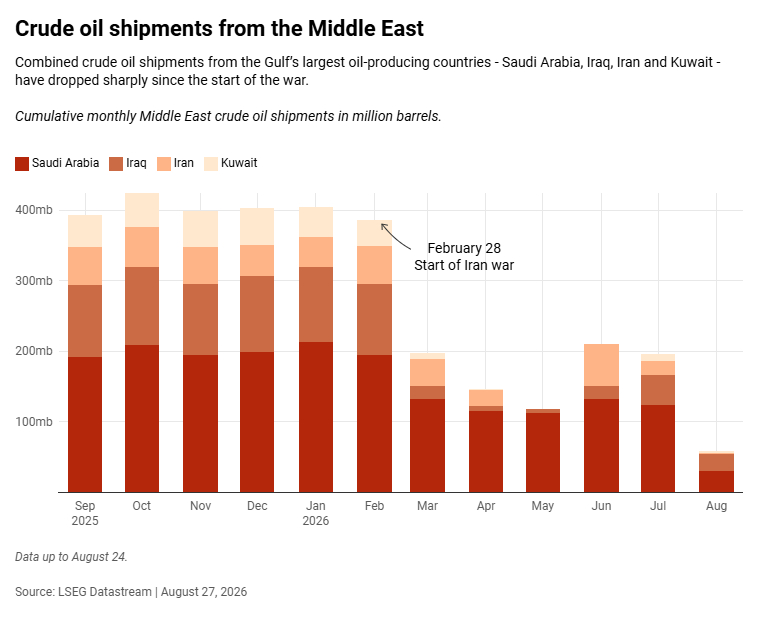
Oil exports from Middle East down by 39% in August, tracking firm says
Crude oil exports from the Middle East remained well below pre-war levels in August, down 39 percent compared with January and February this year, when roughly 18.5 million barrels per day were exported, according to TankerTrackers.
The lowest point came in May, when exports fell 67 percent below pre-war levels, the oil-tracking firm said in a post on X.
By August, that deficit had narrowed to 7.2 million bpd compared with 12.4 million bpd in May, it said.
The decline comes as the closure of the Strait of Hormuz continues to drive one of the worst maritime shipping disruptions in decades.
|
|
|
Araghchi holds calls with counterparts in Turkey, Saudi Arabia
Earlier, Turkey's Anadolu agency reported about a phone call between Turkish Foreign Minister Hakan Fidan and his Iranian counterpart, Abbas Araghchi.
Iran’s IRIB state broadcaster has a readout of that conversation, as well as a separate one between Araghchi and his Saudi counterpart, Prince Faisal bin Farhan Al Saud.
According to IRIB, Araghchi held the calls on Saturday evening.
He discussed “bilateral issues, regional developments, and the latest diplomatic efforts aimed at establishing stability in the region and eliminating the insecurity imposed on the Strait of Hormuz due to the US’s aggressive actions”, IRIB said.
|
|
|
Iran announces economic war task force
Iran has launched an economic war task force aimed at resolving monetary issues resulting from the ongoing conflict, the semi-official Tasnim news agency reports.
Deputy Economy Minister Morteza Zamanian said the ministry would rapidly identify and resolve problems facing businesses, trade, financing and other economic areas.
Iran’s economy is under immense strain following decades of sanctions and the current war. The US imposed additional sanctions on the country earlier this week in an attempt to further isolate Tehran.
|
|
|
About the latest US-Iran attacks in the Strait of Hormuz
- IRGC says that its naval forces attacked a remotely operated US boat which it said was “attempting to enter the protected area of the Strait of Hormuz”.
- Earlier, US Central Command (CENTCOM) claimed attacks on three crude oil tankers.
- CENTCOM said it carried out the attacks after accusing the IRGC of launching ballistic missiles towards two US warships “patrolling regional waters”.
- Iran confirmed it propelled missiles at a US aircraft carrier and a US Navy destroyer that were “harassing” Iranian ships.
- Iranian forces separately attacked three oil tankers transiting “unauthorised” routes in the waterway.
- Iran’s Foreign Ministry has condemned the strikes on its commercial vessels, while US Defense Secretary Pete Hegseth threatened that the US will continue to “destroy” Iranian tankers if Tehran targets US ships.
|
|
|
Iran targeting US aircraft carrier, destroyer a ‘very significant’ escalation
Iran has carried out a “calculated escalation” in its latest attacks on US warships, an analyst says.
“The Iranians did not only target two ordinary warships – they targeted a missile destroyer and, remarkably, an aircraft carrier … the backbone of the American campaign against Iran,” defence analyst Wolfgang Pusztai said.
Although US forces managed to evade the strikes, the attack was a “lucky occasion” for Tehran, he said.
Successful strikes would have prompted discussions in Washington about “how to continue the war and whether to continue the war at all”, Pusztai added.
“This is a very, very significant development, and it doesn’t come as a surprise that the Americans retaliated.”
|
|
|
Iranian trade official says country’s biggest issue is state of economy
The president of the Iran-China Chamber of Commerce says Iran’s greatest issue has been its economy even before the war.
“Even before the war began, neither the government, nor the people, nor the leadership were satisfied with the state of the economy,” Majidreza Hariri said on X.
“Now, this very economy that is in trouble has also been confronted with war, military attacks, and economic siege, and it is natural that these conditions would have economic repercussions.”
In a separate post, Hariri added that “a significant portion” of Iran’s currency crisis is being driven by the economy’s “historical problems”, which have been worsened by the war.
|
|
|
US blockade could backfire economically, IRGC says
The US economic and maritime blockade against Iran could cost Washington far more than Tehran, the Islamic Revolutionary Guard Corps says.
“If the US wants to inflict $1 of economic damage on Iran, it may face several dollars in costs and losses itself,” IRGC spokesman Brigadier-General Hossein Mohibi told Mehr news agency.
He said Trump believes Washington can force Tehran into submission with its military power; however, recent developments have shown otherwise.
The US – facing massive debt and economic competition with China and other major nations – will fail to prevail in its attacks and sanctions on Iran, Mohibi added.
|
|
|
Iran says response to new attacks will be ‘faster, heavier and more painful’
Iran’s Parliament Speaker Ghalibaf says new attacks on the country will “meet a faster, heavier and more painful response”.
Saying that Tehran’s responses to US strikes would no longer be “proportionate”, he added that “the Americans have surely realized that the era of ‘proportionate responses’ has come to an end”.
“Our recent operations against aggressor bases were merely a start. If they have not realized it yet, they must understand before it is too late that the rules of the game have changed.”
He said that Iran will also overcome US’s economic campaign just like it overcame the US militarily and diplomatically.
|
|
|
Iran says policy decisions won’t be changed by US economic warfare
The economy minister says the notion that Iran’s governance decisions can be forcibly changed by US economic pressure is a “mistake”.
“The responsibility for reforming Iran’s economy lies with the Iranian government and people, not the US Treasury Department,” Ali Madani-Zadeh said.
Madani-Zadeh argued millions of workers in Iran have found new ways for economic survival as a result of years of Western sanctions. Imports, exports and production are continuing as normal, he added.
Iran’s economy is administered for “the life and welfare of the Iranian people”, and it cannot be dictated by the United States, Madani-Zadeh said.
|
|
|
Iran in an ‘existential war’, says senior official
The spokesman for Iran’s Commission on National Security and Foreign Policy says the country is in an “existential war”, confirming that Iran targeted US warships with ballistic missiles, according to Iranian news outlet Entekhab.
“This blockade should never have existed,” said Hassan Qashqavi.
“Four days ago, the president of our country said at the Bishkek summit that we are ready to return to negotiations, but American officials do not pay attention to these issues and instead intensify the blockade.”
|
|
|
US midterm elections could be key turning point in war on Iran
Ongoing military threats by both the US and Iran, for the time being, reflect psychological warfare and are unlikely to result in significant military operations in the Middle East, an analyst says.
“I don’t think that Iran has an interest to start a direct war with its Arab neighbors. I don’t think that Iran has an interest to strike targets in Europe. So altogether I would say the statements from both sides are – for the time being – more information warfare then they will be followed up with a major military escalation,” Wolfgang Pusztai, a former military attaché for Austria, said.
A key moment in the US war on Iran will be the November midterm elections, and President Trump is unlikely to “give up” on the conflict, he said.
“We will certainly see some kind of decision point after the Congressional elections. This will determine the freedom of action for President Trump, and this might also mean that he tries to take some specific action to overwhelm the Iranian resistance.”
|
|
|
Iranian energy minister warns of unavoidable electricity blackouts
Iran’s Energy Minister Abbas Aliabadi says efforts are currently aimed at stopping power outages but warned there will be occasions when blackouts cannot be avoided.
The capital Tehran also faces a shortage of water resources, Aliabadi added.
Days before the outbreak of the US-Israel war on Iran in February, Aliabadi promised a summer without electricity disruptions, however, a severe heatwave and ongoing strikes thwarted the pledge.
In July, local media reported US attacks on a power plant on Kish Island and severe damage to distribution networks in Bandar Abbas, Jask, and Chabahar compounded technical failures driven by the extreme heat.
|
|
|
Iran’s parliament speaker accuses US of producing AI images ‘from the battlefield’
Iran’s parliament speaker recently warned that Tehran’s response to US strikes would no longer be “proportionate”.
Ghalibaf is now accusing the US of using AI to produce fake images of military successes against Iran.
“The leaders of that country find themselves in a state of desperation, resorting to empty words, slogans, and artificial intelligence to generate photos and videos from the battlefield,” he said.
|
|
|
‘Iran preparing for long war’ despite taking ‘heavy blows’ from the US
Iran’s military power is sufficient to continue the war with the United States for the foreseeable future, while in Washington the political repercussions will likely dictate how the conflict moves forward, says defense analyst Wolfgang Pisztai.
“Iran is preparing for a long war, at least on the military side. It has taken some heavy blows from the Americans, but it is certainly not out of action. It still has the capability to attack ships in the Strait of Hormuz,” he said.
“On the American side, this is not so much about military capacity,” Pisztai added, noting US missile supplies are likely not as depleted as some news reports suggest.
“It is more a political problem for President Trump … If Congress turns over to the Democrats in the midterm elections, this does not mean the conflict might be over. This will probably mean the Americans will bet even more on the economic instrument of strategy and less on the military instrument, while the naval blockade will certainly go on.”
|
|
|
US CENTCOM: 92 commercial vessels redirected during Iran blockade
US CENTCOM says it has redirected 92 commercial vessels, disabled three and boarded two during its naval blockade of Iran as of Sunday.
The blockade is aimed at cutting off Iran’s exports, particularly its oil sales, to weaken the country’s economy and force it to accept Washington’s demands.
|
|
CENTCOM continues to spread these kinds of claims. But we have never seen any message posted by maritime traffic watchdogs, confirming vessels redirected by the naval occupying war belligerent.
|
Iran lifts ban on government agencies using foreign social media platforms
Iran says it is lifting a ban on foreign social media platforms “so that the government can respond and combat rumors directly on platforms where people are present”.
“With the consensus of the staff members, the ban on the dissemination of information by executive agencies on non-native messaging platforms was lifted so that the government can respond and combat rumors directly on platforms where people are present,” Abbas Pazuki, deputy for communications and information of the office of the first vice president, said.
|
|
|
Iran surrendering is ‘a futile dream’, says senior commander
The chief of staff of the Iranian army says the prospect of the country surrendering to the US is “a futile dream that will never be realised”, the semi-official Fars news agency reports.
“The enemy is trying to make up for their strategic gaps and failures through soft warfare, cognitive warfare, and economic pressure, but they will certainly achieve nothing in this arena either, adding yet another defeat to their disgraceful track record in military warfare against Iran,” Ali Abdullahi said.
“The world of the future will be different from the world of the past. A difference that will benefit the Iranian nation and will be accompanied by the definitive decline of American power.”
|
|
|
‘Iran-first’ patriotic support a major factor in riding out US blockade
US officials hope Iran’s worsening economy – marked by surging prices, weaker trade and pressure on household incomes – could reignite nationwide unrest that has repeatedly challenged Tehran.
However, Dennis Ross, a former US negotiator, said Washington may be interpreting Iran’s economic distress as evidence of strategic success when the reality is more complicated. The IRGC may believe Iran can absorb the economic pain and outlast the pressure rather than compromise, he added.
Resilience may depend as much on public tolerance as Tehran’s ability to absorb economic hardship, said Burcu Ozcelik, a senior research fellow at the Royal United Services Institute.
“Of course, the economic squeeze raises the risk of public unrest. But for now, a wartime mentality appears to have a significant hold over the population,” said Ozcelik.
“Foreign military intervention, civilian casualties, and the perception of a wider civilization confrontation with a US-led order are sustaining a degree of ‘Iran-first’ patriotic support, tolerance, or simply patience with the regime.”
|
|
|
IRGC arrests 8 people accused of planning false flag attacks
The Guard has arrested eight people affiliated with what it described as “counter-revolutionary groups”, the semi-official Tasnim news agency reports.
The IRGC alleged those detained supported the son of the country’s former shah, Reza Pahlavi, who has positioned himself as a potential leader of Iran if the current government folds. The group was arrested in Iran’s southwestern Fars province.
It accused those detained of participating in January protests and planning to kill Iranians during potential demonstrations and blame it on government forces. Firearms and ammunition were discovered during a raid on their hideout, it said.
|
|
|
‘Total lie: US denies Iran sea drone attack claim
The US military has denied Iran’s claim to have struck an unmanned military vessel in the contested Strait of Hormuz.
Earlier, state-run media reported Iran hit a sea drone trying to enter an area in Hormuz that it called “restricted”.
“The report came from Iranian state media and it’s a total lie,” said Captain Tim Hawkins, a spokesman for US Central Command (CENTCOM).
The comments come after the US said it struck Iranian oil tankers in retaliation for Iran launching ballistic missiles at Navy warships.
CENTCOM said on Sunday that US forces redirected 92 commercial vessels, disabled three, and boarded two others to “ensure strict compliance” with the maritime blockade against Iran.
|
|
|
US and Iran fighting: ‘Only option is to escalate’
The renewed exchange of military strikes between Iran and the US indicates neither side will “cave in” because it “will not look good on them so the only option is to escalate”, says analyst Sina Azodi.
“There’s going to be more clashes between the Iranians and the Americans. There can be miscalculations. There can be more civilian casualties”, especially on the Iranian side, the director of the Middle East studies program at George Washington University said.
“The [US] secretary of defence can send more troops to the region, but I don’t think the Iranians are going to back down. They’re going to resist that blockade and impose further costs on the United States.”
The goal of the US and Iran is to force the other to back down and “the winner is going to be the one that can accept more costs and punishment”, Azodi said.
|
|
|
US claims 9 million barrels of oil transiting Hormuz daily
US Energy Secretary Chris Wright says on average nine million barrels of oil a day are getting through the Strait of Hormuz that should help relieve pressure on rising energy prices.
Wright told CNN with oil also moving through pipelines in the region, “we’re probably two-thirds or more of pre-conflict flows”.
Those flows, however, depend on the presence of the US Navy to help escort tankers and provide some protection against possible Iranian attacks. Wright said he expected other countries will eventually support the Navy’s efforts.
|
|
There are various tallies which are much lower than what the US continues to paint. No one knows how the US tallies (produces) its own figures.
It is therefore very difficult to explain the gap between US-claimed transit figures and those recorded by ship trackers without insight into how the US tallies its own figures.
|
Iran’s resilience during US war continues to ‘surprise’
The clearest path to a deal to end the US war on Iran may lie in the dispute over shipping fees through the Strait of Hormuz, says a former US negotiator.
Iran could abandon any demand for a toll while retaining the right to charge for legitimate navigational, security or environmental services, said Dennis Ross.
Such an arrangement could give both sides a claim to victory, allowing Tehran to step back without appearing to capitulate.
“The Iranians have consistently surprised us in terms of their resilience,” said Ross, adding that he doubted economic and military pressure alone would force an Iranian retreat. Hardliners, he said, may believe they can endure and ultimately secure what they want.
“If you could announce that the strait were reopened, I think Trump would do a deal,” he told The Associated Press.
|
|
|
Iranian professor predicts ‘way, way bigger’ response from Iran if US blockade and attacks persist
Mostafa Khoshcheshm, a professor at the University of Applied Sciences in Tehran, says he believes that “there will be an escalation” in the US-Iran war.
Khoshcheshm said that the recent exchange of fire involving Iranian and US ships indicates a change in the tone of the war and shows that “the rules of the game have changed”.
“Iran has moved towards a new strategy” which involves “going more offensive,” he said.
Khoshcheshm said that “if the Americans continue this blockade and attacking Iranian ships, the next responses will be way, way bigger”. “This will move in an escalatory trend towards the midterms, but the midterms is not the only goal, another goal is increasing the costs for US consumers in order to make Donald Trump remove the sea blockade and leave the region,” he added.
|
|
|
UKMTO says 59 ships passed through the Strait of Hormuz in the last two days
Fifty-nine ships have passed through the Strait of Hormuz in the last 48 hours, according to the United Kingdom Maritime Trade Operations (UKMTO) Centre.
UKMTO put the threat level at the key waterway at a “severe” ranking.
|
|
We do not consider UKMTO is a neutral source, as it is part of the military of the United Kingdom, which is a co-belligerent of the attacking belligerent, the United States.
|
| |
|
|
Iran to announce new restricted zone outside the Strait of Hormuz, says top security official Rezaei
Iran will announce a restricted zone outside the Strait of Hormuz in the coming days, Iran’s top security official Mohsen Rezaei has said, according to state media.
The zone will begin from the line of the US Navy’s blockade and extend to areas in the Gulf, Rezaei was quoted as saying.
Any ship that enters this new zone will be added to the sanctions list, he said.
Share Iran to announce new restricted zone outside the Strait of Hormuz, says top security official Rezaei on social media.
|
|
|
| |
|
|
Iran’s security chief Rezaei says rumours of shortages amid sanctions are false
Iran’s top security official Mohsen Rezaei was quoted by the media as saying that rumors circulating about a shortage of basic materials in the country due to sanctions and the economic siege are false.
|
|
|
Iran and Oman to sign agreed Strait of Hormuz passage maps in coming days: Rezaei
According to state media, Iran’s top security official Mohsen Rezaei says that maps detailing the passage of ships in the Strait of Hormuz have been agreed with Oman and will be signed in the coming days.
|
|
|
US attacks on Iran based on ‘frustration rather than any strategic calculations’
The war with Iran “has hurt US relations and credibility on so many levels,” says Stephen Zunes, Founding Chair of Middle Eastern Studies at the University of San Francisco.
“America’s allies in the Gulf are pretty upset with the United States for having launched this war without their consent, without consulting them, even though it was pretty obvious that they would be major victims of this war,” he said.
“We’re going to be having an on-again, off-again war indefinitely” with “some intense periods,” and “neither side is going to advance their cause by more fighting”, Zunes added.
“In many ways, the US attacks seem to be more cathartic” and carried out based on “frustration rather than any strategic calculations”.
|
|
|
Iran says Strait of Hormuz was ‘wide open’ until US caused shipping disruption
Iranian Foreign Ministry spokesman Esmaeil Baghaei says the Strait of Hormuz was “wide open” until the US and Israel attacked Iran on February 28.
“Washington unleashed an unlawful and savage war on the region and disrupted the normal flow of commercial shipping; tankers are halted, trade is disrupted, and energy prices are rising,” Baghaei said in a post on X.
He accused the US of trying to make Iran responsible for the consequences of a war that Washington started, saying: “America started the war but expects the whole world to pay the bill.”
Baghaei accompanied the post with a Simpsons meme, appearing to mock Washington’s handling of the crisis, showing a fire getting out of control as Homer Simpson says: “Relax. It’s a controlled burn.”
|
|
|
US is ‘strangling’ Iran’s economy, energy secretary says
US Energy Secretary Chris Wright says Washington is “strangling” Iran’s “economy to try to bring either a change in policy from the existing regime or a new regime”.
Wright told CBS News’s Face the Nation that the US military’s “biggest role” was preventing Iran from exporting crude oil, petroleum products, natural gas and other energy-related goods.
He also said Washington remained open to an agreement with Tehran.
“We are always ready to make a deal,” Wright said, adding that Trump’s goal was to seek a negotiated solution and resort to military action only when “absolutely necessary”.
|
|
|
Trump publishes posts berating Iran’s economy, showing attack on Kharg Island
Trump has taken to his Truth Social platform to level multiple claims that Iran’s economy is critically failing.
“Iran’s oil exports are crashing!” he said in one post. In another, he claimed, “Iran’s currency is destroyed”, while another said, “Iran is a failing nation!”
In what appears to be an AI-generated image, a US fighter jet can be seen flying towards an island under attack, with the caption “Bye, bye Kharg”, in reference to Kharg Island, the main hub for Iran’s oil exports, which Trump has repeatedly threatened to destroy.
|
|
|
Iran may see political benefit in absorbing US escalation
Iran has calculated that it can gain politically from escalation with the US, even if it comes at a military cost, according to Stephen Zunes, founding chair of Middle Eastern Studies at the University of San Francisco.
Zunes said that Tehran is responding to mounting pressure from the US, noting that “every escalation that comes from Washington, they’ll find some sort of response”, despite what he called an asymmetrical dynamic given the force the US could bring to bear against Iran.
“Iran also recognizes that, politically, they have the advantage through the damage they can do to shipping and American assets, and those of their allies,” Zunes said.
Tehran may be “welcoming an escalation, because they believe whatever damage can be done on their side, they can reap some political benefits”, he added.
He said Tehran may also be testing whether Washington is willing to de-escalate, though Iran could face “logistical issues in terms of manpower and military equipment” in sustaining a response.
Zunes cautioned that this assumes the US is acting rationally, when, instead, Trump has shown “impulsive” decision-making in the targets and goals pursued over the past week.
He added that it remains to be seen whether renewed negotiations “normalise things” or become “another blip in the cycle of violence and escalation”.
|
|
|
