| Highlights from yesterday |
|
Comments |
- Iran’s IRGC says it has launched a “heavy” ballistic missile attack on Prince Hassan airbase and a US Marine base in Jordan in response to several people being killed by a US attack that hit a wedding in Sirik.
- The US military says its forces “successfully” completed a wave of strikes against Iranian targets on September 1 following what it described as attempted attacks by the IRGC against commercial shipping and American service members.
- In his first message following the new wave of US attacks on Iran, Supreme Leader Mojatba Khamenei said that his country’s armed forces have “unforgettable lessons” in store for Washington.
- Kuwait says that its air defences are actively responding to hostile Iranian drone attacks, while Bahrain activates warning alerts for potential threats and its Ministry of Interior urges residents to seek safe locations.
- Jordanian armed forces said that air defence systems intercepted and destroyed 10 of 13 Iranian ballistic missiles that entered the kingdom’s airspace earlier, with the remaining three falling in remote areas without causing any casualties.
|
|
|
| |
|
|
| |
|
|
| Developments following Trump's attack on Larak Island (since 00:03 GMT) |
|
|
| |
|
|
Trump warns Iran against retaliation for ‘this very justified’ US attack
The US military said it struck targets in Iran over attempted attacks on shipping, as Iranian media reported explosions in Bandar Abbas, Qeshm Island, Konarak, and Chabahar.
Trump said that “if the failed Nation of Iran retaliates for this very justified attack, they will be hit again at a much harder and higher level”.
|
|
Trump has yet to prove "this very justified" as no evidence has been released showing the moment that the IRG was preparing to load missiles with sea mines.
|
US completes strikes in another round of the battle for the Strait of Hormuz
US Central Command issued a statement more than four hours after these strikes commenced, saying that the latest wave against Iranian military targets that were hit by the United States is now complete.
The US is saying that the reason for this escalation was a result of Iran targeting not just freedom of navigation and commercial shipping and laying mines, but also targeting American service members in Jordan.
A US official has said that claims by the IRGC that there were a large number of US casualties as a result of Iranian strikes are, in their words, false, and the CENTCOM statement has not in any way talked about any US casualties.
It’s clear with this latest escalation that the United States is in a battle for the Strait of Hormuz, wanting to keep the freedom of navigation open, even as it alleges that Iran is attempting to restrict it.
There is no reason to assume that the economic pressure has halted. In fact, Operation Economic Outcast is still ongoing, with the Treasury secretary, Scott Bessett, set to announce another Iranian target for US sanctions later this week, and that they will continue to be rolled out with each successive week.
|
|
".. claims by the IRGC that there were a large number of US casualties as a result of Iranian strikes are, in their words, false, and the CENTCOM statement has not in any way talked about any US casualties."
We did not come across any of such claim by Iran to register in the summaries from yesterday.
|
Bahrain intercepts Iranian drones
The Gulf nation says air defence systems have intercepted and destroyed Iranian drones over the country.
This follows an earlier warning from Bahrain’s Ministry of Interior urging residents to seek shelter in safe locations.
|
|
|
Iran’s IRGC claims missile, drone attack on US facilities in Iraq
Iran’s Islamic Revolutionary Guard Corps (IRGC) says its forces have carried out a combined missile and drone attack on US facilities in Erbil province, northern Iraq, in retaliation for a US strike on a wedding celebration in the southern coastal city of Sirik that killed four people including a child.
In a statement carried by state broadcaster IRIB, the IRGC claimed the attack destroyed a repair centre and warehouses containing technical equipment, as well as a US surveillance balloon guidance system. It also claimed fuel tanks at the base were set ablaze and a number of US personnel were killed.
There has been no independent confirmation of the IRGC’s claims regarding casualties or damage.
|
|
|
Regional escalation widens as Kuwait, Jordan, and Bahrain report incoming Iranian drones and missiles
Trump's escalation is spreading across several countries.
In Kuwait, the army says it is responding to what it describes as attacks by hostile drones following the latest Iranian action. It says any explosions people are hearing are the result of air defence systems intercepting incoming drones, and authorities are urging everybody to follow safety and security measures.
In Jordan, the army says 13 missiles entered the kingdom’s airspace. We understand 10 of them were destroyed, while three managed to penetrate, and landed in remote areas, far away from population centers.
In Bahrain, people are also being urged to seek shelter after Iran said it launched what it described as a large-scale drone attack against Sheikh Isa airbase, targeting radar installations and areas where American forces were gathered.
There is no independent confirmation of those attacks or the potential extent of any damage.
A major escalation across the region is now unfolding, with growing concern over whether the conflict will spill far beyond Iran’s borders.
|
|
|
Iran says attacks on US forces to continue ‘until they regret their crimes’
Colonel Ebrahim Zolfaghari, spokesman for Iran’s Khatam al-Anbiya Central Headquarters, says Iranian forces have launched missile and drone attacks on US bases in the region in response to strikes on military and civilian sites in southern Iran.
In a speech carried by state broadcaster IRIB, Zolfaghari claimed the attacks caused heavy damage to infrastructure, facilities, weapons and equipment, and that a “significant number” of US commanders and soldiers were killed or wounded.
“These offensive operations against the Americans will continue until they regret their crimes,” he said.
He warned that continued US attacks would be met with “heavier, broader and more destructive” responses, adding that any country cooperating with the US military must accept the dangerous consequences.
|
|
|
Oil prices jump following latest US-Iran attacks
Oil prices rise nearly 1 percent in early trade, extending the previous session’s surge, as concerns over supply disruption intensify after the US and Iran exchange overnight strikes, dimming hopes for a quick easing of tensions in the Middle East.
Brent crude futures rise 87 cents, or 0.92 percent, to $95.52 a barrel, while US West Texas Intermediate (WTI) crude futures climb 80 cents, or 0.89 percent, to $91.02. Both contracts soared more than $4 in the previous session, marking Brent’s largest gain since July 24 and WTI’s largest since July 23.
|
|
|
Bahrain issues another alert over potential threat
Bahrain’s Interior Ministry issues an alert for the second time over a potential threat, urging citizens and residents to remain calm and move to the nearest safe location.
In a post on X, the ministry also called on the public to follow updates through official channels to protect public safety.
|
|
|
Trump says US has ‘almost total control’ of Hormuz Strait
Trump says he is not trying to force Iran back to the negotiating table, dismissing reports that Washington is seeking a new agreement with Tehran.
“I like our position now much better, with almost total control of the Hormuz Strait, and their economy totally collapsing,” Trump said in a post on Truth Social.
He added that Iran was “playing out the inevitable” and asked: “When are the Iranian people going to rise up and fight?”
|
|
|
Sirens sound in northern Israel due to ‘hostile aircraft’
The Israeli military says sirens warning of a hostile aircraft have sounded in the area of Kfar Yuval in northern Israel.
“The details are under review,” it added.
|
|
|
US energy secretary says 17 million barrels of oil transited Hormuz on Monday
US Secretary of Energy Chris Wright says 17 million barrels of oil transited the Strait of Hormuz on Monday, adding that it was the highest level of crude flow through the waterway since the Iran war disrupted shipping, Reuters reports.
The figure contrasts with preliminary ship-tracking data from Kpler, which showed only five commodity vessels transiting the strait on Monday, with no liquid tankers recorded. Vessels travelling with their transponders switched off would not appear in the data.
Wright has previously said that significantly more oil was moving through Hormuz than vessel-tracking companies were recording.
|
|
Arab states exported an average 6.92 million barrels of crude oil per day over the past 28 days through the US Navy blockade line, oil-shipping tracker Tanker Trackers said on Monday.
Of the total, 2.53 million barrels per day came from oil terminals in the Gulf of Oman, while another 4.39 million barrels per day passed through the Strait of Hormuz.
Tanker Trackers said most of the crude moving through Hormuz was destined to supply other tankers waiting in the Gulf of Oman.
|
Shipping traffic in Strait of Hormuz remains below 10-day average, data shows
Just four vessels transited the Strait of Hormuz on Tuesday, well below the 10-day average of about 13, according to preliminary tracking data from ship tracker Kpler, cited by Reuters.
The four vessels that transited were one very large crude carrier, one Panamax tanker, one Kamsarmax carrier and one intermediate tanker, according to the preliminary data.
The figures could change as some ships typically switch off transponders during the voyage, Reuters said.
|
|
|
US missile attacks target areas near Ahvaz and Aghajari in southwestern Iran
Two locations near the cities of Ahvaz and Aghajari in Iran’s southwestern Khuzestan province were targeted in missile attacks, the province’s deputy governor for security affairs said, according to the state broadcaster IRIB.
|
|
The straight-line (air) distance from Ahvaz, Iran to the closest point of the Kuwaiti border is approximately 170 kilometers. US has two bases in Kuwait.
|
Trump warns Iran of total destruction following US strikes
The US president was asked if he is weighing whether to use a nuclear weapon against Iran, and on Monday in the Oval Office, he reacted quite angrily to that question, calling it a stupid question and denying that he is considering that.
Yet, what we see in his Truth Social post, the US president is not only justifying the latest attacks by the United States, but he’s also threatening Iran with existential attack, and even destruction.
He says in this post that “If the failed nation of Iran retaliates for this very justified attack, they will be hit again at a much harder and higher level”.
And he goes on to say that “Waiting in the wings when it’s over, there will be very little left of the Islamic Republic of Iran”.
And so, the US president is insinuating that if Iran continues to escalate, it faces complete devastation, and even decimation.
|
|
The US resorted to some sort of 'total destruction' before, namely on Hiroshima and Nagasaki, and was the world's first, and for now the two only nuclear genocide in history, only to enforce a brute end of WWII to Asia after the WWII in Europe was over.
|
Israeli military intercepts ‘suspicious aerial target’ in northern Israel
The Israeli military has provided an update on the reason for warning sirens being sounded in northern Israel a short while ago.
“Interceptors were launched toward a suspicious aerial target that likely crossed from Lebanon into Israeli territory,” the Israeli military said.
They added that the results of the interception are under review and no injuries have been reported.
|
|
|
Seven killed in missile attack on Iran’s Khuzestan
Seven people have been killed in a US missile attacks on three locations in Iran’s Khuzestan province, the province’s deputy governor for security affairs said, according to Irna news agency.
Eight others were injured in the strikes, it added.
|
|
|
Trump likely to keep US strikes on Iran limited due to operational constraints
The latest US strikes on Iran will likely remain limited because Washington faces operational constraints and few military targets left to hit, says Harlan Ullman, chairman of the Killowen Group and a retired US senior naval officer who served in the Gulf.
“My guess is that the [Trump] administration is trying to keep this very, very limited, doesn’t really want to escalate,” he said, adding that “the only strategy it has is one of economic strangulation”.
Speaking from Washington, DC, he said the question is “whether Iran can hold out longer, or whether political pressure here is going to force Trump to seek some kind of negotiation”.
To escalate beyond the current targets, the US would have to attack civilian infrastructure, which could be seen as a war crime, he said.
Ullman also pointed to senior military officials warning the administration that the war was damaging the readiness of US forces elsewhere.
He said the aircraft carriers Abraham Lincoln and Gerald R Ford face months in shipyards after long deployments without maintenance, meaning Iran has “taken two US nuclear aircraft carriers out of action” without attacking them.
|
|
|
Iran’s retaliation shows readiness for war escalation
Iran struck back at US bases despite an explicit threat from Trump because Tehran has concluded that Washington is not serious about diplomacy, says Mohammad Eslami, a research fellow in Middle East and North Africa studies at the University of Tehran.
Trump warned that if Iran retaliated for the latest US strikes, it would be hit again “at a much harder and higher level”. Iran then attacked US positions in Jordan, Bahrain and Kuwait.
“The Iranians think that the Americans are not believing in any kind of diplomatic settlements,” Eslami says, adding that Iran now expects a second round of full-scale confrontation with the US and Israel.
He said the earlier phase of the war had shown the limits of American and Israeli power, and that “if they want to again start a kind of full-scale war, it is up to them”. Iran would respond in a much stronger way.
The attacks on US positions in Jordan are so Iranian forces “can be prepared for attacking Israel in the event of a full-scale war”, he said.
On the strike that hit a wedding in Kuhestak, Eslami said US forces were “committing war crimes” in Iran as they had in Iraq and Afghanistan, and that it was “time to stop them and punish them”.
|
|
|
Bahrain issues third ‘potential threat’ alert in six hours
Bahrain’s Interior Ministry has issued a third alert over a “potential threat” in the past six hours, again urging residents to remain calm and move to the nearest safe location.
In a post on X, the ministry also called on the public to follow updates through official channels for their safety.
|
|
|
Senior IRGC official tells Arab states to expel US forces or face strikes
IRGC political deputy General Yadollah Javani has addressed Arab countries, demanding they either expel US forces or face a crushing military response.
“It is better to expel the Americans from your countries and take back the bases,” Javani said in a statement published by the semi-official Tasnim news agency.
He warned that Iran’s military has proven that it will retaliate decisively from any staging point used for attacks against Iran, specifically naming Kuwait, Bahrain, and Jordan.
|
|
|
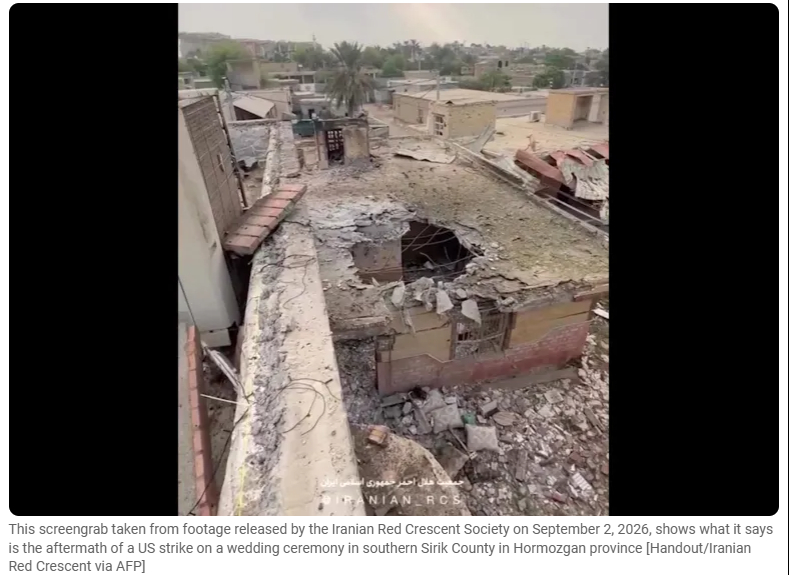
US strikes Iran – Wedding bombed near southern city of Sirik
A reported US attack near Sirik in southern Iran has hit a wedding gathering, with children among the casualties and dozens of people taken to hospital.
Iranian officials described the strike as an attack on civilians, while the US says its latest strikes targeted air-defence sites, radar systems, maritime assets and mine-laying capabilities in response to attempted Iranian attacks on shipping in the Strait of Hormuz.
Iran’s Islamic Revolutionary Guard Corps quickly retaliated with attacks on US military sites across the Middle East. Bahrain and Kuwait issued alerts over possible attacks, while Jordan said it intercepted 10 of 13 missiles fired into its airspace, with the other three falling in remote areas.
As mediators push to revive US-Iran negotiations, civilians in Iran are once again caught in the crossfire.
|
|
|
US failure to honor bilateral MoU drove latest conflict
Negar Mortazavi, a senior fellow at the Center for International Policy, says the renewed conflict between the US and Iran stems from Washington’s failure to honor its commitments under the memorandum of understanding signed in June.
Mortazavi said that the US began “violating or not abiding by the MoU, or essentially treating it like a worthless piece of paper.”
She said that Trump faced intense political pressure over the agreement from both Democrats and members of his own party. Tehran viewed the MoU as “a good deal” and wants to return to it, she argued.
“Let’s go back to that with actual commitments,” Mortazavi said, pointing to unfulfilled promises, including “ending the war on all fronts, including Lebanon”, unfreezing Iranian assets, and resolving maritime security in the Strait of Hormuz through regional cooperation.
She said those commitments had not been fulfilled, referring to broken promises that derailed diplomatic progress.
“Ending the war on all fronts, including Lebanon, which didn’t happen, unfreezing Iran’s assets, which didn’t happen,” Mortazavi said, adding that Iran and Oman had agreed on a resolution for the Strait of Hormuz last week, prior to the new US escalation.
|
|
The main thread is not 'failure' but arbitrary interpretation of the MoU by the US.
|
Global bonds hit multi-decade highs for second day amid US-Iran conflict
Government bonds sold off sharply on Wednesday, driving borrowing costs to multi-decade highs as the US and Iran trade blows, raising energy prices and inflation fears, according to Reuters.
It was the second day of the market rout, which began after a US strike on Larak Island triggered the latest round of escalation.
The conflict pushed up energy prices, feeding investor fears about inflation and mounting government debt. Consequently, the 10-year government bond hit a near three-year high in the US, a 30-year high in Japan, and a 15-year high in Australia, while prices for German and French 10-year bonds fell to multi-year or record lows.
Because bonds served as benchmarks for broader borrowing, their rise made mortgages more expensive and increased funding costs for governments.
|
|
|
Bahrain denounces ‘heinous’ Iran attacks; pledges to defend kingdom
Bahrain has condemned “treacherous Iranian air attacks” saying its forces destroyed a number of incoming projectiles.
“Iran continues its systematic aggression through its heinous attacks targeting civilians in the Kingdom of Bahrain,” its military said in a statement.
It highlighted its “unwavering resolve and high combat readiness”.
“The General Command affirms that all its weapons and units are at the highest levels of readiness and are fully prepared to defend the Kingdom.”
|
|
Bahrain is a host country as it harbors the Fifth Fleet, which belongs the US as the attacking war belligerent.
Iran then has the right to consider Bahrain as military objective.
|
Israeli military says interception earlier likely a ‘false target’
The Israeli military says its interception overnight of a “suspicious aerial target” was “apparently launched at a false target”, it said following an investigation.
Warning sirens sounded in northern Israel a few hours ago.
|
|
|
Car slams into pro-government rally in Iran killing 4
A vehicle rammed into a gathering of supporters of Iran’s government and armed forces in the northeastern city of Mashhad overnight, killing four people and injuring 10 others.
The car travelling at high speed first collided with another vehicle, lost control and then veered into the crowd after hitting safety barriers and traffic signs, Noor News reported, citing Mohsen Mousa-Abadi, head of Razavi Khorasan province’s traffic police.
Initial checks showed the driver, who was arrested, was not in a normal state, Mousa-Abadi said, without giving details on his condition.
There was no immediate indication of a political motive, and authorities described the incident as a traffic accident.
|
|
|
IRGC says attack on Kuwait airbase inflicted US casualties
Iran’s Islamic Revolutionary Guard Corps has claimed it “killed a number of enemy elements” in missile and drone strikes on a military base in Kuwait hosting US forces.
The IRGC said it hit the headquarters and residence of the American commander of the Ali Al Salem airbase. Al Jazeera could not immediately confirm the veracity of the statement. There was no immediate comment from US Central Command.
The attack set fire to a drone hangar and a ramp through which UAVs participated in attacks on Iran, it said, adding several US drones were also destroyed.
Kuwait earlier reported intercepting drones and missiles but didn’t report any casualties.
|
|
|
Iran’s Revolutionary Guard claims drone strikes on US bases in UAE
The Islamic Revolutionary Guard Corps says it attacked two US military bases in the United Arab Emirates (UAE).
“In response to the targeting of innocent civilians since dawn today, dozens of army kamikaze drones have targeted the radar systems and locations of US forces at the al-Dhafra and al-Minhad bases in the UAE,” state media quoted an IRGC statement as saying.
There was no immediate confirmation from the Emirates.
The IRGC described the al-Dhafra base as one of the key operational centres of “criminal America in the region and is used for air operations, reconnaissance, surveillance, and support”.
The attack was in retaliation for US strikes on Iranian residential areas and the “targeting of a wedding ceremony”, it said.
|
|
The US is regularly denying that Iran has hit and/or has caused casualties. But Iran uses a range of technologies even when these technologies are not theirs.
|
Kuwait says fire extinguished after Iranian drone hits residential complex
Kuwait says an Iranian drone attack ignited a fire at a residential building in the capital but there are no casualties.
The blaze has been extinguished in Kuwait City, the official KUNA news agency reported quoting Brigadier-General Muhammad al-Ghareeb, a fire department spokesman.
“A fire that broke out in a residential complex in the Capital Governorate has been brought under control. The complex was targeted by a hostile drone launched as part of the nefarious Iranian aggression,” said al-Ghareeb.
|
|
|
Update
Children among the dead in US strike on Iran wedding party
A number of Iranians killed in the US attack on a wedding ceremony in southern Iran’s Sirik county.
The casualties include two children.
The Hormozgan governorate announced the names of the four people killed in Tuesday night’s attack: Amir Ali Karimi, 4, Mohammed Mollahi, 16, Kolsoom Mollahi Najhandania, 43, and Zarkhatoon Taheri, 50.
|
|
|
Pakistan says escalation in war ‘undesirable’; hopeful for US-Iran talks
Pakistan says it’s “concerned” about renewed attacks by the United States and Iran, with the escalation “undesirable”.
“We remain positive that the parties will return to the table for dialogue,” said the Foreign Ministry.
Pakistani military officials recently visited Tehran and created “considerable momentum” towards resolving the Strait of Hormuz crisis, it noted.
|
|
|
US bases in Iraq’s Erbil hit with missiles, drones, Iran says
Iran’s IRGC says it struck US military sites with missiles and drones in Erbil in Iraq’s autonomous Kurdish region.
The IRGC said it “carried out a coordinated missile and drone attack” that destroyed a maintenance centre, warehouses, and the “guidance system of a US surveillance aerostat”, according to a statement carried by state-run IRNA news agency.
The Iraqi Kurdish counterterrorism agency said coalition forces downed 10 explosive-laden drones in the airspace of Erbil province between 1:13am and 3:31am local time, without causing casualties.
Drone attacks have previously repeatedly hit Erbil, the capital of the Kurdish region, which is also home to a major US consulate complex.
|
|
|
Qatar condemns Iran attacks on Gulf neighbors and Jordan
Qatar has denounced Iran’s renewed attacks on its Middle East neighbours, calling them a “flagrant violation” of their sovereignty.
The Foreign Ministry called the missile and drone strikes a “dangerous escalation that will complicate efforts aimed at containing tensions [and] undermine political and diplomatic endeavors aimed at achieving security and stability in the region”.
Earlier, Iran’s Supreme Leader Mojtaba Khamenei said its armed forces have “unforgettable lessons” in store for the United States after a series of attacks on Tuesday.
|
|
|
IRGC says 4 troops killed in US attack on western province
Iran’s Revolutionary Guard says four military personnel were killed in a US attack on the western province of Kermanshah overnight.
“Four fighters of the IRGC Aerospace Force in Kermanshah province were martyred in an attack by the US regime,” it said in a statement carried by Fars news agency.
At least five civilians were also killed at a wedding ceremony in the south in a US strike, authorities said earlier.
|
|
Kermanshah province borders with Iraq where the US has several bases, including at Baghdad International Airport and in Iraqi Kurdish Erbil. The attack is to consider being carried out from one of these bases.
|
Basij fighters killed in US strikes on Iran’s Lavan Island
Three Basij paramilitary fighters were killed in US strikes on Iran’s Lavan Island, according to Iran’s Mehr news agency.
At least 18 military personnel and civilians died in the overnight American air strikes.
The Basij is a volunteer unit that falls under the command of the Islamic Revolutionary Guard Corps and enlists civilians. The militia is considered deeply ideological, often made up of young, working-class men. There are an estimated force of 450,000 personnel.
Basij troops are often deployed on the front lines of protests and have played a large role in countering uprisings against the government in recent years.
|
|
|
| |
|
|
| |
|
|
US attacks on Iran yesterday killed 18 people
The death toll from US attacks on Iran yesterday has been updated to 18.
- Four people were killed at a wedding party in Kouhestak
- Seven people were killed in three different locations within the Khouzestan province
- Four IRGC members were killed in Kermanshah
- Three Basij paramilitary fighters were killed in Lavan Island
|
|
|
Iran’s parliament speaker calls out US army for killing children again
Iran’s Parliament Speaker Mohammad Bagher Ghalibaf has called out the US for killing children in Iran, calling its forces “Satan”.
In a statement on X, he said “if a power acts like Satan, picks targets like Satan, and kills like Satan, it’s Satan.”
He listed the Minab primary school killings, where more than 150 people, mostly young children, were killed. He also mentioned the attack in Sirik on a home during a wedding celebration, killing at least four people, including a child.
|
|
|
| |
|
|
| |
|
|
IRGC says two oil tankers hit mines and were disabled
The IRGC says two oil tankers hit sea mines and were disabled while attempting to transit the Strait of Hormuz.
In a statement shared by state media, the IRGC said the tankers had been forced to disembark their crews and were placed in the hands of US operatives to pass through what it called an “illegal route” in the strategic waterway.
“The IRGC Navy had previously warned about the dangers of passing through the mined passage, and in addition, double punishments have been foreseen for shipping companies that, instead of following the legal path, fall for the deception of the United States and leave their vessels at the disposal of the enemy, which will be implemented soon,” the IRGC was quoted as saying.
|
|
|
Saudi shipping company says two sailors killed in incident transiting Hormuz
Two crew members were killed on board the SIDR vessel in an incident while transiting the Strait of Hormuz on Monday, Bahri, a shipping company in Saudi Arabia, says.
The company said the two crew members were from the Philippines.
|
|
|
Saudi Arabia condemns Iranian attack on tanker in Strait of Hormuz
The Saudi Foreign Ministry says Iran targeted a Saudi tanker while it was passing through the Strait of Hormuz.
It added that the attack “resulted in fatalities among the tanker’s crew”.
|
|
Iran did not attack the Saudi tanker. The vessel run onto a sea mine, which means the captain of the ship took a the risk.
|
Kuwait condemns Iranian attack on Saudi tanker
Kuwait has also condemned and denounced the Iranian attack on a tanker belonging to Saudi Arabia, calling it a “heinous” attack that violated international law and is a “direct threat to the security of maritime navigation, its safety, and global energy supplies”.
In a statement, the country’s foreign ministry emphasised the need to immediately halt all “escalatory actions”.
|
|
|
Qatar condemns Iranian attack on Saudi tanker, rejects use of Strait of Hormuz as ‘bargaining chip’
Qatar has condemned Iran’s attack on the Saudi tanker as it was transiting the Strait of Hormuz, killing two people.
In a statement, the Foreign Ministry said it “renews the State of Qatar’s categorical rejection of the use of the Strait of Hormuz as a bargaining chip, and in this regard, calls for its reopening without conditions”.
It emphasised the need to halt Iran’s “unjustified attacks on the properties of brotherly countries” and affirmed its full solidarity with Saudi Arabia.
|
|
|
Oil prices hold steady as market weighs supply risks
Oil prices are little changed after climbing to more than one-month highs earlier in the session as traders weigh the risk of supply disruptions following overnight US and Iranian strikes.
Brent crude futures rose 9 cents, or 0.1 percent, to $94.74 a barrel by 08:05 GMT and US West Texas Intermediate crude futures lost 19 cents, or 0.21 percent, to $90.03.
“The market is facing a binary risk,” said Saxo Bank head of commodity strategy Ole Hansen.
“An announcement that a deal has been reached, or that progress is being made, could send prices tumbling, while any escalation would further undermine the prospect of a peace deal. That’s why oil remains highly volatile with a potential $5 move in either direction on fresh developments.”
|
|
|
China, Russia, Iran call for greater cooperation at summit
The Shanghai Cooperation Organization (SCO) marked its 25th anniversary summit in Bishkek, Kyrgyzstan with a call for greater multilateral cooperation and a multipolar world order.
Chinese President Xi Jinping and Iranian President Masoud Pezeshkian spoke against unilateralism and military blocs, while Russian President Vladimir Putin highlighted growing trade among SCO members.
|
|
|
Jordanians question value of US bases after repeated Iranian attacks
These were pretty extensive Iran attacks, some of the heaviest we’ve seen in the past month.
Bahrain again found itself targeted. It’s the home of important US military assets. In Kuwait, the army headquarters there said it was subjected to Iranian drone attacks. Explosions were reported in the skies over Kuwait overnight.
And again Jordan has been targeted.
This puts Gulf states and US allies in the Middle East in extremely difficult positions.
Jordan has a longstanding friendship with the US but we are gradually seeing a realization – or a sense among many Jordanians – questioning whether it is worth having bases that make it more of a target.
|
|
|
Iran’s Red Crescent calls ICC to investigate US strike on Kuhestak wedding ceremony
In a letter to the International Criminal Court, Iran’s Red Crescent Society (IRCS) has called for legal action following last night’s US missile strike on a wedding ceremony in Kuhestak, Hormozgan.
“Given the reported civilian character of the location as the venue of a family wedding ceremony, as well as the presence of civilians at the site, the incident raises serious concerns under international humanitarian law and warrants an independent, impartial, thorough, and effective investigation,” the IRCS said.
“Intentionally launching an attack in the knowledge that such attack will cause incidental loss of civilian life or injury to civilians that would be clearly excessive in relation to the concrete and direct overall military advantage anticipated may, subject to the conditions and elements prescribed by the Rome Statute, give rise to individual criminal responsibility under international criminal law,” the statement said.
The organization added that the attack, which killed four people and wounded 67, could constitute a war crime.
|
|
|
‘US is in a very confused state in terms of its strategic goals’
A security analyst has expressed “deep, deep concern” after the United States resumed attacks on Iran after a month long lull in the war.
“It’s very concerning because clearly the accuracy and potency of Iranian retaliation is being proven, but also their ability to continue retaliating over half a year after the start of the US-Israeli attack,” said Samir Puri, a lecturer in war studies at King’s College London.
“There’s no sign that Iran is running out of munitions. There’s every sign that the US wants to force Iran into some kind of visible concession… So I think, yes, at the moment there is every possibility of further escalation.”
US President Donald Trump’s “messaging is extremely confused” regarding the endgame of the six-month war, Puri said.
Iran’s backing at this week’s Shanghai Cooperation Organisation summit by China, Russia, India, and others shows it’s “clearly not that isolated on the international stage”.
“So I think the US is in a very confused state in terms of its strategic goals here,” said Puri.
|
|
|
US combines sanctions and strikes in new approach to pressure Iran
The latest escalation by US forces on Iran and the retaliatory strikes are a “little bit different than the previous”, says Luciano Zaccara, research assistant professor in Gulf politics at Qatar University.
In the last few months, “diplomacy was going on at the same time that the attacks were and the attacks did not mean that diplomacy was ending”.
“It seems that Trump is trying to give a different kind of signal to Iran [this time]… he was threatening to use bigger type of weapons.”
Zaccara added that the sanctions on Iran would take much longer to work, so attacking them is a means to speed up pressure.
“Trump is trying to find a middle way between trying to use economic measures that would take much longer to have an effect on the Iranian economy.
“With the combination of bigger attacks, that would convince Iran to come back or not to the table because Trump says now that he’s not interested at all in conversations.
“So, we are in a new situation in which it’s not clear whether the US is looking for a military defeat because they are not using enough resources to produce a military defeat, but neither to push Iran to the table of negotiations.”
|
|
|
European gas prices surpass their highest level since 2023
European natural gas benchmark futures surged to their highest since January 2023 after the US launched renewed strikes against Iran on Tuesday, Bloomberg reported.
|
|
|
Iran, US exchange new attacks
The US’s CENTCOM said it struck dozens of military targets along Iran’s southern coast on Tuesday.
Trump said Iran will be “totally wiped out” if it retaliates.
Iran responded by firing ballistic missiles towards Jordan, Bahrain, Kuwait and Iraq’s semi-autonomous Kurdish region. Tehran has accused the US of hitting a wedding party, killing at least four people.
|
|
|
IRGC pledges retaliation for US attacks as diplomacy door closes
As soon as the US attacks happened, the IRGC issued strong announcements that retaliation would be forthcoming.
During his visit to Bishkek, Iranian President Masoud Pezeshkian said the door for diplomacy remains open. Several politicians here delivered the message that the Memorandum of Understanding can be revived.
However, following more US attacks last night, diplomacy has taken another hit, with Iran striking US bases in Jordan, Kuwait, Bahrain, and Iraq’s Erbil.
At the end of Iran’s retaliation, the IRGC claimed it killed American soldiers and damaged US aircraft, but the US side hasn’t commented on that.
Also, Jordan said it intercepted all the missiles fired by the Iranian military.
|
|
|
US embassy in Saudi Arabia issues security alert for Americans
American citizens in Saudi Arabia have been warned to take precautions as attacks surge between the United States and Iran.
“Due to tensions in the Middle East, the security environment remains complex with the potential for unforeseen escalation,” the US embassy in Saudi Arabia said in a post.
“Americans currently in the Middle East should exercise heightened vigilance and be aware of potential flight cancellations, airspace closures, and travel disruptions.”
|
|
|
Russia condemns escalation between US and Iran
Russia has denounced the recent surge in attacks in the US war on Iran.
“We regret the recent escalation surrounding Iran and are doing everything we can to reduce its intensity,” a Foreign Ministry spokesperson told Al Jazeera.
“What is happening in the Gulf region is a terrible adventure that has led to dire consequences.”
The renewed fighting “confirms our expectations that the truce agreement has not been implemented”, added the spokesperson.
|
|
|
Gulf Cooperation Council condemns Iran’s attacks as ‘heinous’
The Gulf Cooperation Council has condemned Iran’s retaliatory attacks against Bahrain, Kuwait and Jordan calling them “heinous”, the secretary-general of the group said in a statement.
“These Iranian attacks represent a blatant violation of the sovereignty of states and a direct threat to their security and stability,” said Jasem Mohamed AlBudaiwi.
Iran fired on US allies in the Gulf early Wednesday following a night of American bombardment.
The latest violence ended a month-long lull in fighting between the US and Iran and raised new questions about how to end a war that has led to a spike in oil prices, roiled the global economy, and is posing increasing political problems for President Trump ahead of November midterm elections.
|
|
All members of the GCC and Jordan are hosting a foreign military power from another continent whose leader had declared war on Iran on February 28th, and made his country an attacking belligerent.
If any of the GCC states allow the belligerent to resort to any activity directly linked to the war on Iran, these states are co-belligerent and allows Iran to consider these countries as military objectives.
|
China’s Xi urges rejection of ‘external interference’ in the Middle East
China’s President Xi Jinping says external powers should stop their double standards in the region and reject “external interference” in the Middle East.
Chinese state media outlet Xinhua reported that he made these comments during talks with Egyptian President Abdel Fattah el-Sisi in Cairo.
|
|
|
Palestinian issue ‘should never be overlooked or marginalized’: China’s Xi
Chinese President Xi Jinping met Egyptian President Abdel Fattah el-Sisi in Cairo.
In the talks, Xi backed Middle East nations in building a new security architecture and said the Palestinian issue should not be marginalized, according to China’s state-run Xinhua News Agency.
“China supports regional countries in building a new security architecture for the Middle East,” Xi said, calling for a “comprehensive solution for common security” in the region.
The Palestinian issue “remains the core of the Middle East question, should never be overlooked or marginalized”, he added.
He also called for support for the UN’s “effective role” in the region and urged external powers to abandon “double standards” in the Middle East.
Amid tensions in the Strait of Hormuz due to the US-Iran war, Xi said China was “ready to work” with the Middle East countries to “safeguard the security of international shipping lanes”.
Xi arrived in Cairo on Tuesday for a two-day state
|
|
|
Iran security official vows ‘new strategy’ to break US after attacks
Iran’s Supreme National Security Council Secretary Mohsen Rezaei has pledged the US will soon witness Iran’s “new strategy” for war after its recent strikes.
“With these flailing efforts, not only will you not emerge from the hell you’ve created for yourselves, but you will soon see that Iran’s new strategy on the battlefield, in diplomacy, and in confronting the economic blockade will shatter your foundations,” he said on X.
|
|
|
Stocks fall, bond rout deepens as US and Iran trade attacks
World stocks fell as new US air strikes on Iran pushed oil prices to five-week highs, stoking inflation concerns and extending a global bond sell off.
Fears of further disruption to energy supplies lifted oil prices, with Brent crude futures last up 0.1 percent at $94.87 a barrel.
“The recent increase in energy prices has put additional upward pressure on bond yields, which had already been on the rise on the back of some fiscal concerns,” said Kiran Ganesh, multi-asset strategist at UBS Global Wealth Management.
The escalation in the Middle East and the global bond selloff have given September a shaky start, adding to pressure on global markets.
“With the market already pricing quite a hawkish outlook for the Fed, we think there’s much more scope for downward surprises for the dollar than there is for some of the other currencies,” Ganesh said.
|
|
|
Iran calls US strike on wedding a ‘war crime’
The Foreign Ministry has described a deadly US attack on a wedding celebration in the south of the country as a “war crime”.
“The truth of this unlawful war of choice – and the true face of the war crime – is in Sirik where a wedding ceremony was brutally bombed as part of America’s desperate struggle to conceal its failure,” spokesman Esmaeil Baghaei posted on X.
The Iranian Red Crescent said at least four people, including a child, were killed and more than 50 others wounded by the US air strike.
Video shared by an Iranian government account showed debris and damage at what it said was the wedding site in Sirik following the attack with people heard screaming in the background.
“Unfortunately, this is a residential building and unfortunately this happened during my daughter’s wedding ceremony,” Ali Mallahi, father of the bride, said in a video carried by state TV.
“It is a very saddening incident… Thank God the casualties were not higher.”
US Central Command spokesman Tim Hawkins said “the US military never targets civilians, unlike the IRGC”, referring to Iran’s Revolutionary Guard.
|
|
|
CENTCOM denies targeting civilians after four people killed in US attack
The US’s CENTCOM has denied targeting civilians after Iran said a US attack on a wedding in Sirik killed at least four people, including two children, Reuters news agency reports.
According to Iranian authorities, more than 50 people were wounded in the attack.
|
|
|
Death toll from US attacks on Iran rises to 19
The death toll for the US’s attacks on southern Iran last night has risen to 19 people, according to Iranian media.
At least four people were killed in Kouhestak, seven people were killed in Khouzestan province, four IRGC members were killed in Kermanshah, three Basij members were killed on Lavan Island, and one person was killed in Jahrom in Fars province.
|
|
|
Iranian official rejects US claims denying it targets civilians
Foreign Ministry spokesperson Esmaeil Baghaei has rejected US CENTCOM’s position that the US does not target civilians.
“Apparently, he [CENTCOM spokesperson] has forgotten his own military record: Kakarak in 2002, Mukaradeeb in 2004, and Deh Bala and Wech Baghtu in 2008 – documented US attacks in Afghanistan and Iraq that resulted in the deaths of civilians, including women and children,” Baghaei wrote on X.
“He has forgotten something else as well: even Homeland, an American-produced television series, portrayed, in its fourth season, a US drone strike on a wedding in Pakistan – an attack that killed around 40 civilians.
“The reality is so horrifying that even American propaganda has never dared make the claim Hawkins is making today. Sirik is not a story. The civilians are real. The victims are real.”
|
|
|
Reports suggest telecommunication tower located near site of fatal US attack on wedding
The wedding took place in a residential building that belongs to a family. There is no verification whether the building was deliberately targeted or if it was collateral damage, but reports suggest a telecommunications tower is located nearby.
The reports come after Iran accused the US of bombing a house during a wedding celebration in the southern county of Sirik Tuesday night, killing at least four people, including two children.
Even though technology is more sophisticated with missiles and drones, collateral damage is still on the table. US Central Command (CENTCOM) has said its targets are the IRGC military, not residential areas. But at the end of the day, civilians were killed during these attacks.
So far, we have seen the Iranian military respond against US assets in four countries across the region. Tehran’s message is clear — every US attack will have a cost.
The volume and tone of the Iranian military’s message have risen over time. Speaking to people on the streets, you hear their complaints about the economic situation, but even the potential for harsher US sanctions does not mean that there are cracks in the administration.
|
|
|
Iran used one of its newer missiles against US bases
Castle Breaker is a medium-range ballistic missile which has been developed by the IRGC as part of its wider range of missiles.
It is one of Iran’s newer medium-range missile systems, with a range of roughly 1,450km (901 miles), with a payload range (warhead capacity) of 449kg to 590kg (990 pounds to 1,300 pounds).
|
|
|
US deploying military and economic tactics to fight Iran
Certainly, in the past few weeks, the US’s emphasis has been on the economic isolation of Iran.
The secretary of the US Treasury said this morning that not only would there be sanctions against banks that do business with the Iranian government and Iranian companies, but they are now considering expanding those sanctions to airlines, data-mining companies, and other institutions that might help support the Iranian economy directly or indirectly.
So those sanctions are forthcoming. We don’t know exactly when they will be released, but Scott Bessent said the economic isolation will continue with the military campaign.
|
|
|
Both Iran and US face intensifying pressure to end the war
Neither side can continue indefinitely in this zone between full-scale war and a truce, an analyst says.
US military resources are stretched and political pressure in Washington is mounting, while Iran’s economy falters and its currency collapses.
“At some point one of the sides may see a need to escalate in order to break this cycle,” said Hamidreza Azizi, senior Iran analyst at the Crisis Group.
“So that could bring the two sides to a point that they have been trying to avoid until now – which is a full-scale war.”
|
|
|
‘US had never taken military action off the table’
The US had never taken military action off the table.
There’s this perception that with more public focus on trying to isolate Iran economically, the US was walking away from direct combat. That has never been the case.
However, it is worth pointing out the reason why the US said it struck Larak Island on Sunday night was that they had intelligence that the Iranians were planning to start mining operations in a recently cleared lane through the Strait of Hormuz.
The US said it was committed to allowing commercial traffic without fear of being damaged by Iranian mines, and they said this was an action to prevent any future attacks on civilian and commercial shipping.
So this is a situation where the US military has always been ready to follow the president’s orders and to launch strikes if and when it was deemed necessary.
|
|
"...they had intelligence.."
Yesterday the US was saying that they have seen the IRG were loading missiles with sea mines.
Today, Trump is saying that Iran was trying to build a rocket that can lay mines, which contradicts his earlier claim, that Iran was trying to launch a rocket with sea mines.
|
Iran asserts dominance in Strait of Hormuz amid escalating military strikes
As far as the US military campaign is concerned, Iran is being hit hardest in terms of devastation, damage from strikes and casualties.
But as long as it can maintain its pressure campaign on the Strait of Hormuz, it undeniably has the upper hand in what has become the most important flashpoint of this war.
The IRGC says that two oil tankers exploded after hitting a mine and are now on fire. This is very significant since those sea mines have been a major issue for the US.
The Iranian statement also goes on to say sanctions will be doubled on shipping companies that don’t follow along with its procedures to cross the Strait of Hormuz.
This is the pressure campaign Iran is placing on the Strait of Hormuz, on international shipping and on the international economy.
And with the events that we’ve seen in the last 24 hours, this is likely what it is going to continue to look like.
|
|
|
US a ‘source of regional insecurity’, Iran’s chief negotiator says
The US is a “source of regional insecurity”, Iran’s chief negotiator, Parliamentary Speaker Mohammad Bagher Ghalibaf, said during a meeting with Hamas’s head of communications today, according to Iranian news agency Fars.
Ghalibaf also called on the US to “honour their commitments” by implementing the terms of the MoU signed in June, while stating Iran is not rejecting negotiations.
|
|
|
Iran seizes smuggled fuel and arrests the ship’s crew members
Iranian border guards have seized a vessel carrying 382,000 litres (101,000 gallons) of smuggled fuel in the northern Gulf, Iran’s state media is reporting.
The report added that they also arrested 11 of the crew members.
|
|
|
Trump suggests renaming the Strait of Hormuz after himself
The US president posted a message on his Truth Social platform suggesting that the Strait of Hormuz should have its name changed to the “Trump Strait.”
“Now that we have it under U.S.A. control, should we change the name Hormuz Strait to TRUMP STRAIT??? Like America itself, it would be “hotter” than ever before! Thank you for your attention to this matter. President DONALD J. TRUMP”, the president posted.
|
|
|
Saudi Arabia may no longer show ‘restraint’ after attacks on tankers
Nawaf Obaid, a senior research fellow at King’s College London, says Saudi Arabia will soon be in a position “where it can no longer have any measured and strategic restraint as it’s had for the last few months” after today’s attacks on its tankers in the Strait of Hormuz that killed two crew members.
Obaid told Al Jazeera that Saudi Arabia has been exhibiting “strategic patience” so far throughout the war on Iran.
He said that “Iran had started re-mining the Gulf” before yesterday’s US strike, adding that Iran’s “only card” is to “attack the source of these [US] attacks wherever they may come from”.
|
|
|
Iranian official says war highlighted new technological insights into ‘enemy’ methods
Iranian acting defence minister Brigadier General Ibn al-Reza says the war has brought the country “important achievements and lessons” from a technology perspective, state broadcaster IRIB reports.
Ibn al-Reza said that based on their findings throughout the war, they are “designing and architecting appropriate systems for possible future battlefields”.
|
|
|
Deputy IRGC commander says will ‘respond firmly to any enemy movement’
Deputy Commander of the IRGC Mostafa Izadi says that the force is “fully prepared against the enemy”, Iranian state broadcaster IRIB reports.
“Relying on our missile and drone capabilities, we will respond firmly to any enemy movement,” Izadi added.
|
|
|
Threat of sea mines enough to disrupt Strait of Hormuz traffic
It’s been less than a week since US CENTCOM announced that it had cleared the Strait of Hormuz of any sea mines.
According to US President Donald Trump, the Strait of Hormuz was under US control, that the free flow of international shipping and navigation of the Strait of Hormuz was perhaps imminent.
The threat of sea mines is real and present. And it doesn’t take a lot. It can be a report; it can be a few sea mines. It may not even have to be actual to create a level of risk that international shipping companies – the people navigating waterways like the Strait of Hormuz – could make it an impossible risk to take for them.
Thereby blocking once again any sort of free flow of traffic along that waterway.
|
|
|
Health minister: US strikes claim 18 lives and injure 108 in Iran
Iran’s health ministry says overnight US attacks killed 18 people and wounded at least 108, Iran’s state broadcaster reports.
|
|
|
Trump is ‘confused’ and ‘not happy’ with lack of clear victory in Iran
Abdulla Banndar al-Etaibi, professor of international affairs at Qatar University, said that while President Trump has an array of tools against Iran, from strikes to sanctions, he is still at a loss.
“He is confused and maybe sort of not happy with the results because you need the use of power to deliver something. And this is not delivering something for him,” he said.
Trump, al-Etaibi explained, is looking for a resounding victory against Iran, something he can sell to his US base, but measures like sanctions take too much time to deliver for the “impatient” president, hence the continued strikes.
On the other hand, the US could also be testing whether Iran still maintains capabilities to control the Strait of Hormuz, he noted.
Ironically, al-Etaibi added, while Trump has stated that he wants regime change in Iran, and appears to be betting on a popular uprising, the military strikes are a good opportunity for the Iranian government to rally the citizenry, and emphasise the need to stick together.
Trump could also be hoping that under enormous economic pressure, some members of the IRGC will turn against each other, he concluded.
|
|
|
Iran blacklists 11 ships from sailing through Hormuz
Iran’s Persian Gulf Strait Authority (PGSA) has added a further 11 ships to its blacklist, barring the vessels from transiting through the Strait of Hormuz for “non-compliance”.
The move comes a week after Tehran blacklisted 45 tankers that it claims had broken its rules for navigating the Strait of Hormuz. PGSA, a body set up by Iran to manage the strait, now prohibits 56 vessels from transiting the critical waterway.
Tehran warned that any vessel cooperating with a banned ship would also be added to the blacklist. “To request removal, vessels must submit a formal application with justifications”, PGSA said on its website.
|
|
|
UAE condemns ‘hostile’ Iranian attacks
The United Arab Emirates condemned “hostile attacks by Iran” that targeted Bahrain, Jordan and the semi-autonomous Kurdish region of Iraq.
Per a statement from the UAE’s Ministry of Foreign Affairs, the country said that the Iranian attacks “constitute a flagrant violation of sovereignty”. The Emirati Foreign Ministry reiterated its “support for all measures aimed at safeguarding” the respective countries’ “security and stability”.
|
|
|
Funeral for those killed in US attack on wedding to be held tomorrow, Iranian media report
The funeral of those who were killed in a US attack on a wedding in Kohstak last night is scheduled for tomorrow, the IRGC public relations office in the Hormozgan province, news agency Fars reports.
At least four people were killed in the attack and more than 68 others were wounded, according to the country’s health ministry.
|
|
|
Trump claims new fighting with Iran will not last ‘too long’
Trump has said he doesn’t think renewed fighting with Iran will last “too long”.
The US president also claimed that Washington has control over the Strait of Hormuz, following clashes between the two sides on Wednesday.
“We are controlling the Hormuz Strait, we are bringing lots of boats out everyday with millions of barrels of oil,” he told a press conference.
“We are for the most part doing it without trouble, every once in a while they shoot a drone and we knock it down. We have control, very strong control.”
|
|
|
Trump tells Israel not to worry about resumption of Iran war
US President Donald Trump tells Israeli news outlet Kan that Israel does not need to worry about a resumption of the war with Iran.
According to the report, Trump told the news agency during a phone interview that they did not need to worry because “I am the president and I will take care of it.”
Trump’s comments come after Israeli Defence Minister Israel Katz said earlier today that they were prepared to respond “with great force” if Iran attacked them during the Jewish holiday season, which begins next week.
|
|
|
Qatar, Egyptian FMs discuss regional efforts to de-escalate tensions
Qatari Foreign Minister Sheikh Mohammed bin Abdulrahman bin Jassim Al Thani spoke to his Egyptian counterpart, Badr Abdelatty, via phone and discussed relations between the two countries and the latest regional developments.
In a statement by the Qatari Foreign Ministry, the two officials especially discussed diplomatic efforts and joint coordination to “de-escalate tensions and promote security and stability in the region”.
“His Excellency the Prime Minister and Minister of Foreign Affairs affirmed, during the call, the State of Qatar’s support for all diplomatic efforts and endeavours aimed at reaching a solution that ensures freedom of maritime navigation and paves the way for a comprehensive agreement that achieves sustainable peace in the region,” the statement added.
|
|
|
US secretary of state warns countries against aiding Iran, threatening sanctions
US Secretary of State Marco Rubio warned that any country helping Iran create “mechanisms” to generate funds will also face sanctions from Washington.
“Nothing that anyone is providing Iran is in any way impeding our ability to act as necessary to protect the United States,” Rubio told media.
The US launched its self-described “Economic D-Day” last week, aimed at crippling the Iranian economy via the toughest sanctions regime on any country in US history.
Rubio also said that the critical Strait of Hormuz “will remain open” and that the US “will continue to target those things that pose an imminent threat to our forces and to global shipping in the straits”. This comes after clashes between the US and Iran on Tuesday night in the Gulf.
Rubio claimed that Tehran has “lost control of the straits”. Hours earlier, Iran blacklisted 11 ships from the Strait of Hormuz, bringing the total number of vessels banned by Tehran to 56.
|
|
So, what will Rubio do against Russia and China?
|
US CENTCOM says 86 vessels redirected in Strait of Hormuz
The US military’s Central Command (CENTCOM) says the Navy is continuing to enforce its blockade against Iran and has redirected 86 commercial vessels as of today – up from 84 yesterday.
In a post on X, CENTCOM added that they have also disabled three vessels and boarded two to “ensure compliance.”
|
|
|
Qatar’s Sheikh Mohammed speaks to Turkish, Lebanese FMs to discuss latest regional tensions
Qatari Foreign Minister Sheikh Mohammed bin Abdulrahman bin Jassim Al Thani spoke to his Turkish counterpart, Hakan Fidan, during a phone call, during which they reviewed “relations of cooperation between the two countries”.
According to a statement by the Qatari Foreign Ministry, they also discussed the latest regional developments, including “the joint coordination to de-escalate tensions and promote security and stability in the region.”
In a separate call, Sheikh Mohammed spoke to his Lebanese counterpart, Nawaf Salam, and also discussed regional tensions and affirmed Doha’s full support for all “diplomatic efforts and endeavors aimed at reaching a solution” to ensure freedom of maritime navigation and “sustainable peace in the region”.
|
|
|
UAE backs Riyadh, slams ‘hostile’ Iranian attacks on Saudi carrier
The United Arab Emirates condemned “in the strongest terms the hostile Iranian attack” on a Saudi tanker transiting the Strait of Hormuz that killed two Filipino sailors.
Riyadh has accused Iran of attacking the Saudi-owned supertanker, Sidr, on Monday evening, striking the ship with projectiles north of Oman’s Musandam Peninsula. Tehran has not responded to the Saudi allegations.
The Saudi national shipping company, Bahri, confirmed on Wednesday that its vessel was “involved in a security incident while transiting the Strait of Hormuz”.
The UAE expressed its “solidarity with the Kingdom of Saudi Arabia”, saying in a statement that “targeting commercial shipping and exploiting the Strait of Hormuz as a tool of economic coercion or blackmail are unacceptable acts that constitute a direct threat to the stability of the region”.
|
|
|
Trump made ‘false statements’ about the war on Iran during today’s news conference
Ali Akbar Dareini of the Center for Strategic Studies joined Al Jazeera from Tehran, commenting on US President Donald Trump’s news conference earlier Wednesday.
Dareini said that “Trump made a lot of false statements as usual, saying Iran is not in control of the Strait of Hormuz, [that] the United States has blown up Iranian radars”.
Dareini questioned why US warships “don’t dare even to get close to the Strait of Hormuz” if Trump’s claims about controlling the strait were true.
“The very fact that the United States is carrying out military strikes against Iran is material evidence that Iran remains in firm control of the Strait of Hormuz. Trump is resorting to tactics that have already failed,” Dareini said.
|
|
|
Vessels are barred from the Strait of Hormuz
Iran’s Persian Gulf Strait Authority (PGSA) has added 11 more ships to its blacklist for alleged “noncompliance”.
Tehran blacklisted 45 tankers last week for what it said were violations of the rules it imposed on the waterway. The PGSA, set up to police and manage the strait, has now banned a total of 56 vessels.
They include:
- Panama-flagged crude oil tanker Kiku, which was last recorded around the UAE’s Fujairah port, according to the monitoring site VesselFinder
- Liberia-flagged LNG tanker Mubaraz, which was last noted to be in the Gulf after leaving the UAE’s Das Island.
- Liberian-flagged Minoan Pioneer, which was struck by a projectile while transiting the strait on August 3 and suffered major damage to its engine room.
The vessels will face fines, seizures or confiscation unless they report to authorities first, the PGSA said.
|
|
|
Neither US nor Iran wants war to continue, but are escalating to ‘send the proper message’ to each other
Both Iran and the US are escalating to “send the proper message” to one another, Ross Harrison, senior fellow at the Middle East Institute, said, adding that the US will not be satisfied “until the regime is overthrown”.
“The question, in the long term, clearly is what will be the ramifications of this war on the body politic on the Iranian people, and what impact will that have on the Iranian regime,” Harrison said, noting that citizens did not take to the streets during Israel’s 12-day war on Iran last year but did stage sweeping protests six months later.
The senior fellow told Al Jazeera that he believes neither side wants the conflict to continue but that “the alternative at times can look more daunting than returning to the negotiating table”.
|
|
|
China’s Xi urges Middle East to reject foreign influence during rare visit to Egypt
Chinese President Xi Jinping has called on Middle East countries to oppose external influence and consider reshaping the region’s security order.
Xi’s remarks on Wednesday to his Egyptian counterpart Abdel Fattah el-Sisi, on his first visit to Cairo in a decade, come as Beijing seeks to expand its influence in the region amid the US-Israel war on Iran.
“We must uphold the principle that the people of the Middle East are the masters of their own affairs, oppose external interference [and] support regional countries in strengthening dialogue on peace and security,” Xi said in a meeting with el-Sisi, according to Chinese state news agency Xinhua.
Xi was greeted by el-Sisi and a 21-gun salute for talks at the Ittihadiya presidential palace in the Egyptian capital.
|
|
|
Iran criticizes UNICEF over lack of response to deaths of Iranian children
Iran’s representative to the United Nations has criticized UNICEF for what Tehran described as its failure to condemn attacks by the United States and Israel that have killed Iranian children.
Amir Saeid Iravani made the comments during a board meeting of the children’s rights agency in New York, according to IRNA, the Iranian state-run media outlet.
The Iranian representative said UNICEF had remained silent in the face of what Tehran described as crimes against children, prompting an exchange with the US representative, IRNA reported.
UNICEF has previously expressed concern over child casualties in Iran and called on all parties to comply with international humanitarian law, but has generally not attributed individual attacks to the US or Israel.
In July, UNICEF said 386 children were reportedly killed and 2,117 injured in Iran during the first five months of the conflict. In March, it said 168 girls were reportedly killed when a strike hit a primary school in Minab.
|
|
|
Trump aides want Iran war to remain quiet until November’s congressional elections, Reuters reports
Trump’s senior aides are pushing to prevent the Iran war from escalating before the November congressional midterm elections, hoping to limit Republican losses at the polls, Reuters news agency reports.
Four people familiar with the discussions told Reuters that White House officials may consider ramping up military action after the elections, though a return to full-scale war is not likely.
The United States will use economic pressure in the meantime.
“We are keeping the pressure on Iran,” a White House official told the agency. “But November is a priority.”
The war is unpopular with voters, with 63 percent of the US public disapproving and only 31 percent approving, according to a late August Reuters/Ipsos poll.
|
|
|
US military actions have had ‘no real positive strategic effect’
Middle East Institute Senior Fellow Ross Harrison tells Al Jazeera that US attacks against Iran have had “no real positive strategic effect for the United States or, frankly, for the Iranian people”.
Harrison said there had been “confusion between actions taken and damage inflicted upon Iran – which has been substantial – and actually getting Iran to some kind of political change that the United States wants”.
He said President Donald Trump appeared to have “bought into the notion that just one more turn of the screwdriver and the Iranian regime will either collapse or capitulate”.
“We haven’t seen that,” Harrison said, adding that Iran’s strategy is to deny Washington its political objective of either “regime collapse or capitulation”.
|
|
|
