| Highlights from yesterday |
|
Comments |
- Iran’s security chief Mohsen Rezaei has warned Gulf countries against joining US sanctions against Tehran, saying they would be considered an enemy if they do so, adding that Tehran would target their interests in retaliation.
- Iran’s President Masoud Pezeshkian has said Tehran is not going to “bow [its] head and give in to the enemy”, while urging internal unity.
|
|
|
|
|
|
|
| |
|
|
Iran is updating its military doctrine to prepare for future escalation
Hamidreza Azizi, a researcher on Iran at the Clingendael Institute, says Iran’s military doctrine is changing, with a growing focus on deterring threats to the country earlier.
Azizi, who also writes the Substack Iran Analytica, says the “failure” of Iran’s previous deterrence model to prevent repeated US and Israeli attacks has prompted the country to rethink how it deters future attacks, with a focus on earlier deterrence emerging.
“Tehran appears to be trying to establish deterrence at an earlier stage, by signaling that even preparations for an attack could trigger an Iranian response,” Azizi wrote in a post on X.
Two elements in the new “offensive doctrine” are emerging, Azizi said: preemption, which is aimed at preventing a perceived threat from materializing; and disproportionate retaliation, which is aimed at raising the cost of any attack that does occur.
Iran’s warning against Gulf states joining the US’s economic war against the country is “essentially an ultimatum” to the Gulf states, he said, adding that Iran’s military-security establishment “is increasingly preparing for another round of escalation”.
|
|
|
Trump repeats claim that Strait of Hormuz is US territory
President Trump has repeated the claim that the Strait of Hormuz is US territory in a post on Truth Social.
He shared an image depicting a map of the region, with the Strait of Hormuz circled, below a caption reading: “NEW U.S. Territory.”
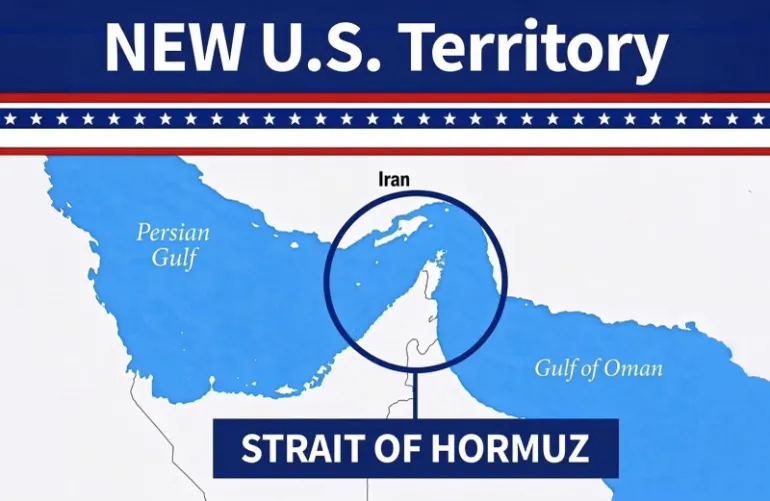
It is the second time in a week that Trump has shared the image; however, this time he included no caption or commentary.
The post comes a day after he told a rally in South Carolina that he viewed “the Strait of Hormuz as an American territory right now”.
|
|
Can an attacking war belligerent claim an international waterway as its territory?
An attacking nation cannot legally claim an international waterway as its own territory during a war.
International law strictly forbids countries from taking land or water by force.
- UN Charter: The rules of the United Nations state that countries cannot use war to grab land or water.
- Global waters: International waterways allow ships from all nations to pass through. One country cannot change this global rule just by starting a fight.
- No Legal Ownership: Any claim to own an international strait or sea lane through military attack is illegal under international law.
In the context of land grab in Palestine:
The Israelis cannot grab Palestinian land by force. Every new phase of expansion by force will not be recognized but considered it does not exist, even when the Israelis will say in negotiations: "We've been there already"
|
Macron, Saudi crown prince to meet in Paris, discuss Hormuz situation
French President Emmanuel Macron will host Saudi Crown Prince Mohammed bin Salman in Paris for a two-day visit starting today.
During the trip, the two leaders are expected to talk about plans to develop alternative routes to the Strait of Hormuz, The Associated Press cites officials in the French presidency as saying.
Proposals include increasing trade through Omani ports outside of the Gulf, expanding or doubling pipelines in Saudi Arabia and elsewhere and developing new rail links, the officials said.
On Monday afternoon, Macron and the Saudi crown prince will chair the inaugural meeting of the Saudi-French strategic partnership council.
Macron’s office said they will discuss “key regional issues, in a context calling for close coordination between France and its Gulf partners to foster stability and peace” in the Middle East.
|
|
|
Iranian hackers shut down a UK power plant last month
Hackers affiliated with Iran shut down a British power plant for four days in an unprecedented cyber attack in July.
The incident took place at the same time as a series of attacks on US water infrastructure last month, which affected 12 states and caused concern in the White House, according to British newspaper The Telegraph, which reported the news.
It is understood that the plant affected was relatively small. The UK is home to dozens of smaller power plants dotted across the country, many of which only come online intermittently.
The government did not reveal which plant was attacked, citing security concerns.
Major cyber attacks on the UK have previously brought down National Health Service Systems, locked schools out of their IT services, and affected commercial manufacturing facilities, including that of Jaguar Land Rover.
|
|
|
US to apply more economic pressure on Iran
US President Donald Trump has threatened to launch an “economic D-Day” against Iran. But with so many sanctions already targeting the country, what measures could he implement to ramp up pressure?
- Targeting independent Chinese refineries: China’s independent refineries, known as “teapots”, buy large volumes of Iranian oil. However, these independent refineries are harder to deter through sanctions since they have little exposure to the US financial system.
- Sanctioning large Chinese banks: The US Treasury has warned two large Chinese banks that they could face secondary sanctions if they process Iranian funds. Hitting those banks could severely hurt China’s financial system, but also trigger possible retaliatory action.
- Land blockade: Some US and Israeli officials have reportedly raised the idea of imposing a land blockade on Iran, which would disrupt its imports of food, energy and other crucial goods. However, such a plan would require unlikely cooperation from all of Iran’s neighbors – Iraq, Turkiye, Pakistan, Afghanistan, Turkmenistan, Azerbaijan and Armenia.
- Secondary tariffs: Trump has repeatedly threatened tariffs on goods from countries that do business with Iran, though the plan faces challenges with Congress and the courts.
|
|
|
President Pezeshkian says Iran is in ‘a full-scale war’
Iran’s president has said: “We are in a full-scale economic, military and security war”.
Masoud Pezeshkian also said in his televised speech that the government is “ashamed” that there are significant problems in the economy.
“[US President] Trump easily says that they will impose the most crushing or the most terrible sanctions on Iran,” added Pezeshkian. “We are standing and trying to serve the people in the face of this unequal war.”
|
|
|
World is amazed by Iran’s ‘resistance, solidarity and cohesion’: Pezeshkian
Iran’s president says Washington falsely predicted before the war that the country would fall amid US aggression and become like Venezuela.
“The enemy had assessed that if Iran falls, it will become Venezuela,” he said in a televised speech.
“Not only did it not happen, but it became a power that amazed the world with its resistance, solidarity and cohesion.”
Pezeshkian said Iran’s enemies hope to “create division and rift in society through problems”.
“We will try with all our might to avoid division, rift, conflicts and egos,” he concluded.
|
|
|
Strait of Hormuz deadlock continues amid Tehran-Washington standoff
The diplomatic standoff between Tehran and Washington continues, as does the deadlock over the Strait of Hormuz.
Starting in February, when the war began, Iran announced the closure of the strait. The Islamabad Memorandum of Understanding was later supposed to pave the way for its reopening. However, Iran subsequently said the United States had not fulfilled its commitments under the memorandum and closed the Strait of Hormuz again.
There is a sort of holding pattern when it comes to this geostrategically significant choke point. From time to time, Iranian authorities have given some ships, vessels and oil tankers the green light to transit through the important waterway.
Recently, Iran’s state news agency IRNA reported that some Iraqi oil tankers had been allowed to transit through the strait.
However, the overall situation in the Strait of Hormuz remains vague. Iran has been involved in talks with Oman to find arrangements for reopening the strait, but so far no deal has been reached, despite what Tehran has described as good progress.
In the larger context, the United States remains another determinant when it comes to the closure of the strait, with Iranian officials saying that as long as the naval blockade continues, the strait will remain closed.
|
|
|
Iran’s Pezeshkian stresses need to move beyond ‘no war, no peace’ situation
President Masoud Pezeshkian has stressed the need to move beyond what he called a “no war, no peace” situation.
In a speech quoted by state media, Pezeshkian said Iranian officials were discussing almost daily how to move beyond the situation and reach an understanding that would preserve Iran’s principles and values, while deterring adversaries from contemplating another attack.
He said war offered no solution, while prolonged uncertainty about whether fighting could resume was also taking an economic toll on the country.
Pezeshkian warned that investment would be difficult to attract as long as the threat of renewed conflict persisted, stressing the need to overcome the situation through logic while maintaining Iran’s strength.
The president also defended the recent memorandum with the US, saying it contained no provision that amounted to capitulation or required Tehran to make concessions.
“What was achieved in the process of the memorandum of understanding – after long discussions and talks – was an expert consensus of all those who had a hand in the fire.
“From the warriors who fought, to the managers who maintained the security of the people and the executives, legislators and judges who were present in the field of action.
“If we stood our ground and did not bow down to the enemy, it was because of these people,” he concluded.
|
|
|
Pakistan army chief to visit Tehran on Monday
Pakistan’s army chief, Asim Munir, will visit Tehran on Monday, says Iran’s Foreign Ministry spokesman, as reported by Fars news agency.
Esmaeil Baghaei said the visit is aimed at strengthening bilateral cooperation and continuing what he described as Pakistan’s “sincere efforts” to help promote peace and security in the region.
|
|
|
War on Iran has led to ‘a new geopolitical awakening’
The war on Iran has led to “a new geopolitical awakening”, particularly greater public awareness of the strategic importance of the Strait of Hormuz and its potential influence on Iran’s foreign policy and regional position, says Iran’s army spokesman.
Brigadier General Mohammad Akraminia added that Iran’s military doctrine had gradually shifted from a predominantly “defensive” posture towards a more “proactive” approach during the recent two wars.
He stressed that did not necessarily mean initiating conflicts, but rather maintaining the capability to respond rapidly and forcefully to aggression.
The military was using the current ceasefire period to rebuild damaged systems, introduce new capabilities and train staff, he added.
|
|
|
Six countries push EU for windfall tax on oil firms
Six European countries are urging the EU to impose a windfall tax on oil companies that have seen profits increase dramatically since the start of the war on Iran.
The AFP news agency reports that it has seen a draft letter from Germany, Italy, Austria, Poland, Portugal and Spain which says, “Oil companies are enjoying overall profitability and margins on refined products that exceed the rise in crude oil prices”.
“We are experiencing one of the biggest supply shocks in decades and all over the world there is growing discontent about the rise in the cost of living,” the letter adds.
The countries are pushing for their call to be discussed at the EU finance ministers meeting in Dublin next month.
A windfall tax is implemented on companies or sectors enjoying sudden large margins of profit, usually during periods of war or other unforeseen circumstances. The EU levied a temporary windfall tax on energy companies after Russia invaded Ukraine in 2022.
|
|
|
Iran sees economic, diplomatic and military pressures as linked, expert says
The US strategy of using its markets, technology and resources to force compliance in its economic warfare against Iran on other countries might prove to be wrong, said academic Paul Musgrave.
“They are running the risk of seeing that thesis be dramatically reversed simply because other countries do have options. And even if they don’t have options, as we’ve seen with Iran, you’ve seen them just unwilling to give up core issues of sovereignty, because countries don’t back down when they see something as more important than money,” said the associate professor of government at Georgetown University in Qatar.
Tehran views the pressures the country is facing as interconnected. “They are consistently signaling that they may view this not as a new phase of the war, one that’s only economic, but one in which the economic, diplomatic and military are all linked directly, making military valid,” Musgrave said.
The US is set to announce its so-called D-Day warfare package on Monday, which further targets the Iranian economy. Iran has been facing increased economic hardship for months due to reduced oil exports. The UAE, Iran’s second-largest trading partner, announced that it was cutting economic ties the day before the US announced renewed economic sanctions.
The IRGC “seem much less interested in economics, much more interested in politics”, he added.
|
|
|
China hosted Iran’s deputy foreign minister in Beijing last week
The deputy foreign ministers of China and Iran met last week in Beijing, according to a statement from China’s Foreign Ministry.
China is Iran’s largest trading partner. No details were released on the topics discussed.
|
|
|
Iranian army official credits war with strengthening national unity
Strong government support for the military during the war against the United States and Israel is a key factor in maintaining military capabilities, Iranian army spokesperson Brigadier General Mohammad Akraminia has said.
In an interview with the official IRNA news agency, Akraminia said the government had adequately met the armed forces’ budgetary and financial requirements despite Iran’s economic difficulties during the war.
Cooperation between the government and armed forces remains strong, he said, adding that the conflict has strengthened national unity and created greater geopolitical awareness among Iranians.
Akraminia also said that strengthened national cohesion is one of the major outcomes of the war, as Iranians rallied around the country, its national interests and the leadership.
|
|
|
Iran’s FM says Trump’s economic war an ‘old US bullying tactic’
Foreign Minister Araghchi says Trump’s economic pressure campaign against Iran is part of what he described as Washington’s longstanding “bullying” tactics.
“Economic warfare is a recurring scenario and the same old bullying tactic in American policy,” he said. “It’s a familiar movie that we’ve seen many times, and we know how to deal with it.”
Araghchi said Washington’s renewed use of military threats and claims of possible attacks showed that it was “desperate in the face of the Iranian nation” and had “no new solutions”.
|
|
|
Iran announces major gas discovery in Fars province
Iran has announced a major gas find – more than 7.5 trillion cubic feet (212 billion cubic meters) worth “tens of billions of dollars”, according to the Fars news agency.
Oil Minister Mohsen Paknejad said around 5.7 trillion cubic feet (161 billion cubic meters) of the reserves in southern Iran’s Fars province are estimated to be recoverable, an amount equivalent to roughly 15 years of production from one phase of the South Pars gas field.
The field also contains significant volumes of gas condensate and the combined resources would create “a new source of wealth for the country”.
|
|
|
War and sanctions are ‘not unfamiliar’ to Iran, says Baghaei
Iranian Foreign Ministry spokesperson Esmaeil Baghaei says war and sanctions are “not unfamiliar” to Iran, noting that the country has been under sanctions for two decades.
|
|
|
Iran should use NGOs to document US, Israeli crimes, says Foreign Ministry
Iran’s Foreign Ministry spokesperson Esmaeil Baghaei says Tehran should make greater use of NGOs to document what he described as crimes committed by the US and Israel for possible use in domestic and international courts.
Speaking at a joint news conference with the head of Iran’s National Organisation for Social Affairs, Baghaei said the government remains in regular contact with “friendship associations” and helps them engage audiences abroad through diplomacy, public diplomacy and cultural work.
He said the impact of US and other Western sanctions on people’s livelihoods, medicine and healthcare was among the issues these groups could highlight, adding that Tehran also supports their participation in international bodies, including the UN Human Rights Council.
“The crimes committed by the United States in Minab, Lamard and Qeshm are just three examples,” Baghaei said. “These crimes are numerous and diverse, and they must be documented.”
|
|
|
US economic war is admission of ‘military defeat’: IRGC
Sardar Mohebi, a spokesperson for Iran’s Islamic Revolutionary Guard Corps (IRGC), says the US resorting to economic warfare against Iran is itself proof of defeat on the battlefield, according to Iranian state media.
Mohebi said the US president’s announcement of an intensified economic campaign against Iran amounts to a “tacit admission” of failure in the military arena. “If you were victorious in the military arena, you wouldn’t have to start an economic war,” he said.
Economic pressure is nothing new, he said, noting that Iran has faced sanctions on its “economic pillars” for 47 years. He added that the US goal now is simply to “create perception” and shape public belief.
Mohebi said the IRGC has “a scenario for every hostile action” by the US, including plans to blunt the effects of economic war and expand relations with other countries. He claimed Iran is already “bypassing America” through economic interactions with the US itself, saying the results would become visible “in the near future.”
|
|
|
US ambassador holds ‘fruitful conversation’ with Omani diplomat in Muscat
The US embassy says Ambassador Ana Escrogima has held a “fruitful conversation” with the Omani Foreign Ministry’s undersecretary for political affairs, Sheikh Khalifa bin Ali Al Harthy.
According to the US embassy’s statement on X, the discussion focused on “advancing US-Oman collaboration and our joint efforts toward regional stability”.
Last week, US President Donald Trump threatened to bomb Oman if it “gets in the way” of a peace deal between the US and Iran.
Oman is negotiating with Iran over the reopening of the critical Strait of Hormuz.
|
|
|
Iran’s parliament speaker mocks US economic woes
Iranian Consultative Assembly Speaker Mohammad Bagher Ghalibaf has appeared to take jabs at the US as Americans grapple with high food and fuel costs during the war.
In a post on X, Ghalibaf mocked Trump’s recent move to allow the import of 300,000 tonnes of cheaper ground beef on much lower tariffs in a bid to ease price pressures.
“Importing frozen meat to fix meat prices. Okay, that might work,” Ghalibaf posted.
“What’s the plan for bonds, import frozen yields? Frozen homebuyers for housing? Frozen paychecks for wages? A frozen foreign policy delivers a frozen economy,” Ghalibaf continued, referencing other problems facing the US economy.
|
|
|
Iranian government preparing public for fuel price hike
With the United States’ siege of Iran’s seaports and the economic impact of the war continuing, the offer of heavily subsidized fuel to the country’s 93 million population is a burden that the government is struggling to afford.
The International Monetary Fund predicts that Iran’s gross domestic product (GDP) will contract by 5.4 percent in 2026.
Hiking the price of petrol in this oil-rich country has already sparked unrest before, including nationwide demonstrations in 2019. Such measures also preceded the January 2026 protests by several weeks.
So authorities are treading carefully, with a final decision expected over the coming weeks.
|
|
|
Pakistan intelligence chief meets Bahrain’s crown prince in Manama
Bahrain’s Crown Prince Salman bin Hamad Al Khalifa has met Pakistan’s intelligence chief and national security adviser, Lieutenant-General Muhammad Asim Malik, in Bahrain’s capital Manama, according to Bahrain News Agency.
The crown prince highlighted Pakistan’s critical role, alongside its allies, in strengthening the foundations of regional security and stability.
The two discussed ways to address the latest regional and international developments and ways to enhance cooperation.
|
|
|
US to enter ‘new phase’ in Iran war ‘very soon’: US House speaker
Mike Johnson, the speaker of the US House of Representatives, has told Fox News that he expects the war with Iran to enter “a new phase”.
“I think we’re going to get into a new phase here very soon. I believe our allied nations are going to assist in the next phase, and we’ll get this finished,” Johnson said in an interview on Fox News on Sunday.
He claimed that President Trump managed to prevent Iran from possessing nuclear weapons, which was “a goal for all previous administrations”.
“People know we took the head off the snake,” Johnson said. “You can’t trust the Iranians on the other side of the negotiating table. That’s the challenge.”
|
|
|
‘New balance of power’ in Middle East brought Saudi, French positions closer
Jacques Reland, a senior research fellow at the Global Policy Institute and a European Affairs analyst, says the US-Israel war on Iran has shifted the balance of power in the Middle East, thus creating new opportunities for partnerships, for example between Saudi Arabia and France.
“It’s all part of a new ballgame,” Reland said, as French President Emmanuel Macron welcomed Saudi Crown Prince Mohammed bin Salman for a two-day visit to France on Sunday.
“There’s a new balance of power. It’s now a question of Iran threatening to become a central power, and it’s crucial for Saudi Arabia to be able to thwart the Iranian threat in the region and to analyse things in this context,” Reland said.
The researcher suggested that given the new realities, Paris and Riyadh could find common ground on a variety of issues that were previously contentious.
“It’s not just Iran,” he said. “There are also issues [such as] Gaza, on which Palestine, France, and Saudi Arabia proposed a meeting in 2025 on finding a solution. On [the subject of] Israel, Saudi Arabia is no longer talking about the Abraham agreements. Also in Lebanon, where France has always been involved.”
Reland said the two countries were also finding common ground on Syria, where Saudi Arabia was previously “quite mistrustful” of the French position, but where “now both France and Saudi Arabia see eye to eye on the future”.
|
|
|
US forces claims to have redirected 70 vessels during reinstated naval blockade on Iranian ports
The US Navy claims its forces have redirected 70 commercial vessels, disabled three and boarded two to ensure compliance with its reimposed blockade on Iran’s ports since mid-July, up from 68 redirected two days earlier.
More than 20 warships, including the guided-missile destroyers USS John Finn and USS Ross, are supporting the blockade.
The update followed Trump reposting a map on Truth Social that labels the Strait of Hormuz as “NEW US Territory”, a day after he told supporters at a rally that he considers the strait “American territory”.
|
|
|
Iran’s parliamentary commission approves draft law on Hormuz service fees
The Iranian parliament’s National Security and Foreign Policy Commission has approved Article 3 of its “Strategic Action to Ensure the Security and Progress of the Strait of Hormuz” plan, according to which ships of countries permitted to pass through the Strait of Hormuz will pay for the services provided by Iran.
Iran’s state-run IRNA quotes the spokesman for Iran’s National Security and Foreign Policy Commission of the Islamic Consultative Assembly saying “Based on Article 3, a fee will be charged for services including maritime, environmental, fueling under special conditions, insurance, safety, and other services provided in the Strait of Hormuz”.
“The Persian Gulf and the Strait of Hormuz have their own rules and conditions, and in this regard, after accepting the 1982 Convention on the Law of the Sea, the country of Oman immediately issued a political declaration emphasizing that the provisions of this convention should not violate the country’s national sovereignty and national security”, it said.
Committee spokesperson Hassan Qashqavi said the fees would be collected from vessels belonging to countries permitted to pass through the strait and paid in Iranian rials or another currency designated by Tehran.
He added that the draft legislation takes into account the rights of states bordering the Strait of Hormuz.
|
|
|
Traffic through Hormuz, Bab al-Mandeb ‘at reduced levels’
Commercial traffic through the Strait of Hormuz has remained at reduced levels over the past 48 hours, according to the latest report by the United Kingdom Maritime Trade Operations (UKMTO).
“Independent tracking data indicated suppression with single-digit numbers transiting in both directions,” UKMTO said.
It reported no confirmed attacks or disruptions, but added that the threat of Iranian attacks and “harassment activity persisted including UAV overflight, targeted surveillance of merchant shipping and occasional VHF hailing”.
These actions, UKMTO said, “continue to demonstrate Iran’s intent to assert presence along key transit lanes and maintain pressure on transiting vessels”.
Meanwhile, UKMTO said commercial traffic through the Red Sea and Bab al-Mandeb Strait also “continues at reduced levels” following the 20 July naval blockade against Saudi Arabia by Yemen’s Iran-allied Houthi group.
|
|
|
Iran believes ‘restraint invites more aggression’
Tehran has moved from a defensive posture to an offensive one in its standoff with Washington, according to Ali Akbar Dareini, a researcher at Tehran’s Center for Strategic Studies.
President Pezeshkian’s statement that returning to the memorandum of understanding (MoU) remains the best way out of the conflict “only means that Iran has provided an off-ramp for Trump”, Dareini said, adding that Washington must return to its obligations under the MoU before anything else can happen.
In the absence of that, he said, Iran shifted its approach after concluding that “restraint invites more aggression”.
On sanctions, Dareini said Iran has “got accustomed to sanctions” over 40 years and has “a PhD in circumventing sanctions”, adding that while the measures inflict real pain on the country’s 90 million people, “Iran doesn’t fear the US strategy”.
He added that Iran is warning neighbouring states against hosting US military bases, arguing “those bases are against Iran, and those bases are to protect Israel”, and that Tehran “cannot expect … to remain idle” while they are used against it.
|
|
|
Iran’s security chief doubles down on threats against Trump’s ‘economic war’
Iran’s top security official has repeated threats to retaliate against Trump’s proposed sanctions against Tehran, in a post on X.
Mohsen Rezaei, Iran’s secretary of Iran’s Supreme National Security Council, wrote in English: “If the economic war continues, not a single drop of oil will be exported٫ neither through the Strait of Hormuz nor from anywhere in the Persian Gulf. Iran will regard any country’s participation in or support for America’s economic war against the Iranian people as an act of war.”
|
|
|
US could target countries involved in oil trade with Iran, including China
David Des Roches, a former Pentagon director of Arabian Peninsula affairs, about what measures the US could announce on Monday.
Des Roches said the US could target countries involved in oil trade with Iran. For example, in China, where small-scale refiners process Iranian crude, not only could the refineries be targeted, but individual municipal officials in these areas could be directly sanctioned, too, he said.
“That’s pretty important because we know a lot of the Chinese leadership, they try to maintain a foothold in the United States,” he said. “Sanctions by definition are most effective when they are targeted at the potential trading partners.”
Des Roches emphasized that while it’s unclear what the US will do, what is certain is that the US has a lot of economic power that it has not yet deployed in its war on Iran.
The US “has not achieved its goals through military might”, Des Roches noted. One way out of a failed bombing campaign, he said, could be to arm dissident groups in Iran to target the government.
Still, Iran is “not a victorious country”, Des Roches said. The evidence, he noted, was in the shake-up of the security cabinet recently, which he said proves that Iranian leadership recognizes the threat posed to the “Revolutionary Guard regime”.
|
|
What does international law say when an attacking belligerent forces other countries under threat of sanctions to stop trade with the country it is attacking?
International law generally views the threat of secondary sanctions to force third-party countries to stop lawful trade as an unlawful act of economic coercion and a violation of state sovereignty.
- Article 2(1) of the UN Charter, all member states have equal sovereign rights. A state cannot dictate the internal or commercial policies of another independent nation.
- The International Court of Justice established in the Nicaragua case that economic coercion aimed at forcing a sovereign state to change its lawful policy choices is a breach of the customary rule against intervention.
- Traditional laws of neutrality allow third-party countries to maintain normal commercial and trade relations with belligerent nations, provided they do not supply direct military assistance or violate a legally recognized naval blockade.
- Forcing foreign banks, companies, or ports to cut off civilian trade under threat of financial penalties treats domestic entities of other nations as subject to a foreign power's domestic laws, which violates jurisdictional limits.
Many nations and regional bodies (such as the European Union) treat unilateral secondary sanctions as illegal extraterritorial overreach.
Some governments pass specific domestic laws—known as blocking statutes—to legally forbid their local businesses from complying with foreign secondary sanctions.
|
Iran warns vessels repeatedly violating its Hormuz instructions
The Iranian Persian Gulf Strait Authority (PGSA Iran) says vessels violating Iranian regulations governing passage through the Strait of Hormuz “will face restrictions on their future voyages”.
“In light of violations by certain vessels of the Iranian arrangements for transiting the Strait of Hormuz, these vessels will face restrictions in their future transits through Strait of Hormuz, such as fines, seizure, or confiscation,” a statement on X by PGSA Iran said.
It warned that vessels cooperating with the restricted ships will be added to a list of violators and emphasised that cargo owners wishing to have their names removed from this list must submit a request with supporting documentation.
The authority urged shipping companies and cargo owners not to use these ships to avoid problems by searching for proscribed vessels on its “noncompliant vessels list” portal.
|
|
|
