| Highlights from yesterday |
|
Comments |
- US President Donald Trump said he cancelled “scheduled strikes and bombings against Iran” and that a deal with Tehran could be signed as soon as this weekend.
- Iran’s Foreign Ministry spokesman Esmaeil Baghaei said Tehran had agreed to much of the draft text of a potential deal but still had “red lines”.
- India’s Shipping Minister Sarbananda Sonowal confirmed that three missing Indian seafarers were killed in a US attack on an oil tanker in the Gulf on Wednesday.
- Israeli forces continued their deadly attacks across Lebanon, including one that injured 10 hospital staff in the southern city of Tyre on Thursday.
- Israel’s army said it has seized “operational control” of the area north of Lebanon’s Wadi Saluki stream, 10km (six miles) from the Israeli border inside Lebanese territory.
- The World Bank has warned that the war on Iran could slow global economic growth to its lowest levels since the COVID-19 pandemic.
|
|
|
Trump says he ‘cancelled the scheduled strikes’ against Iran
Trump says he has cancelled the scheduled bombings of Iran following earlier warnings that he would attack it “very hard”, citing what he described as a breakthrough in high-level negotiations with Tehran.
|
|
|
‘Positive understanding’ in Tehran on proposal, but final signing ‘subject to consideration’
There is a positive understanding about this memorandum of understanding.
The Ministry of Foreign Affairs, through its spokesperson, told the media this evening that, yes, there is a proposal; it is now under consideration by the supreme leader of Iran, and also the top leaders of the country, and that it might well end in a kind of signing.
But the news about a location and timing are probably speculations at this moment.
Also, there is no complete agreement by the Iranians on this yet, subject to consideration.
He also mentioned that this agreement is almost the same as the one that was agreed on in principle between the two sides with the Pakistani mediation before the recent strikes, and the Americans have chosen two things… to demand for more modifications on the agreement, out of greed. They went to those military strikes to frame the Iranian approval or potential approval today as something that has come under military pressure.
He is basically showing that the Iranians are, on the one hand, almost on the same page with the Americans, but also, not yet, not completely, not absolutely, because they are still studying the details, and at the same time, they are not fully trusting the American side.
They are still suspicious about whether the Americans, this time around, are serious about this peace deal proposal, or whether they will suddenly change their minds, as they used to do, and begin a new course of action against Iran, as they did several times during the last couple of months.
|
|
|
Hezbollah claims 24 attacks on Israeli forces in south Lebanon
The Lebanese armed group Hezbollah announced it has launched a series of drone, missile and rocket attacks targeting Israeli military personnel, armored vehicles and positions across southern Lebanon and the Bekaa Valley region.
According to the statement detailing operations from Wednesday through Thursday, Hezbollah said it repeatedly targeted gatherings of Israeli soldiers and armored vehicles, particularly focusing on the al-Rajman area in the vicinity of Tayr Harfa, which was struck four separate times.
Gatherings of Israeli troops and vehicles were also targeted in the Lebanese towns of Naqoura, al-Qaouzah, Rashaf, al-Qantara, Zawtar al-Sharqiyah and Yohmor al-Shaqif, it said.
|
|
|
French, Lebanese foreign ministers discuss end to fighting in Lebanon
Lebanon’s foreign minister, Youssef Raggi, has met with his French counterpart, Jean-Noel Barrot, amid ongoing negotiations to end fighting between Israel and Hezbollah in Lebanon.
According to a summary of the meeting, released by Raggi, Barrot described the Lebanese government’s position – which includes participating in mediated talks with Israel – as “courageous”.
Raggi “expressed the hope that these negotiations will lead to a ceasefire and a complete Israeli withdrawal”.
He also emphasized that the “decision to reserve the right to bear arms to the State has been taken definitively and irrevocably”, Raggi wrote in a post on X.
|
|
|
Trump says ‘we ended the war with Iran today’
Trump has again spoken about negotiation with Iran during a tele-rally in support of Senate candidate Barry Moore, claiming that the war is now over.
“I don’t know if you heard, but we ended the war with Iran today, and they have agreed never to have a nuclear weapon, something that we, we insisted on,” Trump said.
Later in the call, Trump made similar comments, saying: “Today, we settled up with Iran”.
“We made a great deal. There’ll be no nuclear weapons. People will start coming home very soon. It’s pretty much, pretty much completed. We got everything we wanted.”
“The big thing is there will be no nuclear weapons in Iran. That means not developed and not purchased,” Trump said.
“They had a clause they won’t develop. I said, ‘What about purchasing?’ They said, ‘Well, we didn’t cover that.’ So, two days later, they agreed to that. We got everything we wanted,” he said.
|
|
|
As US changed tactics, Iran understood ‘no war, no peace’ unsustainable
Arman Mahmoudian, professor of international affairs at the University of South Florida, spoke to Al Jazeera earlier about the negotiations between the US and Iran.
“We witnessed a major shift of behavior,” Mahmoudian said about Washington’s tactics.
“On June 7, the United States was pushing Israel to restrain from further attacks or retaliatory attacks against Iran, and then, by June 9, we have the United States attacking Iran, and on June 10 attacking again,” he said.
“There is a great deal of shift of diplomacy within less than a week. It showed to everybody that the current status quo – the current ‘no war, no peace’ – was not sustainable.
“Either it is going to resolve in a war, or it has to be a deal that comes out of it. There is no third option in it,” he added.
“I think the Iranians understood that.”
|
|
|
US forces report Iranian drones shot down over Strait of Hormuz
US and international news media have reported that Iran launched drones towards vessels transiting the Strait of Hormuz on Thursday night.
A senior US official told US broadcaster Fox News: “It appears Iran has attempted to strike commercial ships transiting the Strait of Hormuz tonight.”
“US forces shot down two Iranian one-way attack drones,” the official added, according to the report, which was also published by Reuters.
Earlier, Iran’s military said it had stopped a “violating vessel” attempting to pass through the Strait of Hormuz, which has been declared closed by Tehran.
|
|
|
Iran’s priorities in deal with the US: Security guarantees and sanction relief
Professor Arman Mahmoudian from the University of South Florida about the reported agreement Trump announced with Iran:
“Tehran is aiming for two primary issues. The first one must be the security guarantee: that there will be no further attacks against Iran”, which is going to be hard for Trump to give."
While Trump may be able to give a security guarantee on behalf of the US, “there is not a chance he can do the same thing about Israel”, he said.
There is also a concern about whether Israeli Prime Minister Netanyahu will be on board with any deal emerging between Tehran and Washington, he added.
The other major issue for Iran in a deal will be the lifting of sanctions and “immediate economic relief”, as the country’s economy has been badly damaged by the US-Israel war and the US blockade on the country’s ports.
|
|
|
Donald Trump calls off strikes against Iran, citing talks progres
Trump announced the cancellation of scheduled military strikes against Iran, pointing to what he termed a major breakthrough in senior-level talks with Tehran.
Conversely, the Iranian Foreign Ministry stated that Tehran has not yet made a definitive decision on the matter.
During a briefing at the White House, Trump asserted that the “final points” of a deal had been consented to by everyone involved.
|
|
|
Trump applied ‘escalate to de-escalate’ strategy with Iran
Richard Weitz, an international security expert at the NATO Defense College, said that Trump appears to have followed an “escalate to de-escalate” strategy with Iran.
“The idea is, if you have a modest conflict or intense conflict – but not high intensity – such as between Iran and the United States, in order to force an end to it, you can threaten to escalate,” Weitz said.
“That apparently was the purpose of the latest round of US strikes – President Trump’s threats earlier today to seize islands in Iran and so on, and this may have worked,” he said.
“I think we still have a bit of uncertainty over what precisely was agreed and how it will be implemented,” he added.
|
|
|
|
Donald Trump and Netanyahu have long had a friendship.
They’ve also had a shared desire to limit Iran’s nuclear program to ensure it never has a nuclear weapon.
As a result was their launching earlier this year of joint military operations and strikes to attack Iran.
But what we also know, in the midst of that military cooperation, was also a growing concern on the part of the US president that the Israeli prime minister was also threatening to derail efforts in the diplomatic realm.
In recent weeks, what has been spilling into public view is that Donald Trump has increasingly been trying to restrain Benjamin Netanyahu not to retaliate against Iran, in order to, in the words of the US president, allow time for diplomacy.
|
|
"As a result was their launching earlier this year of joint military operations and strikes to attack Iran."
Trump decided to join Netanyahu's war on Iran after being told by his son-in-law Jared Kushner that Iran was going to attack. Netanyahu started his war while Oman was still mediating between Iran and the US in Geneva where Kushner was. He was in contact with the Israelis.
In March 2026, the Pentagon said that Iran was not preparing an attack before February 28th, the day the war on Iran began.
|
UN says 2 Malaysian peacekeepers injured in Lebanon
Two UNIFIL peacekeepers from Malaysia were lightly injured in an attack on a logistics convoy near the village of Harris in southern Lebanon, UN spokesperson Stephane Dujarric has said.
“Their condition is stable”, and “UNIFIL will investigate the incident”, Dujarric told reporters, without specifying who was responsible for the attack.
Separately, Dujarric said that an Israeli military tank fired near a UN convoy near Bint Jbeil, with the convoy taking a detour to “safely resume its movement”.
“UNIFIL peacekeepers also observed significant drone activity in the Biyyada area,” on Wednesday, Dujarric said.
“We once again remind all actors of the inviolability of UN personnel and the UN assets,” the spokesperson added.
|
|
|
US-Iran likely ‘phased deal’; Hormuz Strait opening will benefit Iran, region and world
Richard Weitz, an international security expert at the NATO Defense College about Trump’s announcement of an imminent agreement to be signed with Iran:
“It sounds like it’s a phased deal, with a couple of provisions executed quickly, such as opening the Strait of Hormuz”, and “others to be dealt with later, such as the nuclear question”, he said.
“There is always the risk that you could start off well enough, but then they get bogged down in details later, and that leads to the reimposition or reversal of the achievements of the first phase,” he added.
Regarding the opening of the Strait of Hormuz, Weitz said it is also important for Iran, which needs to export its oil, as well as the US’s Gulf allies and the world economy.
|
|
|
Egypt urges US, Iran to seize ‘available opportunity’ to end war
The Egyptian Foreign Ministry has expressed hope that the opportunity will be seized to reach a final agreement between the United States and Iran.
In a statement released on X, the ministry said that Egypt “followed with great satisfaction and commends what was announced by US President Donald Trump regarding the cancellation of the military strikes that were scheduled to be carried out against Iran”.
Egypt hopes “the available opportunity will be seized to reach an agreement on various outstanding issues and to foster an environment conducive to ending the war and launching a new phase of regional stability”, the ministry said.
Egypt “continues its tireless, serious, and sincere efforts, in coordination and cooperation with regional and international partners, to de-escalate tensions”, it added.
|
|
|
Israeli drone attacks Lebanon’s Jebchit town
Lebanon’s National News Agency and Al Jazeera’s correspondents have reported an Israeli drone strike on the southern Lebanese town of Jebchit in the Nabatieh district.
The extent of the damage and the number of casualties were not immediately known.
|
|
|
Iran weighs proposed deal but remains wary of US intentions
Iran’s Foreign Ministry spokesman Esmaeil Baghaei said in a statement to Iranian media that there is a document being studied by the leadership in Tehran and it is “closer to being approved than ever before”.
But Iran still has doubts about US intentions.
|
|
|
Israeli warplanes strike southern Lebanon’s Arid Debbine area
Lebanon’s NNA news outlet is reporting Israeli air attacks on Arid Dbeibine, an agricultural area surrounding the southern town of Dibbin, in Lebanon’s southern Marjayoun district.
The attack follows an overnight strike on the nearby town of Khiam.
|
|
|
Iranians hopeful of a deal with US despite cloud of mistrust
Iran is saying that it is engaged in the diplomatic trajectory to settle down the [remaining] issues, however, they don’t deny the potential for another round of confrontations.
There is a cloud of mistrust, especially when it comes to the Americans.
They are criticizing the US for changing their position from time to time and that is impacting their approach.
Also, there is still a long list of sticking points.
The situation in the Strait of Hormuz and the naval blockade imposed by the US are among the key issues. But the ceasefire across the region and, in particular, in Lebanon is also a key demand for the Iranians.
Iranians are looking for security assurances to make sure they don’t fall into the vicious circle of a limited period of peace and then another round of confrontation.
Also, war reparations, Iran’s ballistic missiles, Iran’s regional relations – these are all among the issues the two sides should try to resolve, whether on the table of diplomacy or another round of confrontations.
Iranians are hopeful that diplomacy can solve these issues – but not that hopeful.
They have a clear memory of the experience of [being attacked by the US] while their country was holding talks, not once but twice.
|
|
|
Veteran Palestinian politician calls out Israel’s ‘culture of hate’
Hanan Ashrawi, a former member of the Palestine Liberation Organization’s executive committee, has called for accountability for the perpetrators of Israel’s genocide.
“Israel’s culture of hate, supremacy & unbridled violence gave rise to genocide, ethnic cleansing & pogroms,” the former PLO negotiator wrote on X.
Ashrawi, a veteran Palestinian politician, said it was time to call the things that Israel does by their name, and call out those responsible.
“Accountability now,” she said.
|
|
|
President Trump ‘trying to send positive messages to markets’
The United States is talking about a potential memorandum of understanding (MOU) with Iran being close while continuing to change the text of the deal, an analyst says.
“Donald Trump is trying to send some kind of positive messages to the markets and to the global economy,” Mohammad Eslami, from Tehran University, said of the US president’s “close to a deal” comments.
“Donald Trump and American negotiators are trying to make a problem for the existing memorandum of understanding,” Eslami said.
“It is very important to find some kind of solution that the Iranians will get their own money at the starting point of signing the memorandum of understanding. Right now, the Iranians are working with Qatari counterparts on a solution to get the money.”
Supreme Leader Mojtaba Khamenei and his advisers have the last say on the final wording of any agreement, he said.
The Iranians do not want to offer Donald Trump “a kind of victory” when it comes to the MOU, said Eslami.
|
|
|
US president facing domestic pressure to end war on Iran
The US president has been under a lot of pressure, even though he would deny that domestically, because this is a deeply unpopular war that has proved economically very damaging for the American people.
Trump has been feeling this sort of pressure even though there have been some Republican hawks in Congress who urged him not to make a deal that would be too favorable to Iran.
What President Trump has been looking for, most importantly, is an off-ramp. He wants this war to end, he wants the political damage to cease and wants the economy to revive – and he wants all these things to happen before the mid-term elections in November.
He appeared once again optimistic that a deal is in the offing, saying it could be signed in Europe and that he would not be there for it, but Vice President JD Vance would. He says preparations for the signing of the memorandum are in an advanced stage and only require approval from Iran’s senior leadership to be put in place.
|
|
|
The US threat to use Iranian assets to compensate Gulf damage
US Treasury Secretary Scott Bessent says Gulf countries will be compensated for damage caused by Iran attacks with funds taken from frozen Iranian bank accounts.
Last week, Reuters news agency reported the Treasury is asking Gulf states for estimates on how much it would cost to repair damage caused by Iranian strikes.
Bessent also said any tolls paid to the Persian Gulf Strait Authority, which Tehran set up to oversee traffic through the Strait of Hormuz, would be offset by seized funds.
Iran is thought to have at least $100bn frozen in bank accounts around the world – including in Europe, Japan, China and Qatar – as a result of sanctions by the US and other countries. The Islamic republic has had multiple rounds of sanctions imposed on it since the 1979 revolution.
|
|
Under customary international law, a state that commits an internationally wrongful act (such as a war of aggression) has a binding obligation to make full reparation for the damages caused.
To translate into the war on Iran:
Under customary international law, the United States committed an internationally wrongful act by launching a war on nuclear political grounds without authorization from the UN Security Council, and in violation of the UN Charter, to cause major damage and destruction in the country of Iran.
As an attacking war belligerent, the United States has a binding obligation to make full reparation for the damage it has caused in Iran.
|
Unclear if Lebanon included in US-Iran agreement
It is still not clear whether Lebanon is included in any potential deal between the US and Iran, but Tehran has repeatedly insisted that the Lebanese and Iranian fronts cannot be separated.
Lebanon’s government instead insists it is not part of US-Iran negotiations. In the words of President Joseph Aoun, Iran does not speak on behalf of Lebanon, and this is part of a struggle for sovereignty.
The president has talked to Lebanese army commanders because on June 22, there are going to be political and security discussions with Israel in Washington.
The two sides are still far apart on their positions, with Lebanon demanding a full withdrawal of Israeli troops from the south of the country. Israel’s public broadcaster said the government would demand that Lebanon take action against Hezbollah outside the so-called “security zone” before they can even discuss the possibility of a withdrawal.
While there is a lot of diplomatic activity, Israel continues to target southern Lebanon and to widen its ground invasion.
|
|
Lebanon was included in the ceasefire as agreed on April 8, 2026 by all parties involved, as stated in a message posted by Pakistan's Prime Minister Shebaz Sharif on that day.
However, it is Netanyahu who sow confusion by rushing to dictate that Lebanon is not included.
|
Trump attempting to exit ‘strategic disaster’ in Ira
Andrea Dessi, a lecturer in international relations at the American University of Rome, Italy, said the US president is looking for a “face-saving off-ramp” to exit the war on Iran, which has been a “strategic disaster”.
“Trump’s flip-flopping via tweets and social media reflects the divisions within the administration,” Dessi said. “Messaging over the past hours is positive, and we hope that this can bring us nearer to a breakthrough, but everything can change very quickly.”
Leaks of the final document suggest Trump may have dropped a few of his previous requests to reach a deal, he said.
“At the same time, we need to be careful with regards to the messaging because, of course, the US needs to sell this agreement to its own constituency as well as Israel,” Dessi said.
|
|
|
One wounded in latest Israeli attack on southern Lebanon
An Israeli air strike on the small village of al-Bayyad in Lebanon’s Tyre district has injured one person as attacks continue despite a US-brokered “ceasefire”.
Lebanon’s National News Agency reported that the strike occurred on the main street near the Ali Kamal Suleiman Volunteer Center, which is affiliated with the al-Risala Health Ambulance Association. The injured person was then transported to a hospital for treatment.
Israeli attacks on Lebanon have killed at least 3,711 people and wounded 11,483 others since the conflict escalated on March 2. Among the dead are at least 247 children and 132 health workers, the Health Ministry says.
|
|
|
Critical mineral trade surges as energy demand spikes
Critical minerals are reshaping global trade as demand rises for clean energy, electrification and digital technology, the UN Trade and Development agency (UNCTAD) says.
The burgeoning energy crisis spawned by the US–Israel war on Iran has again placed energy security at the centre of geopolitical tensions.
In its June 2026 Global Trade Update, UNCTAD said copper, nickel, lithium, cobalt and rare earth elements have become central to industrial policy, development and geopolitical competition.
The agency said these minerals are essential for electric vehicles, battery storage, renewable energy technologies, semiconductors and data centres.
Demand for lithium is projected to grow by more than 350 percent by 2040, while graphite demand could rise by more than 130 percent, according to UNCTAD.
Australia, Chile and China together produced more than 70 percent of global lithium, while China plays a dominant role in refining several critical minerals.
|
|
|
Hezbollah MP says Lebanon to be included in any US-Iran deal
Hezbollah lawmaker Hassan Fadlallah says any peace deal between Iran and the US would include Lebanon, whether the government accepts it or not.
Speaking during a commemorative ceremony for the group’s fallen fighters in Beirut’s al-Janah neighborhood, Fadlallah slammed the government’s direct negotiations with Israel, which he said brought no relief to southern Lebanon as Israeli attacks continue.
“We do not trust a political administration that makes concession after concession at the country’s expense, especially when no viable or discussable political option has been presented to us,” he said.
Fadlallah said Hezbollah is not opposed to diplomacy “grounded in strength” through indirect negotiations, and argued Lebanon’s government is negotiating with Israel on matters it cannot fulfill.
Earlier this month, Israel and Lebanon agreed to implement a ceasefire requiring a “complete cessation” of fire by Hezbollah after US-led talks in Washington, DC.
“We currently have no choice in facing this existential aggressive war targeting Lebanon – especially the south – except to continue resisting, standing firm, and enduring no matter the pain, sacrifices, and costs,” Fadlallah added.
|
|
|
Is Israel’s ‘buffer zone’ inside Lebanon an attempt to grab gas reserves?
Israel’s imposition of a “security buffer zone” in southern Lebanon that extends into Mediterranean waters has alarmed experts who say it’s a bid to occupy Lebanon’s maritime territory, which has potential oil and gas reserves.
A map of the “buffer zone”, which is demarcated by what Israel calls the “yellow line”, was announced by Avichay Adraee, the Israeli army’s Arabic-language spokesperson, on April 19, days after the United States brokered a ceasefire between Israel and Lebanon.
Israel claimed it required the buffer zone – which stretches roughly 10km (6 miles) north of the Lebanon-Israel border and represents about 6 percent of Lebanese territory – to prevent attacks from Hezbollah fighters.
Experts says the announcement not only violates the ceasefire but also absorbs Lebanon’s Qana gas project, whose exploration rights were explicitly guaranteed to Lebanon under a 2022 US-brokered maritime border agreement with Israel.
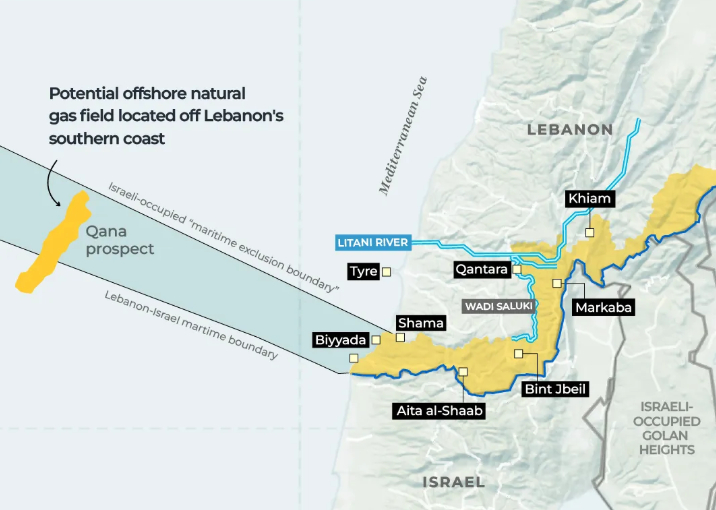
|
|
|
Iran calls reported 14-point peace deal text ‘media speculation’
The reality on the ground is we’ve got a lot of sticking points when it comes to an agreement: the situation in the Strait of Hormuz, war reparations, the removal of naval blockades, the dropping of sanctions, and the freeing of Iran’s frozen assets.
We’ve got a 14-point draft, as reported by several media outlets in Iran, but the spokesperson for the Ministry of Foreign Affairs says this is just media speculation. It remains unclear whether this will end up in a long-lasting peace or at least a short opportunity for the two sides to further continue talks.
This is something that we have to keep waiting to see.
Meanwhile, it’s not an easy situation for the Iranian people. They’ve witnessed this war and have lived in its shadow for more than a year.
There is a slim hope among people, however, that if a negotiated settlement could be reached, it will end devastating sanctions and would result in better livelihoods for citizens. This is a very intricate situation for not only Iranian politicians but ordinary Iranians as well.
|
|
|
Iranian military official says Hormuz ‘firmly’ under IRGC Navy control
Admiral Habibollah Sayyari says the Strait of Hormuz is firmly under Iran’s control and it continues to wield “power” over the Gulf region.
“The west of the Strait of Hormuz, the strait itself, and the Persian Gulf are under the firm control of the IRGC Navy,” Sayyari was quoted as saying in Iranian media reports. “No vessel can enter without our permission.”
Sayyari, deputy coordinator of the Iranian army, also responded to US claims that it wiped out Iran’s navy.
“They say that the Iranian navy has been damaged. If they are men, let them come forward. We have had and continue to have power in the region.”
|
|
|
Mixed reactions in Israel to possible US-Iran deal
Netanyahu issued a brief statement saying US President Trump would keep Israeli priorities in mind in his deal-making with Iran, namely decommissioning Iran’s uranium and its ability to produce missiles.
The minister of energy in Israel went further, saying Israel doesn’t need to commit to any agreement that does not take into account its goals and priorities, and that Israel could go at it alone.
Of course, this is a bit of a stretch because if you speak to military analysts, they’ll tell you that Israel still relies heavily on US support. The worry now is that it’s not just Iran but limitations to Israel’s attacks on Lebanon as well, and that is going to cost the Israeli prime minister a lot of support.
Netanyahu has already seen his numbers dip and elections are coming up in just a few months, before even the mid-term elections in the US, and that is causing a lot of concern.
|
|
|





