| Highlights from yesterday |
|
Comments |
- Iran’s Foreign Minister Abbas Araghchi says Tehran is waiting for an official response from the US on its proposal to reopen the Strait of Hormuz.
- His comments come after US President Donald Trump rejected Iran’s seven-day roadmap, saying Tehran is “losing so badly” and that their deal was not “acceptable”.
- Iran’s President Masoud Pezeshkian says that Tehran no longer trusts talks with Washington, saying each round of negotiations has been followed by more attacks and sanctions.
- Hundreds of people have rallied in Liverpool, calling on the United Kingdom to impose a comprehensive ban on arms sales to Israel.
|
|
|
| |
|
|
| |
|
|
UNGA Summit
|
|
|
| |
|
|
Saudi Arabia accuses Iran of ‘flagrant attacks’ and condemns Houthis in UN address
Saudi Arabia has used its address to the UN General Assembly to accuse Iran of flagrant attacks on civilian and economic targets across the region, while calling on the international community to condemn Houthi actions threatening Red Sea shipping.
|
|
|
Iceland hits back at Netanyahu’s ‘moral cowards’ remarks
Iceland’s Foreign Minister Thorgerdur Katrin Gunnarsdottir has responded to Israeli Prime Minister Benjamin Netanyahu’s denunciation of Israel’s critics as “moral cowards”.
Addressing the UNGA, she said the world must not let “the suffering of Palestinian civilians” become “background noise”, noting that children are still being killed, families are still losing their homes and parents are still trying to keep their children alive – “again and again and again”.
“We have heard the words ‘moral cowards’ from this podium,” Gunnarsdottir said. “To me, moral cowards are those leaders who refuse to sit down and negotiate a just and lasting peace. Moral cowards are those who deny access to humanitarian aid for people in desperate need, and those who repeatedly disrespect international law.”
She said the world cannot accept Gaza being “repeatedly destroyed and rebuilt” while the underlying cause remains unresolved.
|
|
|
China urges respect for sovereignty of Gulf nations at UNGA
China’s Vice President Han Zheng has called for respect for the sovereignty and security of nations in the Middle East as he addressed the UNGA.
“China holds that the sovereignty and security of countries of the Middle East, including the Gulf, should be respected. International industrial and supply chains should be kept stable and unimpeded, and global trade should be safeguarded,” he said.
Han also called for Palestinian sovereignty and for the rebuilding of Gaza.
“China calls for advancing the governance of the West Bank and a post-conflict reconstruction of Gaza, in accordance with the principle of the Palestinians governing Palestine,” he said.
|
|
|
Iranian FM Araghchi meets UN humanitarian chief
Abbas Araghchi has met Tom Fletcher on the sidelines of the 81st session of the UN General Assembly in New York City.
According to a statement by Araghchi’s office, the status of humanitarian aid in crisis-stricken areas and avenues for cooperation between Iran and UN bodies were reviewed.
The foreign minister also highlighted “the humanitarian catastrophe” ongoing in the war-battered Gaza Strip and occupied West Bank resulting from the genocide committed by Israel.
Araghchi brought up the displacement of hundreds of thousands of people in Lebanon from continuous Israeli attacks and occupation, urging the United Nations and international humanitarian organisations to act.
|
|
|
| |
|
|
| |
|
|
| |
|
|
| |
|
|
Trump rejects Iran’s proposal but offers no alternative plan
There had been a lot of discussion going on between the US and Iran through intermediaries on the sidelines of the UN General Assembly in New York. And at one stage, President Trump said that these negotiations were going well.
But now he said that he’s rejected the Iranian proposal that emerged out of those negotiations.
The president says that he’s not interested in what the Iranians suggest. He says that they’re only trying to make this deal because they are suffering because of the blockade of the Strait of Hormuz, which he continues to insist is causing massive economic pain.
He claims as well that some 20 ships passed through the Strait of Hormuz in the course of the last 24 hours, insisting that oil is still flowing there despite the evidence of experts to the contrary.
He is now saying no; he’s rejected the Iranian plan. But he has given nothing to put in its place. And some media sources are reporting that Trump’s aides are saying that he’s considering starting a new bombing campaign after the midterms.
This may be something that has happened before – an idea being floated in public to kind of gauge the public reaction. Public reaction is likely to be seen when the voters go to the polls in those midterm elections.
|
|
|
Iran’s seven-day proposal for Hormuz
Iran’s FM Abbas Araghchi laid out Tehran’s proposal to reopen the Strait of Hormuz within seven days at the sidelines of the United Nations General Assembly.
Last Friday:
- Trump said the proposal calls for the US to take actions it committed to under the failed June 17 Islamabad Memorandum of Understanding (MoU) on an accelerated timeframe.
- Those actions include releasing $12bn in frozen Iranian assets, lifting Iranian oil sanctions and ending the US’s naval blockade on Iranian ports.
- He also said all hostilities, including in Lebanon where Israel still occupies part of the south of the country, must cease during the seven-day period.
- Once the US conditions are met, which Araghchi estimated would take four or five days, the Strait of Hormuz could be reopened and negotiations with the US on a “final deal” would start on day seven, he said.
- He added that the process could begin as soon as the US accepts the plan.
|
|
|
Araghchi says Iran ‘will not back down’ from its conditions
Iran’s foreign minister has said that Tehran is still awaiting an official response from the US on its plan to reopen the Strait of Hormuz.
He has issued a detailed statement on his Telegram channel.
Here’s what he said:
- The main aim of all of Iran’s meetings at the UNGA was to state its conditions for the reopening of the Strait of Hormuz and the resumption of talks. These conditions were set by the country’s Supreme National Security Council.
- These terms were fully explained to the mediators, who conveyed them to the US.
- “We have seen the first reaction from the US president, but nothing has been conveyed to us from the mediators yet.”
- Trump has often made many “contradictory statements”, and “we are waiting for the definitive opinions to be conveyed to us” by the mediators. “We will make a decision based on that.”
- The reopening of the Strait of Hormuz is contingent on the fulfillment of Iran’s conditions. “We will not back down from them.”
- “There is no one in the world now who can accuse the Islamic Republic of Iran of not having tried the path of diplomacy … We are in a superior political position because we have never closed the path of diplomacy and negotiations, but we have never renounced our rights either.”
|
|
|
Iran likely ‘not surprised at all’ by Trump’s rejection of Hormuz plan
Ross Harrison, a senior fellow at the Middle East Institute, says Iran’s seven-day plan to reopen the Strait of Hormuz is a show of goodwill towards the US.
“I think they are trying to show the willingness to talk and negotiate,” he told Al Jazeera. “That’s what’s important for their home audience back in Iran. And it’s also important for the American public, which is why [Iranian] officials came to New York this week,” he said.
The analyst added that Iran’s leaders likely expected Trump to reject the proposal, since it is the same as the Memorandum of Understanding signed in June.
The Iranians believe “the Americans have done their best to try to undermine the modalities of that” agreement, he said, adding: “I don’t think they were surprised at all” by Trump’s rejection.
Since the MoU, Iran has focused on two things, according to Harrison.
“One is getting the strait opened right away,” he said, noting that Tehran had been trying to get ships to hug the Iranian coast.
“But they were also trying to set the post-war reality for the Strait of Hormuz, which is to possibly have a toll structure. And they’ve been working very hard to get the Gulf Arab states to agree on some kind of post-war arrangement.”
|
|
|
US envoy to NATO says Trump was ‘right to reject’ Iran proposal
Matthew Whitaker, the US’s ambassador to NATO, has said that Trump was “right to reject” Iran’s seven-day proposal to reopen the Strait of Hormuz.
Whitaker suggested that because Trump has been so successful with the naval blockade and sanctions, “they [Iran] desperately want a deal”.
“But these half-measures that they offered or illusory deals to make themselves look good on a world stage are just not acceptable,” the ambassador told Fox News.
Whitaker also addressed public concerns about high oil and petrol prices.
“Ultimately, when this is successful, when we have these wars resolved, to the advantage of the United States and our allies, we are going to see plenty oil, gas and diesel on the market and that should be sooner rather than later,” he said.
|
|
NATO resorts to glorification and ignores the consequences Trump's counter blockade has caused to the global economy.
|
Araghchi ignores Trump, waits for mediators’ response on Hormuz
No further information.
|
|
|
Trump rejects Iranian offer to reopen Strait of Hormuz
The US president has rejected Iran’s latest proposal to reopen the Strait of Hormuz to shipping.
Speaking to reporters at the White House, Trump insisted Tehran is attempting to strike a deal because “the money isn’t coming in” under a US naval blockade.
|
|
|
| |
|
|
| |
|
|
| |
|
|
US thanks UK, Turkiye, Oman and UAE for enforcing sanctions against Iran
US Treasury Secretary Scott Bessent has thanked the governments of the United Kingdom, Turkiye, Oman and the UAE for backing Washington’s economic campaign against Iran.
In a post on X, Bessent said he dispatched teams across the globe to push for action against Iran following the launch of “Operation Economic Outcast“.
“These efforts are delivering results,” he wrote.
“Turkiye and Oman announced the cessation of Mahan Air flights to their countries. The UAE has halted all flights by Iranian airlines, and top commercial banks in the UAE and Turkiye have stopped transacting with Iran,” he said.
“I appreciate the governments of the UK, Turkiye, Oman, and the UAE. We will continue working together as there is more to be done to prevent Tehran from carrying out its terrorist agenda.”
|
|
|
Iran warns of ‘new military technologies’ and ‘surprises’ against any aggression
Brigadier General Abolfazl Shekarchi, the spokesman for Iran’s armed forces, has warned that any aggression against the country would be met with “new military technologies”.
He told state media that Iran’s army has grown stronger by shifting towards asymmetric warfare and relying more on domestically produced defence technology. He said the country was now far better positioned than in previous rounds of hostilities with the US and Israel.
“Iran’s armed forces are in very good condition,” Shekarchi said.
“Iran’s missiles and drones have become more advanced and more powerful, and this time, we have surprises in store for the enemy. We will respond to any potential aggression by the enemy with new military technologies.”
He added that Iran’s asymmetric approach focuses on countering expensive and heavy weapons with less costly, but effective and practical defence equipment.
|
|
|
IRGC threatens attacks on US ships in Indian Ocean if a new war breaks out
The navy of the Islamic Revolutionary Guard Corps (IRGC) has threatened to attack US warships, including in the Indian Ocean, if Washington launches a new war against Iran.
“If Trump considers the Strait of Hormuz his strait, then why aren’t his ships and vessels here?” Ali Mohammadi, the IRGC Navy’s deputy for political affairs, said, according to the semi-official Fars news agency.
Mohammadi said the US “should just bring one of its ships close to this area” if it claims to control the waterway.
He added: “If another war breaks out, we will undoubtedly attack and hit their ships and destroyers even in the Indian Ocean.”
|
|
|
High risk of US-Iran military escalation ahead of US elections
After President Trump rejected an Iran offer to reopen the Strait of Hormuz, the return to military action between the US and Iran is likely soon, an analyst warns.
“I don’t think the Iranians are on the verge of surrendering, capitulating in any way,” said Mohamad Elmasry, a professor at the Doha Institute for Graduate Studies. “So we could end up with an escalation prior to the midterms. I think that’s a real possibility.”
Iran may decide “to make Trump pay for declining the proposal and the increased economic pressure the country is under”, he said.
“They may decide that this is the time to escalate … just as the midterms are approaching.”
Iran’s Hormuz proposal could be seen as “kind of throwing a bone to Trump” as a potential way to get oil and gas prices down ahead of the November vote, Elmasry added.
The Republican Party is not doing well in the polls with a number of candidates “distancing themselves” from Trump, he noted.
It’s not just the Iranians under severe economic pressure because of the US naval blockade and ongoing sanctions, “it’s also the Trump administration”, said Elmasry.
|
|
|
‘Better deal’: What’s behind Trump’s rejection of Iran’s truce offer?
US President Trump’s rejection suggests that while both sides continue to publicly leave the door open for diplomacy they remain far apart over who should make the first concessions.
“Trump’s calculation looks fairly straightforward. He believes the combination of the naval blockade and economic isolation is finally squeezing Iran hard enough that Tehran’s latest proposal is evidence of weakness rather than an offer Washington needs to seize,” Andreas Krieg, associate professor at King’s College London, said.
His public argument that Iran is “losing badly” is important because it suggests he thinks time is improving the US bargaining position, Krieg added.
|
|
|
‘War is not over’ with US, says top Iranian general
A top Iranian general says the war with the US is now in its “critical and decisive” stage.
“The war is not over; we have won, but we must consolidate this victory, and the aggressor enemy, which has suffered severe blows, must still be ready to receive severe blows from the dear Iranian soldiers,” said Amir Hatami, commander-in-chief of the army.
“We are proud to be the soldiers of a country that today stands against the embodied evil of the United States and the Zionist regime and has humiliated them,” he said at a military ceremony. “This is Iran, and it is not a place for their excesses and arrogance.”
|
|
|
Iran ‘stood firm’ after US-Israeli killing of supreme leader: General
Major-General Amir Hatami, commander of Iran’s army, says the notion that the government would fall after the series of assassinations that the US and Israel carried out at the beginning of their war was a “miscalculation by the enemy”.
Hatami specifically highlighted the killing of Iranian Supreme Leader Ali Khamenei on February 28, the first day of the war.
He was quoted as saying by state-run media: “Yet it was under this flag that everyone stood firm – soldiers and commanders alike.
“Through their presence and steadfastness, the Iranian nation inspired the armed forces, defeated the enemy’s scheme to incite chaos and bolstered the country’s officials in the political, social and economic arenas.”
|
|
|
Iranian army says US could attack again over its ‘precarious’ situation
Army spokesman Brigadier-General Mohammad Akraminia has called the US’s current position in the Middle East “precarious”, adding it might resort to “military aggression” again because of its situation.
“The army of the Islamic Republic of Iran is fully prepared to confront the enemy,” he was quoted as saying by state-run media.
Expelling the US from West Asia “will bring security to the region”, he added.
“The US prioritises the security of the Zionist regime and its own interests over those of the region’s Muslim nations,” said Akraminia.
|
|
|
‘Removal’ of US from the Middle East ‘not far away’, says Iran general
The top commander of Iran’s army says the Hormuz Strait will remain closed until economic warfare by the United States comes to an end.
“The Strait of Hormuz is the strait of our honor, and we will not allow the enemies of the country to use this great logistical bottleneck,” Amir Hatami told a gathering of the armed forces.
“We have said this many times that if the region is to be insecure, it is insecurity for everyone… If Iran can’t do business and if Iran can’t live, no one can trade and live,” state media quoted him as saying.
“I call on all neighbors and countries in the region: you saw that cooperation with the United States does not create security… Security in the region will not happen except with the removal of the United States and the Zionist regime – and this is not far away.”
|
|
|
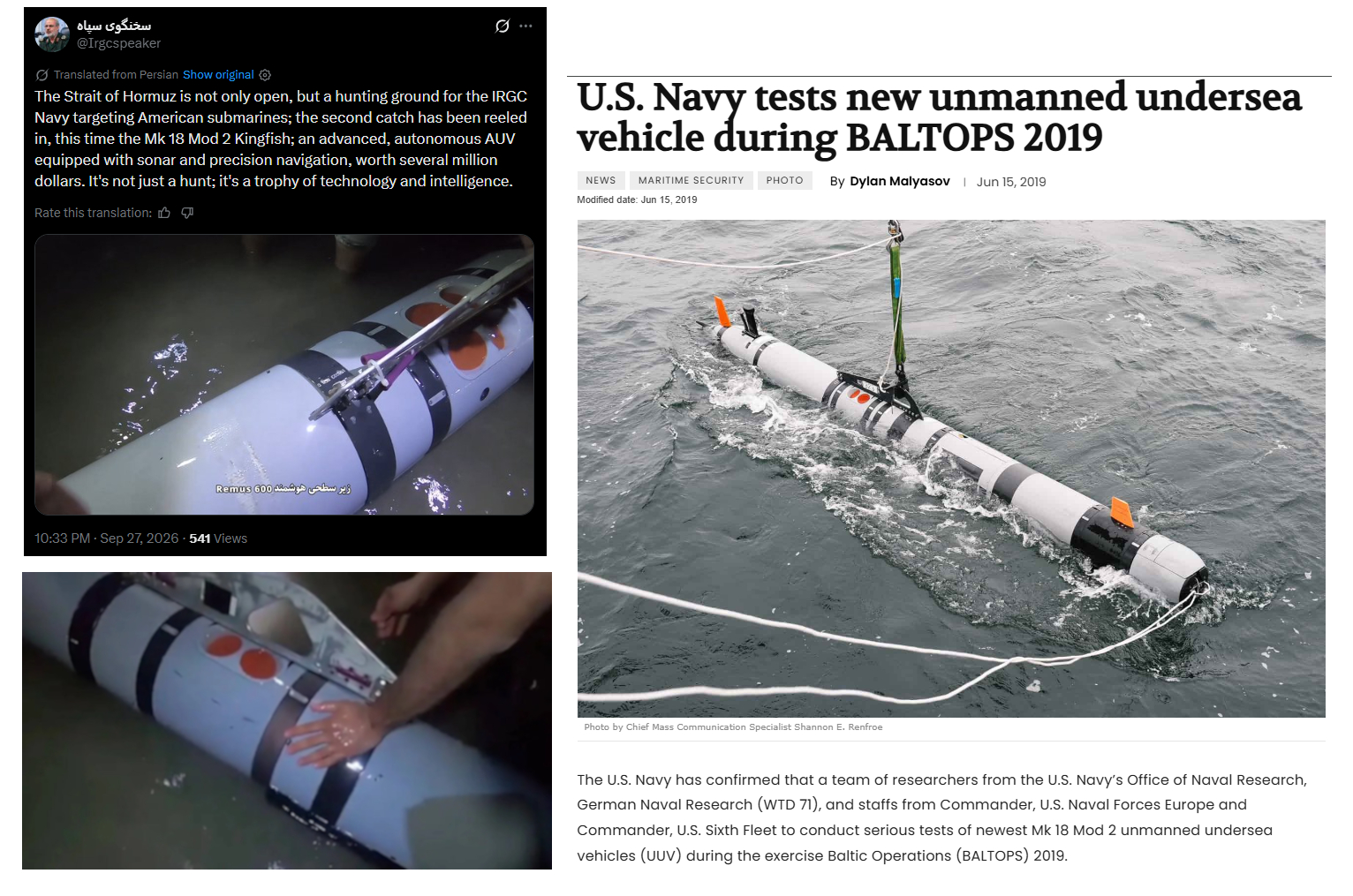
IRGC says US sea drone seized in Hormuz Strait
Iran’s Revolutionary Guard says it captured a US autonomous underwater vehicle in the Strait of Hormuz, state media report.
|
|
|
‘Clearly desperate’: US refutes Iran claim ‘advanced’ drone seized in Hormuz
The US military has denied earlier statements from Iran’s Revolutionary Guard saying it had captured an advanced US underwater vehicle conducting surveillance in the Strait of Hormuz.
US CENTCOM spokesman Captain Tim Hawkins told Al Jazeera that the US maintains “positive control of all of our operational drone assets” and called the IRGC’s claim “clearly desperate”.
Earlier, the IRGC Navy described the unmanned vessel as an “advanced submersible called Remus 600”, which is “now in the hands of the force’s specialists to retrieve its information”.
|
|
The US is clearly fearing that the drone will come into the hands of Russia.
|
IRGC repeats claim to have seized US underwater drone in Hormuz
Iran’s Islamic Revolutionary Guard Corps has claimed its forces seized the second US underwater drone in the Strait of Hormuz.
The strait “is not only not open, it is a hunting ground for the IRGC navy for American underwater vessels”, spokesman Brigadier General Mohebbi wrote on X.
He named the latest allegedly captured vessel as a Mk 18 Mod 2 Kingfish, calling it an advanced autonomous drone fitted with sonar and precision navigation and worth several million dollars.
“It is not just a catch; it is a technological and intelligence prize,” he said, attaching a picture circulated earlier that labels the vessel as a Remus 600.
The IRGC Navy had earlier described it as a Remus 600 and said its specialists were extracting the data it held.
The US military denies an underwater drone was captured.
|
|
|
| |
|
|
| |
|
|
Renewed military action between US-Iran ‘a real possibility’
The US may be overplaying its hand with Iran after dismissing Tehran’s offer to reopen the Strait of Hormuz as a first step to wind down the war, says analyst Mohamad Elmasry.
“The United States continues to see itself as in kind of a position of power and control over the situation. So they still think that they can kind of dictate the terms,” the professor at the Doha Institute of Graduate Studies said.
However, Elmasry said it’s a mistake by US President Trump to reject Iran’s offer to reopen the Strait of Hormuz.
“For the Americans to reject this Iranian proposal – which is very similar to the June memorandum of understanding, which was already pretty favorable to the Iranians – now I think that Trump is miscalculating,” he said.
“I don’t think the US has as much leverage as they think… So we could end up with an escalation prior to the [US] midterms. I think that’s a real possibility.”
|
|
|
Araghchi says Iran ready to resume conflict, even if it results in ‘doomsday’
Iranian Foreign Minister Abbas Araghchi has said Iran is prepared for war to resume, “even if it comes to a doomsday war”.
In an interview with NBC’s Meet the Press, Araghchi reiterated the terms of the country’s peace plan aimed at ending hostilities between the United States and Iran.
“We want our assets, which are illegally frozen, be released. We want to be able to sell our oil. We want certain things that the US has already committed itself in the previous deals,” he said.
Iran’s top diplomat also said the US and Israel attacked Iran in the middle of negotiations during last year’s 12-day war.
“If you ask us, there is no reason why we should go back to diplomacy. But I’m still trying diplomacy, because I think we shouldn’t miss any chance for peace.”
While Iran has heard US President Donald Trump rejecting the peace plan, “we are still waiting for an official response through mediators”, Araghchi said.
|
|
|
Trump says he expects more talks with Iran this week
US President Donald Trump has said he expects negotiators to engage in more talks with Iran this week.
“They want to make a deal, but it is not the deal that I want to make. It is what we would have maybe agreed to a year ago. They overplayed their hand,” Trump said in a phone interview with Axios, a US news outlet.
The remarks come a day after Trump said he rejected an Iranian peace plan to end the war.
When asked by Axios whether he is considering resuming attacks on Iran, Trump responded: “I am always thinking about it.”
Trump repeated the claim that the US military facilitated the transit of the largest amount of oil since the war began, saying the quantity amounted to “more than 20 million barrels”.
|
|
|
Tehran slams US over plan to send envoys to pressure countries into isolating Iran
Iranian Deputy Foreign Minister Kazem Gharibabadi has dismissed US plans to send teams abroad to press other governments over their economic ties with Tehran.
In a post on X, he accused US Treasury Secretary Scott Bessent of talking as though the world were Washington’s “backyard”.
It follows an announcement by Bessent that the US had deployed envoys to pressure countries into economically isolating Iran.
“Independent governments determine their relations with Iran based on their own interests and priorities, not on the orders of the US Treasury,” Gharibabadi said.
“The era of imposing one’s will through threats and sanctions is coming to an end,” he added.
|
|
|
Trump’s rejection of Iran’s seven-day proposal could backfire
Negar Mortazavi, a senior fellow at the Washington-based Center for International Policy, has said that the US president “appears to be gambling that time is on his side”, believing that accepting Iran’s seven-day proposal – which would see the Strait of Hormuz reopen in exchange for US concessions – “could look premature”.
Trump hopes sanctions and the US naval blockade will eventually force Tehran into offering greater concessions, a strategy that carries risks, she said.
Economic pressure could weaken Iran’s economy without producing political capitulation or shifting what Tehran regards as its “fundamental red lines”. Iran also retains leverage through the Strait of Hormuz and the rejected proposal offered a route to reopening it.
With the US midterms approaching, a prolonged conflict and higher energy prices could increase domestic political pressure on Trump.
If Tehran concludes Washington will reject any compromise short of much broader concessions, she said, “Iranian leaders may decide there is little incentive to offer another off-ramp”, hardening positions on both sides and prolonging the war.
|
|
|
Oil rebounds after Trump rejects Iran proposal
Oil prices rebounded more than 1 percent on Monday after US President Donald Trump rejected a proposal from Iran to resolve the conflict and reopen the Strait of Hormuz.
Brent crude futures rose $1.82, or 1.74 percent, to $106.14 a barrel by 22:02 GMT, while US West Texas Intermediate crude was at $93.55 a barrel, up $1.14, or 1.23 percent.
|
|
|
| |
|
|
| |
|
|
Trump says US transported record amount of oil through Hormuz
President Trump says the United States transported “a record amount of oil from the Hormuz Strait” last night, adding the quantity was “more than we took out before the war”.
While speaking to reporters in Chicago, Trump said oil prices will decrease “as soon as Iran gives up, as soon as the war is over, which will be soon”.
Trump on Saturday rejected an Iranian peace blueprint aimed at ending hostilities and reopening the vital Strait of Hormuz.
While Tehran maintains diplomacy remains the only viable resolution to its conflict with the United States and Israel, Iran’s military leadership warned its armed forces stand fully prepared for any renewed attacks.
|
|
the quantity was “more than we took out before the war”.
In 2025, nearly 15 mb/d of crude oil, nearly 34% of global crude oil trade, passed through the Strait of Hormuz – with most of the exports destined for Asia: IEA
Oil exports through Hormuz reached a seven-day average of 13.2 million bpd on Wednesday, compared with around 17 million bpd before the Iran war disrupted traffic: chief economist Daniel Lacalle on X.
|
Iran’s top negotiator cites oil prices to challenge US claim of controlling Hormuz
Mohammad Bagher Ghalibaf, Iran’s parliament speaker and top negotiator, has cited the price of oil to dispute US claims that Washington has wrested control over the Strait of Hormuz from Tehran.
The “US gas lighting bureau says Iran doesn’t control SOH” but oil remains far above its pre-war price, trading $35 a barrel higher than before the US-Israel war on Iran, Ghalibaf wrote on X in English.
“So either the market’s dumb or the US narrative-laundromat is faking it,” he said.
Ghalibaf joked that there was a “free-dollar vending machine in Hormuz for believers” of the US account, challenging them to “go grab it”.
|
|
|
China ‘substantially reduced’ assistance to Iran, US treasury secretary claims
US Treasury Secretary Scott Bessent says China has “substantially reduced” its assistance to Iran.
“I am confident, given that there’s only 15 million more barrels of Iranian oil on the water, Iran will have nothing left to trade for anything,” Bessent told Fox News.
“Probably within the next two weeks, they’re probably going to make their final deliveries of oil to China and then they will have nothing,” he added.
Bessent said the Iranians proposed a peace deal to the US because “they are feeling the pressure”.
|
|
|
Iran explores Caspian trade route as US blockade cripples exports
With Iran’s southern ports subject to a US naval blockade, Tehran is looking for alternatives to export oil and import goods. The Caspian Sea on Iran’s northern coast is seen as one portal for Iran to the outside world.
Recent efforts at the United Nations to end the deadlock between Iran and the US appear to have failed as US President Donald Trump said Tehran’s offer to reopen the Strait of Hormuz was “unacceptable”.
With no breakthrough in sight on ending the war launched by the US and Israel on Iran on February 28, Tehran is making adjustments to export oil and import essential goods. But maritime trade via the Caspian Sea has its own logistical challenges, experts say.
|
|
|
Iran reroutes trade overland through Turkey – but it comes with costs
The queue of trucks waiting at Turkey's Gurbulak crossing into Iran stretches for kilometers. A journey that once took a day can now take a week.
The Turkish transporters’ association has confirmed that waiting times have increased sharply as more freight moves through the border. The queues reflect a wider shift in Iran’s trade. Before the war, more than 80 percent moved through its southern ports.
Now, with maritime routes restricted, Tehran is turning to its land borders. The customs authority says imports through Gurbulak rose 250 percent in the five months to August.
But shifting trade from sea to land creates more bottlenecks. Roads and border crossings cannot match the capacity of Iran’s ports – longer journeys mean higher costs for businesses and, ultimately, consumers.
For now, the pressure is showing itself on the borders in the long lines of trucks waiting to cross.
|
|
|
US-Iran diplomacy being shaped by upcoming midterm elections
Diplomacy between Washington and Tehran is likely to remain stalled until after the US midterm elections, says Richard Schmierer, a former US ambassador to Oman.
Trump’s decision to reject the Iranian seven-day peace proposal was “understandable” as the terms favoured Tehran, he told Al Jazeera.
Despite the rejection, Trump and his administration have left the door open for diplomatic engagement, Schmierer said.
“I don’t believe either side intends to resume military activity,” he said. “But we might have a stalemate for several weeks because of the upcoming midterm elections.”
The US midterms are “key for both sides”, with Iran believing that Trump will be in a weaker position if his party loses power in Washington, while Trump fears that making concessions before the election could be “politically problematic”.
“Trump, I think, wants to get to the other side of the election before making concessions,” he said.
|
|
|
US envoy to UN says Washington offered to sell Iran uranium for civilian program
As part of previous negotiations aimed at ending the US-Israel war on Iran, Washington offered to sell Tehran uranium for use in a civilian nuclear program but Iran refused, according to the US Ambassador to the United Nations, Mike Waltz.
“Heck, our negotiators even offered to sell them uranium,” Waltz said on NBC’s Meet the Press.
He said the agreement would have been akin to that with the United Arab Emirates, which has “a peaceful program, right there in their neighborhood and they abide by international law and inspection regimes”.
Waltz said the administration of US President Donald Trump was open to allowing Iran to keep a civilian nuclear program, provided it agreed to its obligations in accordance with international law and the Nuclear Non-Proliferation Treaty (NPT).
|
|
|
Trump says US achieving success on ‘military and economic fronts’ against Iran
Trump says he believes the US is “going to win the war” it started with Iran “very soon”.
Speaking to Fox News at the Medinah Country Club, Trump said oil prices would fall to pre-war levels once the US defeats Iran, and that “the key is that Iran will not possess a nuclear weapon”.
He said the US was “achieving success on both the military and economic fronts”, adding that a return to military strikes “is possible, but I simply don’t want to say that”.
The US president predicted that oil prices would fall once the war ends.
|
|
|
Trump torn between delaying end to Iran war and rising US public frustration: Ex-US envoy
Trump appears torn between delaying ending the war on Iran until after the November 3rd midterm elections and pressure to end it sooner, Richard Schmierer, a former US ambassador to Oman, said.
Schmierer said the conflict is very “unpopular” among US citizens, given the high fuel prices.
“He [Trump] has the difficult assignment of trying to sell a policy that Americans do not support,” Schmierer said.
Ending the war would work in Trump’s favor, he said, but “the question is: on what terms?”
Schmierer noted that Iran’s latest offer closely mirrors the terms of the June memorandum of understanding, for which Trump was criticized, meaning concessions such as releasing frozen Iranian assets or lifting oil sanctions before the elections “could be politically vulnerable for him”.
“So he’s trying to find a middle ground, telling the American people that this will end soon, without actually bringing it to an end before the election.”
|
|
|
| |
|
|
| |
|
|
Fairford Air Base, Britain
|
|
|
| |
|
|
5 men arrested in UK near airbase used by US to attack Iran
British police arrested five men near a US airbase used to strike Iran on suspicion of explosive and terrorism offences.
“We are in the early stages of an investigation, and five men remain in custody,” Counter Terrorism Policing Senior National Coordinator Vicki Evans said in a statement. “As you would expect we are working closely with our partners to understand the circumstances of the incident.”
The British government gave authorization to the United States to use bombers based at RAF Fairford to strike Iranian missile sites accused of attacking ships in the Strait of Hormuz.
Britain said in July its armed forces were ready to protect the country from any attack after Iran’s Revolutionary Guard warned it not to allow US bombers to fly from Fairford, saying any base used to launch attacks would be a legitimate target.
|
|
|
Trump says five men arrested in UK were ‘under view’, pointing to possible joint surveillance
US President Donald Trump has addressed the recent arrest of five men near the RAF Fairford air base used by the US.
“They were looking to do big damage to our fort and working with the British worked out great … We had them under view for a long time and we got them,” Trump said while on his way to the President’s Cup golf tournament.
Al Jazeera’s Mike Hanna said Trump mentioning the suspects were “under view” is very important as “this assumes that this group of five had been under surveillance by the UK, and possibly its US allies”.
“This points now, it appears, to some form of conspicuous strategic plot to take some action against this RAF airbase,” Hanna added.
“RAF Fairford is the primary forward operating base for US aircraft in their war against Iran. There are B-52s, B-1 bombers based there, and, in fact, many observers point out that the first signs that incoming aerial attack against Iran is when these heavy bombers take off from RAF Fairford,” he said.
|
|
|
Too early to say who is behind UK airbase plot, ex-UK counterterrorism chief
It is too early to say whether a suspected plot against a UK airbase hosting US aircraft was directed from Iran or from Russia, says Chris Phillips, former head of the UK’s National Counterterrorism Security Office.
“We don’t know, actually, yet whether this is an Iranian-based attack, or whether it is indeed potentially a Russian-based attack, because that is also on the cards and quite possible,” he told Al Jazeera. Phillips said that the attacks could also be the work of “self-starters”.
It was, however, “a big concern” that the suspects had gotten so far, Phillips said. “This appears to be quite a decent-sized plot that has been stopped.”
He questioned a claim by US President Donald Trump that the suspects had been under surveillance before being caught near the base.
Instead, he says a member of the “saw these three vans acting suspiciously” and reported them to police. “This is a group of people that clearly weren’t closely being monitored by the security services,” he said.
|
|
|
UK’s RAF Fairford airbase
- The base is located in the county of Gloucestershire, about 160km (99 miles) west of London.
- The agreement that allows the US to use the site dates back to the 1950s.
- The UK initially denied President Donald Trump’s request to use its bases for strikes on Iran.
- But former Prime Minister Keir Starmer later agreed to let Washington use the bases.
- Anti-war activists have staged several protests outside the base, since the start of the Iran war.
|
|
|
